

Context-driven security is security operations where decisions use what’s true about a specific environment—what’s normal there, which systems can’t go down, and what was decided before and why—instead of alert severity alone. In security operations, it’s a decision-making model, not an access-control model.
Key takeaways
- Context-driven security means judging an alert on what’s true in your environment, not on severity alone.
- It’s a capability, not a product category. A SOC can be AI-heavy and still lack context.
- Four things have to be present at the moment of the decision: an environmental baseline, asset criticality, decision history, and signal from comparable environments.
- It’s not the same as Zero Trust or conditional access. Same words, different problem.
- AI made speed cheap. The edge now is the quality of the call, and whether you can defend it afterward.
Most SOCs today are good at fast. Fewer are good at right. Speed stopped being the differentiator once AI made triage and correlation cheap. What’s left is the question of whether an alert matters here, in your environment. This guide defines the term, breaks down what context concretely means, and shows what a SOC needs to get there. For the bigger picture on how security operations got here, see our cybersecurity glossary hub. If you’re comparing SOC models, start with AI SOC vs. autonomous SOC vs. AI-augmented SOC.
What does context actually mean in security operations?
Context isn’t an abstraction. It’s a collection of specific, local facts that helps agents and analysts determine if the telemetry of an alert is malicious or benign. It includes things like:
- A baseline of normal activity for your environment
- Which assets are business-critical
- Who’s traveling or on call this week
- What change windows are open
- What your team decided about similar activity before, and why
An analyst with all of that in front of them makes a different call than an analyst with only a severity score. Same alert, different answer. A login from a new country is noise if the user is on a flight to a conference. It’s urgent if that user is on leave.
Why isn’t speed enough in the SOC anymore?
AI made triage and correlation cheap. Speed became table stakes, not an advantage.
The remaining question is harder: does this alert matter in your environment, and what response won’t disrupt the business? Throughput can’t answer that. Context can.
Bolting AI onto an alert-driven stack closes benign alerts faster. It doesn’t tell you whether the rest are real. That’s the gap context fills.
What does a SOC need to be context-driven?
Four things need to be present when the decision gets made:
- An environmental baseline. A current picture of what’s normal, per environment.
- Asset criticality. Accurate knowledge of which systems can’t go down.
- Decision history. A record of prior decisions and the reasoning behind them.
- Signal from comparable environments. What’s happening in similar organizations right now.
Miss any one and you get confident conclusions on weak foundations. Without these four, an analyst is judging severity, not risk.
Context also needs a rule for who decides what. A governance layer defines which decisions a person must make and which a system can. See the AI Trust vs. Impact matrix for how we think about that line.
How is context-driven security different from Zero Trust or conditional access?
The terms collide. In access control, “context-driven” means conditional access: device posture, location, and step-up authentication, mapped to NIST SP 800-207. In security operations, it means the information used to judge whether an alert matters.
| Access control context | Security operations context | |
|---|---|---|
|
Questions it answers |
Should this request be allowed? | Does this alert matter here? |
|
Inputs |
Device posture, location, step-up authentication | Baseline, asset criticality, decision history, peer signal |
|
Where it lives |
Policy engine | Investigation |
|
Framework |
Zero trust (NIST SP 800-207) | A decision-making model—no formal standard |
This page is about the second column.
How is it different from an AI SOC?
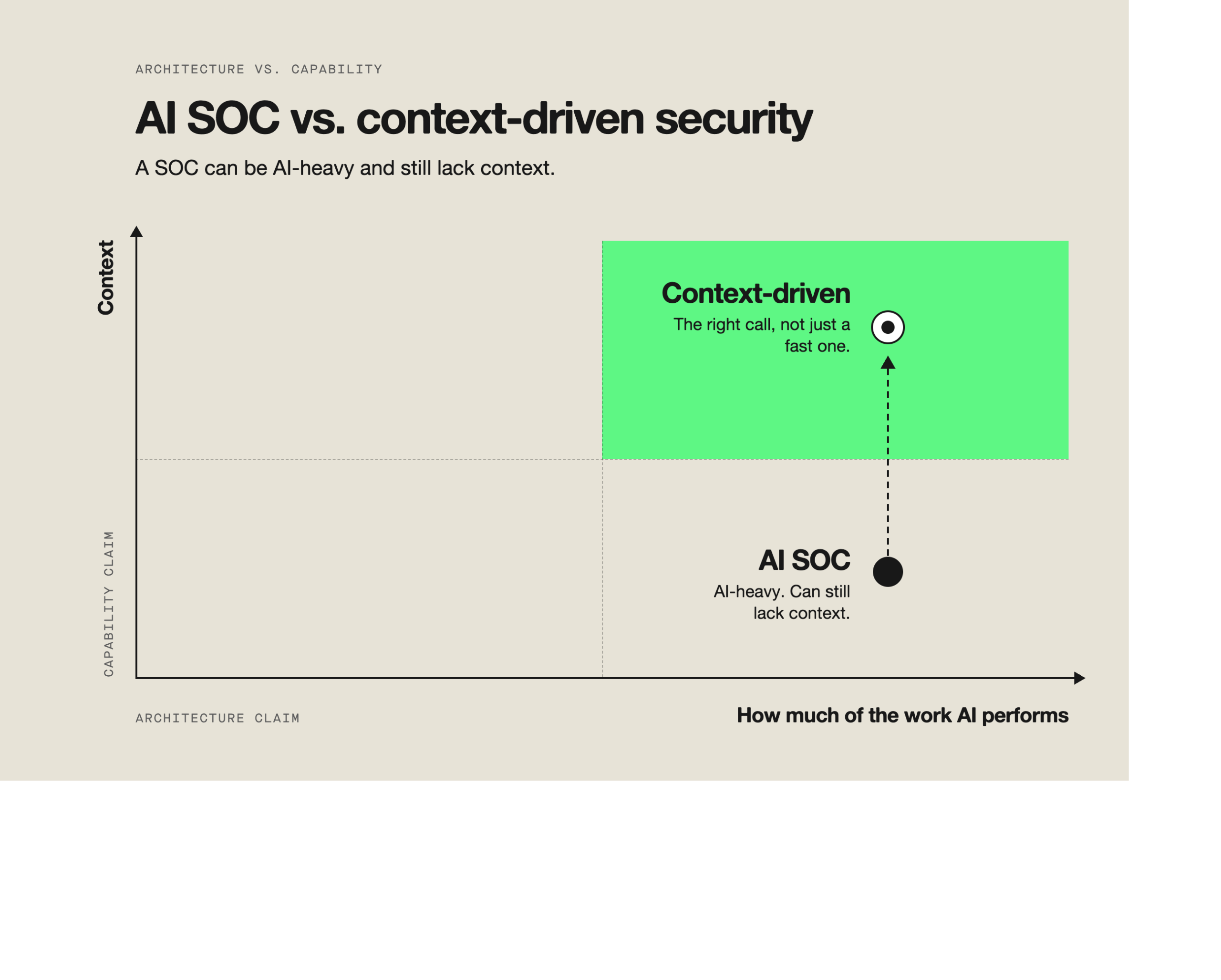
One is an architecture claim. The other is a capability claim. An AI SOC describes how much of the work AI performs. Context-driven security describes what that work is for: making the right call, not just a fast one. A SOC can be AI-heavy and still lack context.
Best practices
When it comes to context-driven security, here’s where you can narrow your focus to get started.
- Write down which decisions need a person. Then audit against the list.
- Train analysts to validate and override AI, not just to triage.
- Make the baseline reachable from the investigation, not buried in a separate tool.
- Record the reasoning behind decisions. Next time, the analyst starts with what you already learned.
- Measure decision quality, not alerts closed. The right call, made fast, with a paper trail.
Expel’s take
We run SOCs for other organizations, so we see context as it actually appears in an investigation, not as a framework diagram. The four components above come from real environments.
Here’s where we land. Routine enrichment and triage should be fast and automated. The call on whether something matters here needs context, and for high-impact decisions it needs a person. That’s the model we build toward: AI does the assembly, and analysts make the call. Human-led, AI-powered.
Frequently asked questions
What is context-driven security?
In security operations, it means decisions are made using what’s true about your specific environment instead of alert severity alone: what’s normal there, which assets can’t go down, what was decided before and why, and what’s happening in similar environments.
Is context-driven security the same as Zero Trust or conditional access?
No, and the terms collide. In access control, context-driven means conditional access—device posture, location, and step-up authentication. In security operations, it means the information used to judge whether an alert matters. Same words, different problem.
What makes a SOC context-driven rather than alert-driven?
Four things at the moment of the decision: an environmental baseline, asset criticality, the history of prior decisions and their reasoning, and signal from comparable environments. Without those, an analyst is judging severity, not risk.
Does context-driven security require AI?
No, but it’s impractical without automation. Assembling identity, asset, and prior-decision context by hand is the bottleneck. Automation makes context available at decision time instead of after it.
How do you measure whether context is working?
Measure decision quality, not alert throughput. Was the call right? What did it cost? Can you explain it afterward? Many customers describe this as time-to-action instead of mean time to respond, because action is broader than containment.