

EXPEL THREAT HUNTING SERVICE
Hypothesis-based threat hunting services
Elevate your security: hypothesis-based threat hunting mitigates risks for cloud, on-prem, and SaaS.
HOW WE HELP
Identify silent attacks. Strengthen your security posture.
Extend the impact of your security team and optimize your current investments with Expel Managed Detection and Response (MDR), paired with Expel Threat Hunting for better protection across cloud, on-prem, and SaaS environments.
Detect and remediate advanced attacks that slipped past your automated detection tools and identify misconfigurations and gaps in your defensive posture for proactive risk mitigation.
HOW EXPEL IS DIFFERENT
Hypothesis-based threat hunting across cloud, on-prem, and SaaS
Integrate your tools with our security platform, Expel Workbench™. Benefit from tech-driven automations, expert threat hunting, and hypothesis-based MITRE ATT&CK aligned hunts to uncover missed attacks. Get guidance on fixing gaps for instant defense improvement.
We hunt for unusual logins, patterns, user behaviors, and more, addressing undetected risks across environments. Assess emerging attack impact and enhance defense continuously. Paired with Expel Managed Detection and Response (MDR), you’ll protect your org from existing threats and future vulnerabilities.

Systematic threat hunting for your security stack
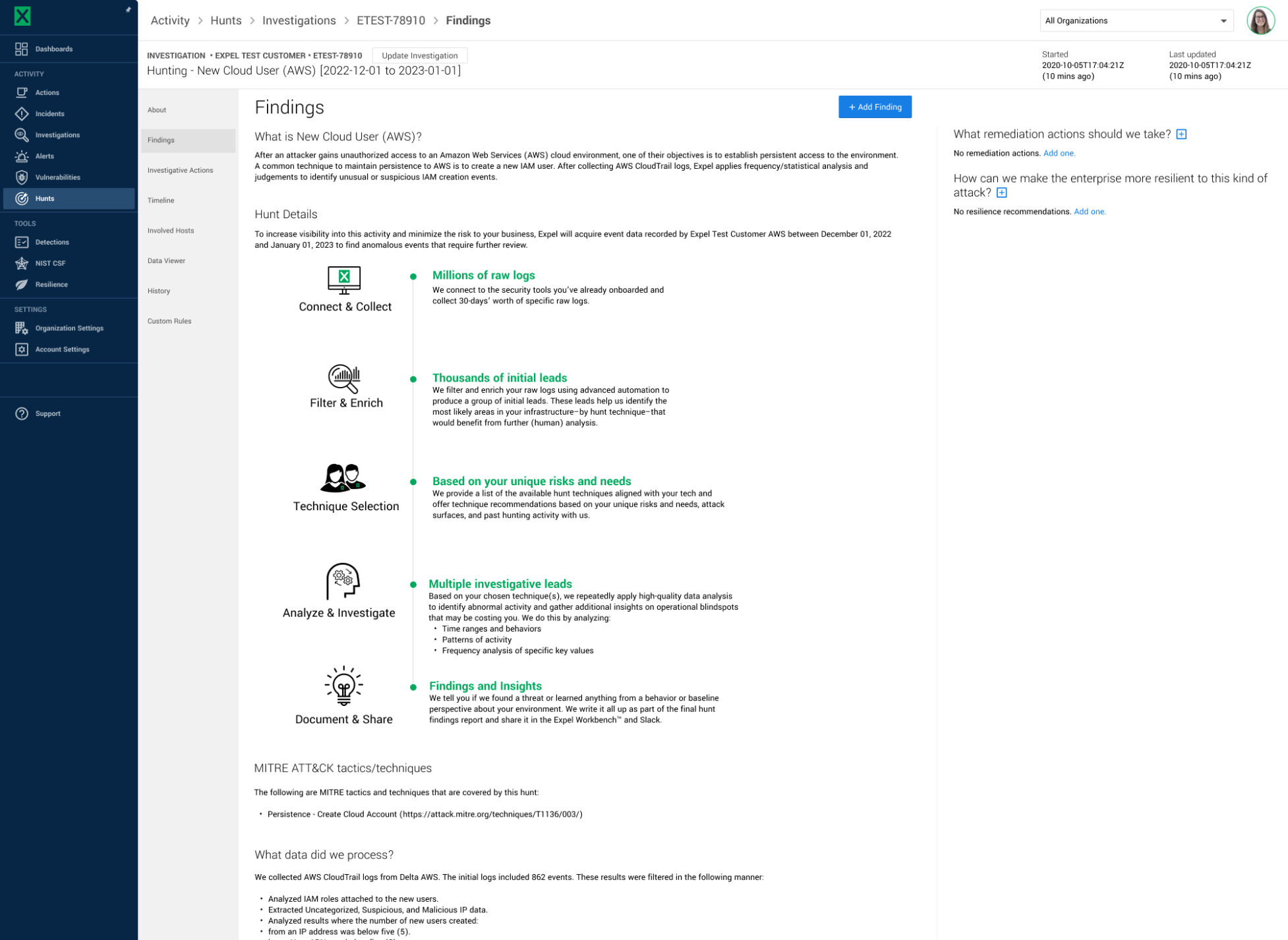
We integrate with your existing security tools and collect 30-days worth of specific raw logs.

Automated filtering and enrichment of raw logs for better insight
Using automation in Expel Workbench™, we produce a group of initial leads targeting specific areas of interest for further hunting and analysis.

Analyzing suspicious activities: unraveling threat patterns
We identify abnormal activity, gather insights on blindspots, and analyze time ranges, behaviors, activity patterns, and more.

Transparent threat reporting and information sharing
Any malicious activity discovered will be instantly routed to our SOC team and yours for immediate response. All hunt findings and gaps uncovered are shared with your team in a monthly report.
WHAT YOU GET
Threat Hunting Service

Monthly hunts on the tools you’ve already invested in, whether it’s on-prem, cloud, or SaaS

Human-led, expert threat hunting assisted by Expel Workbench™ automations to quickly determine potential areas of risk

Hunt techniques aligned to your unique risks and MITRE ATT&CK, spanning from indicators of compromise (IOC) to new cloud user hunts

Clear, consistent guidance on current and future problems areas, so you can build better safeguards

Minimize dwell time and improve security posture with identification of threats that slipped in and immediate response from our MDR team
Related resources

Annual Threat Report 2026
Expel’s latest threat intelligence report takes real-life cybersecurity lessons learned and transforms them into actionable insights for security operators.

Threat hunting: Build or buy?
Should you build your own threat hunting capability or get a partner? This post breaks down your options and the crucial cost considerations.
Hypothesis-based threat hunting: the what, why, and how
Your threat hunting program should focus on TTPs, holes, and areas of concern around your security posture and create hunts to probe those areas.

We’ll cut so much noise, you’ll hear yourself think again.
Expert analysts. AI speed. Radical transparency.
Frequently asked Expel
threat hunting questions
Automated detection catches known patterns. Expel’s threat hunters find the unknown, including attackers living off the land, abusing legitimate tools, or moving slowly to avoid detection. They can also find risks in your environment like misconfigurations and gaps. Expel threat hunters bring human expertise and cross-customer intelligence to surface activity that automated tools miss.
Expel runs monthly threat hunts across each customer’s environment, plus real-time hunts for emerging threats. Every hunt produces a written report with findings, methodology, and recommended remediations, delivered directly in Expel Workbench™. Coverage depth varies by package tier, but all customers receive actionable output from every hunt.
Expel’s threat hunters develop hypotheses informed by real attack patterns observed across our entire customer base, giving us visibility into emerging adversary behaviors that no single organization’s data could surface. Those hunts are also mapped to the MITRE ATT&CK framework. Hypotheses target living-off-the-land techniques, identity abuse, cloud persistence, and lateral movement, among other attacks.
SIEM rules fail more often than most teams realize. A 2025 CardinalOps report found that 10% of SIEM rules are broken and won’t fire during a real attack, due to misconfigured data sources or parsing errors. Expel threat hunting finds these blind spots and coverage gaps before attackers exploit them.
Expel threat hunting covers on-prem infrastructure, cloud, and SaaS applications, not just endpoints, identifying misconfigurations and posture gaps along the way. It runs as a proactive layer on top of Expel Managed Detection and Response (MDR), using Expel Workbench to manage hunts, findings, and remediation guidance in one place.