

An autonomous SOC is the theoretical model at the far end of the AI integration spectrum—security operations running with minimal human involvement, where AI systems handle detection, investigation, and response end-to-end. No vendor offers this in production today in any meaningful sense.
This page compares the autonomous SOC against the two operational models that do exist: the AI-augmented SOC and the AI SOC. For definitions of those terms, see what is an AI-augmented SOC? and what is an AI SOC?
Key takeaways
- “AI SOC,” “autonomous SOC,” and “AI-augmented SOC” aren’t interchangeable—they describe meaningfully different levels of AI integration and human oversight
- The AI-augmented SOC is the proven, widely deployed model; the AI SOC is the current frontier; the autonomous SOC is theoretical and not in production anywhere
- A fully autonomous SOC creates real risk: novel threats go undetected, errors compound without correction, and accountability gaps expose organizations to regulatory and legal liability
- When vendors claim “autonomous” capabilities, ask for production evidence—not demos—and get specific answers about where human oversight exists and what it can catch
- Human analysts in AI-driven operations aren’t a cost to minimize; they’re the judgment layer that catches what AI misses and stays accountable for consequential decisions
The SOC evolution spectrum
The security industry uses “AI SOC,” “autonomous SOC,” and “AI-augmented SOC” interchangeably, and they don’t mean the same thing. Understanding the distinctions matters because vendors make significant claims using these terms, and the difference between a genuinely AI-augmented model and a “lights-out” autonomous claim has real implications for security outcomes, governance, and what you’re actually buying.
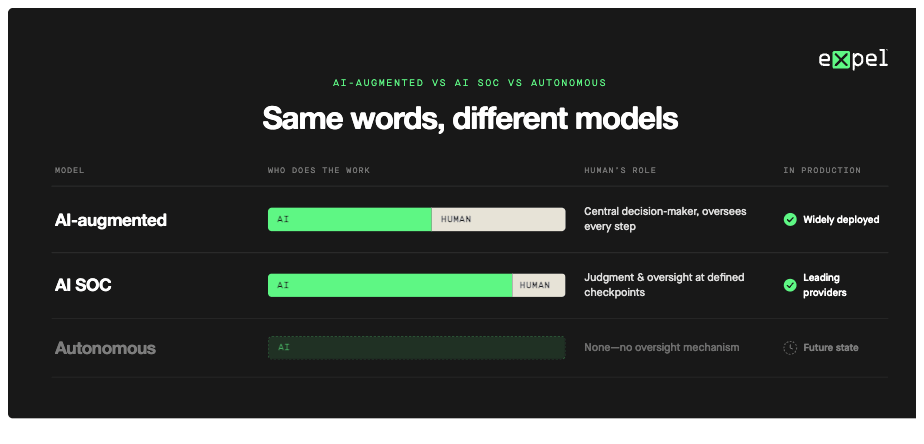
SOC models exist on a spectrum defined by the degree of AI integration and the degree of autonomous operation:
Traditional SOC: Human analysts work with security tools that generate alerts. Analysts gather context, investigate, and respond manually. AI is absent or minimal. The limiting factor is analyst capacity and speed.
Tool-assisted SOC: Security tools—SIEM, EDR, threat intelligence platforms—enhance analyst efficiency but the workflow remains analyst-centric. AI may be present in individual tools but isn’t integrated across the SOC workflow.
AI-augmented SOC: AI is integrated into the SOC workflow (alert triage, enrichment, behavioral analytics) in ways that fundamentally change analyst roles. Humans remain central decision-makers; AI handles data volume and routine analytical steps.
AI SOC: AI is the operational foundation of the SOC. Workflows are structured around AI capabilities. Agentic AI handles significant investigation automation. Human analysts focus on judgment, complex cases, and AI oversight. This is the current frontier of operational deployment at leading providers.
Autonomous SOC (theoretical): Security operations running without meaningful human involvement. Not currently achievable. Not currently desirable. Not honestly represented in any production deployment today.
Defining each model
AI-augmented SOC is the established model where AI tools are integrated into SOC workflows to enhance analyst capabilities—humans remain the primary decision-makers while AI handles specific, well-defined tasks like alert triage and enrichment. It’s widely deployed and well-evidenced in production. Learn more about the AI-augmented SOC here.
AI SOC is the emerging model where AI serves as the operational foundation, with agentic automation handling significant portions of the investigation lifecycle and human analysts focused on judgment and oversight. It’s in production at leading MDR providers and represents where the frontier of practical capability currently sits. Learn more about the AI SOC here.
Autonomous SOC is the theoretical model: security operations with minimal human involvement, where detection, investigation, and response are handled end-to-end by AI systems. This model is not in production deployment today in any meaningful sense. Vendors who claim to offer it are either describing very narrow autonomous capabilities or overstating their AI significantly.
5 questions to ask vendors claiming autonomous SOC capabilities
Vendors use “autonomous SOC” to mean very different things. Before you buy, get specific answers to these five questions:
- What percentage of incidents require human review? Any credible vendor can answer this with production data. Vague or hedged answers signal overclaimed autonomy.
- What decisions require human approval before execution? Understand exactly where the human approval gate sits—and whether it can be removed or bypassed.
- How does the system handle threats it has never seen before? Novel attacker techniques are designed to evade automated detection. Ask what happens when the AI encounters something outside its training.
- What are the failure modes if the AI makes errors, and how are they caught? A fully automated system with no human oversight mechanism compounds errors until an external event—like a breach—reveals them.
- What human oversight mechanisms exist and cannot be disabled? Governance isn’t a feature to toggle off under operational pressure. If oversight is optional, it isn’t governance.
Why “autonomous SOC” is aspirational, not operational
The appeal of a fully autonomous SOC is understandable: if AI can handle all security operations, organizations solve the talent shortage, eliminate operational overhead, and achieve 24×7 coverage at lower cost. The problem is that this vision collides with the actual capabilities and limitations of current AI systems.
Novel threat evasion: Sophisticated attackers specifically design techniques to evade automated detection. A fully automated SOC without human hunters who can recognize new attacker behavior and investigate outside predefined patterns is systematically exploitable by any attacker who studies the automation.
Context requirements: Determining whether anomalous activity is malicious requires organizational context that AI systems don’t reliably access—what business processes are running, what legitimate activities look unusual from an outside perspective, what the risk tolerance and operational priorities are for a specific incident.
Accountability requirements: In most industries and jurisdictions, security decisions affecting individual access, data, or operations carry accountability requirements that can’t be fully delegated to AI systems. Regulatory and legal frameworks expect human accountability for consequential decisions.
Failure mode risk: A fully automated SOC with a systematic AI failure—a blind spot for a specific attack technique, a false positive pattern that suppresses genuine threats—has no human oversight mechanism to catch and correct the failure. The consequences compound until the failure is discovered externally, often through an actual breach.
Why AI-augmented SOC is the proven model
The AI-augmented SOC isn’t a compromise position or a step toward eventual full automation. It’s the proven, widely adopted foundation that demonstrably produces drastically better security outcomes than traditional approaches with current technology. While the AI SOC represents the advanced frontier for leading providers, the AI-augmented model is the standard that mature internal security teams use.
Human analysts in AI-augmented operations aren’t a cost to minimize, they’re the capability that catches what AI misses, exercises judgment in complex situations, and maintains accountability for security outcomes. The evidence from leading MDR providers and advanced internal security programs consistently shows that human-AI collaboration outperforms both human-only and automation-heavy approaches on the metrics that matter: detection coverage, response speed, false positive rates, and sophisticated threat identification.
Where AI SOC sits on the spectrum
The AI SOC model sits at the frontier of current operational capability, between the established AI-augmented model and the theoretical autonomous model. It’s distinguished from AI-augmented primarily by:
- Agentic investigation: AI agents that autonomously execute multi-step investigation workflows, not just enrich individual alerts
- Deeper automation scope: A larger share of the investigation and response lifecycle handled autonomously, with human approval gates at defined checkpoints rather than human involvement at every step
- Workflow redesign: Operations structured around AI capabilities from the ground up rather than AI tools embedded into traditional analyst workflows
The AI SOC doesn’t abandon human oversight, it redefines where human oversight is applied. Rather than humans involved at every step, humans are involved at the high-judgment decision points where human expertise genuinely adds value over AI.
How to evaluate vendor claims about SOC model types
When vendors use these terms, ask specific questions to understand what’s actually being claimed:
For “autonomous SOC” claims:
- What specific decisions are made without human involvement?
- What is the false positive rate for autonomously-taken actions?
- What is the governance model when autonomous AI takes an incorrect action?
- Can you provide production evidence (not demos) of autonomous operation?
For “AI SOC” claims:
- What percentage of investigations are handled end-to-end by AI vs. requiring analyst involvement?
- What are the authorization boundaries for agentic AI actions?
- How are autonomous actions logged and made auditable?
For “AI-augmented SOC” claims:
- How does AI integration change analyst workflows specifically?
- What data sources does AI process and what does it do with them?
- How do analyst decisions feed back into AI model improvement?
Credible vendors answer these questions with specific, production evidence. Vague answers indicate either immature AI capabilities or overclaimed marketing.
Where MDR fits
MDR providers operating at the leading edge of the industry are AI SOC implementations delivered as a service—AI as the operational foundation, agentic investigation automation, human analysts focused on judgment and oversight, and continuous cross-customer intelligence improving AI performance.
For organizations evaluating whether to build an internal AI SOC capability or access it through MDR, the relevant comparison is security outcomes and economics rather than model terminology.
Expel’s take
We’d put ourselves squarely in the AI SOC category—AI as the operational foundation, not just a layer on top of traditional analyst workflows. Agentic investigation automation handles a significant share of the investigation lifecycle before an analyst touches a case.
But we’re skeptical of “autonomous SOC” framing, and not just because it’s currently aspirational. The design question isn’t how to remove humans from security operations—it’s where human judgment genuinely adds value and where it doesn’t. Routine enrichment, alert triage, and low-risk containment: AI handles those. Novel attacker behavior, high-impact decisions, and accountability for outcomes: those stay with people. That’s not a limitation of our model. That’s the model.
Frequently asked questions
What is the difference between an AI SOC and an AI-augmented SOC?
An AI-augmented SOC emphasizes the human-AI collaboration model as the core operational philosophy. An AI SOC is a newer industry term that often implies more advanced AI integration including agentic capabilities. Both require human oversight; the terms differ primarily in emphasis and the vendor capabilities they typically describe.
Is an autonomous SOC possible today?
An autonomous SOC—where AI fully replaces human analysts—is not practically achievable today. Real threats require business context, novel attack handling, legal accountability, and stakeholder communication that AI systems cannot fully provide. Vendors claiming ‘autonomous SOC’ capabilities typically mean advanced automation with human oversight, not true autonomy.
How should I evaluate vendor claims about autonomous security operations?
Ask vendors: What percentage of incidents require human review? What decisions require human approval? How does the system handle threats it has never seen before? What are the failure modes if the AI makes errors? What human oversight mechanisms exist and cannot be disabled? Beware of ‘lights-out SOC’ marketing.
What is an agentic SOC?
An agentic SOC uses agentic AI—autonomous AI systems capable of multi-step reasoning and action—to investigate threats, correlate evidence, and execute response actions. The most effective agentic SOC deployments maintain human oversight for high-impact decisions while enabling AI agents to handle investigation and enrichment autonomously.
Where does MDR fit on the SOC evolution spectrum?
MDR providers deliver AI-augmented (and increasingly AI SOC) capabilities as a service—providing the AI infrastructure, models, and 24×7 analyst expertise that would take years and significant investment to build internally. MDR is an on-ramp to AI SOC maturity without the build cost or risk.