

AI in cybersecurity refers to the use of machine learning, pattern recognition, and automated decision-making systems to enhance security operations. AI helps security teams detect threats faster, analyze massive datasets, automate repetitive tasks, and respond to incidents more efficiently—not by replacing human analysts, but by giving them capabilities that would be impossible to replicate manually at scale.
Key takeaways
- AI in cybersecurity means machine learning, behavioral analytics, and automated decision-making—not magic. It spots patterns in data that humans physically can’t process at scale, including threats that don’t match any existing rule.
- AI is an augmentation tool, not a replacement. It handles data volume and repetitive tasks so human analysts can focus on investigation, judgment calls, and business context—things AI genuinely can’t replicate.
- Rule-based tools catch what you’ve already anticipated. AI catches what you haven’t. The strongest security programs use both: rules for high-confidence known patterns, AI for novel threats and behavioral anomalies.
- In MDR, AI acts as a force multiplier. It triages telemetry, filters noise, and surfaces only what needs a human to look at—so analysts aren’t buried in alerts.
- AI has real limitations: hallucinations, adversarial evasion, training data blind spots, model drift, and the risk of over-relying on outputs. Knowing the limitations is part of deploying it responsibly.
What AI in cybersecurity actually means
“AI in cybersecurity” is one of the most overloaded phrases in the industry. Vendors apply it to everything from basic automation scripts to sophisticated machine learning models. Understanding what it actually means requires separating the signal from the noise.
In a security context, AI refers to systems that can learn from data, identify patterns, and make or recommend decisions without being explicitly programmed for every scenario. That’s meaningfully different from traditional security tools, which apply fixed rules to known threats. AI systems can recognize threats they’ve never seen before, adapt as attacker behavior evolves, and process data volumes that would overwhelm any human team.
The most common forms of AI in cybersecurity today are machine learning (systems that learn patterns from historical data), behavioral analytics (systems that model normal activity and flag deviations), and natural language processing (systems that analyze unstructured text like phishing emails or threat intelligence reports).
Primary AI applications in security operations
AI is being applied across the security operations lifecycle:
Threat detection: ML models analyze network traffic, endpoint telemetry, and log data to identify attack patterns, including novel threats that don’t match existing signatures. AI can correlate signals across multiple data sources simultaneously in ways that rule-based detection cannot.
Behavioral analysis: AI establishes baselines of normal activity for users, systems, and applications, then flags deviations that may indicate compromise. An account accessing unusual systems at unusual times triggers behavioral anomaly detection even without a matching rule.
Automation: AI reduces the manual, repetitive work that consumes analyst time, like alert triage, data enrichment, indicator lookups, case documentation. This frees analysts to focus on complex investigations requiring human judgment.
Prediction and prioritization: AI models score alerts and vulnerabilities by risk level, helping analysts focus on what matters most rather than working through an undifferentiated queue.
Threat intelligence: AI processes and correlates threat intelligence at scale, surfacing relevant indicators, mapping observed activity to known attacker groups, and identifying emerging patterns across large datasets.
How AI differs from traditional rule-based security tools
Traditional security tools operate on rules: if X happens, generate alert Y. Rules are precise and auditable but inherently backward-looking—they catch what you’ve already anticipated. They require constant manual maintenance as environments and attack techniques change, and they produce high false positive rates when applied broadly.
AI-based security tools learn from data rather than following fixed rules. A machine learning model trained on historical attack data can recognize patterns indicative of compromise even when the specific technique is new. Behavioral analytics can flag activity that seems wrong for your environment even without a matching rule. The tradeoff is that AI systems are less transparent than rules. Understanding exactly why an AI model flagged a specific alert requires explainability features that not all tools provide.
The best security programs use both: rules for known, high-confidence patterns where precision is paramount, and AI for pattern recognition at scale and detection of novel threats.
AI as augmentation, not replacement
The most important thing to understand about AI in cybersecurity is what it can’t do. AI excels at processing massive datasets, recognizing patterns, executing repetitive tasks consistently, and operating 24×7 without fatigue. It does not excel at understanding business context, exercising judgment in ambiguous situations, adapting creatively to novel attacker behavior, or communicating findings to stakeholders.
Security incidents require all of those human capabilities. AI handles the data processing scale that humans can’t match; humans handle the decision-making and contextual judgment that AI can’t replicate. The most effective security operations model combines both, and the evidence from organizations that have implemented AI-augmented security supports this clearly.
How AI works in MDR services
MDR providers use AI as a force multiplier for their analyst teams. Rather than having analysts manually review every security event, AI processes incoming telemetry, filters noise, enriches alerts with context, and surfaces the findings that warrant human investigation. The result is that analysts spend their time on genuine threats rather than drowning in false positives.
AI in MDR also enables cross-customer intelligence: ML models trained on threat data from across many customer environments can recognize attack patterns that would be invisible from any single organization’s data alone. An attack technique observed at one customer immediately informs detection across all others.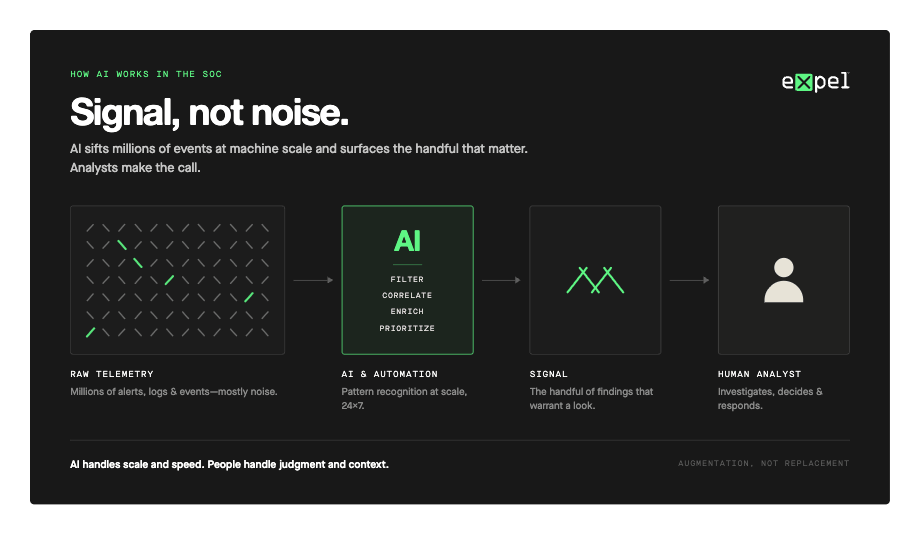
Limitations and considerations
AI in cybersecurity is not a solved problem. The most important limitations to understand are hallucinations (AI confidently producing incorrect outputs), adversarial attacks (sophisticated attackers crafting inputs designed to evade AI detection), training data dependency (models reflect the data they were trained on, so gaps in that data become blind spots), model drift (accuracy degrades as environments change without retraining), explainability gaps (understanding why a model flagged something isn’t always straightforward), and the risk of over-reliance (treating AI outputs as more certain than they are).
Each of these limitations has meaningful implications for how AI should be deployed and governed in security operations. For a full treatment of both the benefits and limitations of AI in cybersecurity, see our dedicated guide.
Expel’s take
AI in cybersecurity isn’t new—behavioral analytics and anomaly detection have been part of security tooling for years. What’s changed is scope: we’ve moved from AI flagging individual alerts to AI that ingests telemetry, correlates signals, enriches findings, and routes high-confidence threats to analysts before a human touches the case.
But the teams getting the most out of AI are clear-eyed about what it’s actually good at. AI handles volume and pattern recognition at a scale no analyst team can match. It doesn’t exercise judgment, understand organizational context, or recognize attacker behavior it hasn’t seen before. Build your operations around that boundary—don’t pretend it doesn’t exist.
Frequently asked questions
What are the benefits of AI in cybersecurity?
AI delivers faster threat detection, the ability to analyze massive datasets that humans couldn’t process manually, 24×7 monitoring without fatigue, reduced false positive rates when well-implemented, and automation of repetitive tasks that consume analyst time. The most effective implementations combine AI speed with human expertise.
What are the limitations of AI in cybersecurity?
AI in cybersecurity faces challenges including adversarial attacks designed to fool models, dependence on high-quality training data, limited explainability of decisions, model drift over time, and inability to apply business context. Human oversight remains essential.
Can AI replace human security analysts?
No. AI enhances but does not replace human security analysts. The most effective security operations combine AI capabilities with human expertise, judgment, and business context.
What’s the difference between AI and machine learning in cybersecurity?
Machine learning is a subset of AI focused on systems that learn from data. AI is the broader concept; ML is the specific technology most commonly deployed in security operations.
How does AI work in MDR?
In MDR services, AI processes incoming security telemetry, filters noise, enriches alerts with contextual information, and surfaces the findings that warrant human investigation. AI handles the data volume that would otherwise overwhelm analyst teams, while human analysts investigate, make judgment calls, and respond to confirmed threats.