

AI in managed detection and response (MDR) services works as a force multiplier for human analysts. It processes telemetry 24×7, scores and triages alerts, cuts false positives, and speeds up investigations. AI handles the scale and speed. Analysts handle the judgment calls.
Key takeaways
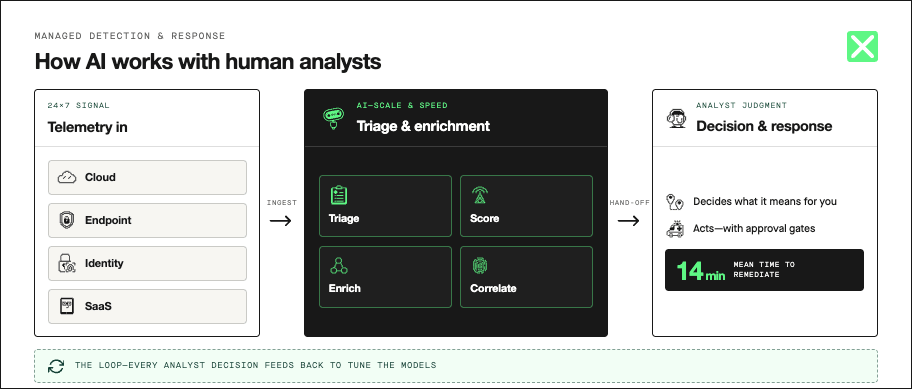
- AI in MDR handles the scale and speed of security monitoring—triage, scoring, enrichment, and correlation—while human analysts make the final call.
- MDR-specific AI differs from AI in standalone tools because a provider’s analysts sit behind every flagged alert, accountable for what happens next.
- Machine learning trained across multiple customer environments can catch novel threats faster than any single organization’s data would allow on its own.
- Automated response follows a graduated autonomy model—routine, high-confidence actions run automatically, and higher-stakes actions wait for an analyst’s approval.
- Human analysts remain essential for judgment, business context, and decisions AI hasn’t seen before.
Buying a managed service, not a tool, changes what “AI-powered” should mean to you. An MDR provider uses AI to run its own detection engineering, alert triage, investigation, and response workflow, not just to ship you another dashboard. That distinction matters when you’re comparing vendors, because a security team that leans entirely on AI output without a human check is making a different bet than one that treats AI as staff support. This page walks through where AI actually sits in MDR service delivery, what it automates, and where analysts still make the call.
How does AI work differently in MDR than in standalone security tools?
A standalone security tool with AI built in—like an endpoint agent, a cloud posture scanner, an email filter—flags something and stops. It’s on you to investigate, decide, and respond. In MDR services, AI is one part of a full service loop: a provider’s analysts, detection engineers, and automation all sit behind the alert, and AI’s job is to get the right alert to the right analyst with the right context, fast.
That’s the real difference—standalone AI tools generate signal, and MDR uses AI to manage that signal on your behalf, with a human accountable for the outcome. If a vendor’s AI pitch stops at “we flag things faster,” ask who reviews what the AI decided and what happens next.
| AI in a standalone tool | AI in MDR service | |
|---|---|---|
|
Output |
A flagged alert | A triaged, enriched, investigated finding |
|
Accountability |
Falls to your team | Shared with the provider’s analysts |
|
Response |
You decide and act | Provider recommends or acts, with approval gates |
What specific AI applications power MDR investigations?
AI shows up in a few specific jobs inside MDR, not as one generic layer:
- Alert triage: Models score incoming alerts for confidence and severity, so the queue is sorted before an analyst ever opens it.
- Threat scoring: AI weighs signals—user behavior, asset criticality, known attacker patterns—to rank how urgent a finding actually is.
- Enrichment: AI pulls in identity, cloud, and endpoint context automatically, so an analyst starts an investigation with the background already filled in instead of hunting for it manually.
- Correlation: AI links related events across coverage areas (an odd login here, a strange process there) into a single investigation instead of a pile of disconnected alerts.
Each of those jobs used to eat analyst time, and now they happen before a person is even looped in.
How does AI reduce alert fatigue and analyst workload?
Alert fatigue happens when analysts face more raw signal than any team can review by hand. The 2025 SANS SOC survey puts a number on that—73% of organizations name false positives as their top detection challenge. AI cuts that volume down to a workable queue by suppressing known-benign activity, scoring what’s left by confidence, and routing it to the analyst best equipped to handle it.
The result is a queue an analyst can actually work through in a shift, instead of a wall of raw telemetry nobody could review manually.
How do AI and human analysts work together in MDR?
Expel built Expel Workbench™, our SecOps platform, around a simple split: AI handles volume and speed, analysts handle judgment and context. AI surfaces a scored, enriched alert, so an analyst can decide what it means for your environment and what to do about it.
Ruxie, our AI SOC manager, is a good example of how that plays out day to day. She anticipates patterns, prioritizes risk, and adapts to a customer’s environment, but every judgment call still runs through a person–it’s analyst augmentation, not replacement. We’ve written more about why we built it this way in Expel’s guiding principles for AI and automation: eliminate noise, keep humans and technology working together, and stay transparent about what the AI did and why.
How does machine learning spot threats across MDR customers?
One advantage of buying MDR from a provider with many customers is that models trained on patterns across that whole customer base can flag a novel attack technique faster than any single organization’s data would allow on its own. When one environment sees a new technique, that pattern can inform detection logic that protects every other environment the provider monitors, without exposing any one customer’s specific data to another.
This is sometimes called federated or cross-customer learning, and it’s a meaningful reason AI-powered MDR can catch threats that a single-tenant security tool would miss entirely.
How does automated response work with human approval gates?
Automated response in MDR isn’t all-or-nothing. Most mature providers use a graduated autonomy model: low-risk, high-confidence actions (isolating a device with a known malware signature, for example) can run automatically. Higher-stakes actions, like disabling a production account or shutting down a business system, wait for an analyst’s sign-off first.
That gate matters. It lets AI move fast on the calls that don’t need a person, while keeping a human accountable for the decisions that could disrupt your business if the model got it wrong.
Why do human analysts remain essential in AI-powered MDR?
AI is good at pattern-matching against what it’s seen before. It’s weaker at judging intent, weighing business context, or handling a genuinely novel situation—the kind of call that needs someone who understands your environment, not just your telemetry. That’s still a person’s job. AI-powered isn’t the same as AI-only.
How do you evaluate AI capabilities in an MDR provider?
Here’s a few questions you can ask to cut through the marketing:
- What specific tasks does the AI handle—triage, enrichment, scoring, response—and which ones still go through a person?
- Can the provider show you what the AI decided and why, or is it a black box?
- What’s the approval process before an automated action touches your environment?
- What proof points back up their claims—real metrics, not just “AI-powered” on a slide?
You can also learn more about how AI works in an AI-augmented SOC here, or about agentic MDR here.
Expel’s take
We built Workbench around one rule: AI does the heavy lifting on volume, analysts do the thinking. That’s not a tagline—it’s why we measure ourselves on time to detect and time to remediate, not on how much of the workflow has “AI” stamped on it.
The MDR providers worth your time are the ones who can point to exactly where AI’s job ends and a person’s judgment starts. If a vendor can’t answer that question directly, that’s the answer.
Frequently asked questions
What AI techniques are used in managed detection and response?
MDR providers use supervised machine learning for threat classification, unsupervised anomaly detection for novel threats, behavioral profiling for user and entity analysis, natural language processing for log parsing, and large language models for investigation, summarization, and alert triage, all validated by human analysts.
How does AI reduce alert fatigue in MDR?
AI in MDR reduces alert fatigue by correlating events across environments, suppressing known-benign alerts using trained models, prioritizing high-confidence threats, and routing alerts to the right analyst, converting millions of raw events into a manageable investigation queue.
What’s the difference between AI-powered MDR and traditional MDR?
AI-powered MDR uses machine learning to automate enrichment, triage, and detection, letting analysts investigate more threats with greater accuracy. Traditional MDR relies more heavily on manual analyst review. AI-powered MDR delivers faster time to detect and time to remediate at scale.
How does Expel use AI in its MDR service?
Expel Workbench uses AI to process telemetry, triage alerts, enrich investigations with identity, cloud, and endpoint signals, and generate resolution recommendations. Human analysts make all critical decisions and provide feedback that continuously improves the models.
Can AI-powered MDR replace an internal SOC?
AI-powered MDR can extend or replace some internal SOC functions, particularly 24×7 monitoring, alert triage, and initial investigation. Effective security operations still need human expertise for complex incident response, strategic decisions, and business context.