

AI-powered threat detection works by training models on large datasets of normal and malicious behavior, then using those models to flag anomalies or known attack patterns in real time. It enables security teams to catch threats faster and at a scale that rules-based detection alone can’t match.
AI threat detection uses machine learning models to analyze security data, identify attack patterns, and flag suspicious activity in real time. Unlike signature-based detection that matches known threat indicators, AI learns from historical data to recognize both known threats and novel anomalous behaviors, finding attacks that no existing rule would catch.
Key takeaways
- AI threat detection works by learning patterns from historical data and flagging deviations—not by matching against known bad indicators. That’s what makes it capable of catching threats no existing rule would ever find.
- Behavioral analysis is the most powerful piece: AI establishes what “normal” looks like for your specific environment, then flags when something breaks that pattern—unusual login times, unexpected process behavior, a service account doing things it’s never done before.
- Signature-based and AI-based detection aren’t competitors—they’re complements. Signatures win on speed and precision for known threats; anomaly detection wins for novel and sophisticated attacks. Strong detection programs use both.
- False positives are the real-world problem that separates useful AI detection from expensive noise. Analyst feedback loops, threshold tuning, and environment-specific customization are what actually make models accurate over time.
- Data quality determines detection quality. Gaps in coverage aren’t just gaps in logging—they’re gaps AI literally can’t see around, no matter how good the model is.
How AI detects threats step by step
AI threat detection isn’t a single action—it’s a sequence. Here’s how it works end to end:
- Ingest telemetry across endpoints, network, identity, and cloud. AI detection starts with data collection across your entire environment: endpoint process and file activity, network traffic, authentication events, cloud API calls, and application logs. The broader the coverage, the fewer the blind spots.
- Establish behavioral baselines. Before AI can flag what’s wrong, it has to learn what’s normal. Models analyze historical activity to build baselines for users, systems, and applications—typical login times, expected network connections, normal process behavior—specific to your environment.
- Apply ML models to identify patterns and anomalies. With baselines in place, machine learning models analyze incoming data continuously, looking for two things: known attack patterns from training data, and deviations from established baselines that could indicate compromise even when no matching signature exists.
- Correlate signals across data sources. Individual events rarely tell the full story. AI correlates activity across multiple data sources simultaneously—an unusual login followed by lateral movement followed by anomalous cloud API calls—connecting dots that would be invisible if each signal were reviewed in isolation.
- Score and prioritize alerts. Not every anomaly is a threat. AI models score findings by risk level based on severity, context, and confidence, so analysts work through a prioritized queue rather than an undifferentiated flood of alerts.
- Surface findings for analyst review. AI hands off to humans at the point where judgment matters. The highest-priority findings—enriched with context, correlated signals, and supporting evidence—go to analysts who investigate, make the call, and respond.
How AI analyzes security data
AI threat detection systems ingest security telemetry from across your environment—endpoint process and file activity, network traffic patterns, authentication and identity events, cloud API calls, and application logs—and apply machine learning models to identify patterns associated with malicious behavior.
The scale of this analysis is what makes AI valuable. A mid-size enterprise generates billions of security events daily. No human team can review that volume. AI models process the full data stream continuously, filtering signals from noise and surfacing the subset of events that warrant human investigation.
The quality of AI threat detection depends directly on data quality and coverage. Models trained on incomplete data have blind spots. Data sources that aren’t feeding the AI layer are invisible to it. The same data completeness challenges that affect SIEM monitoring apply equally to AI-powered detection.
Behavioral analysis and baseline establishment
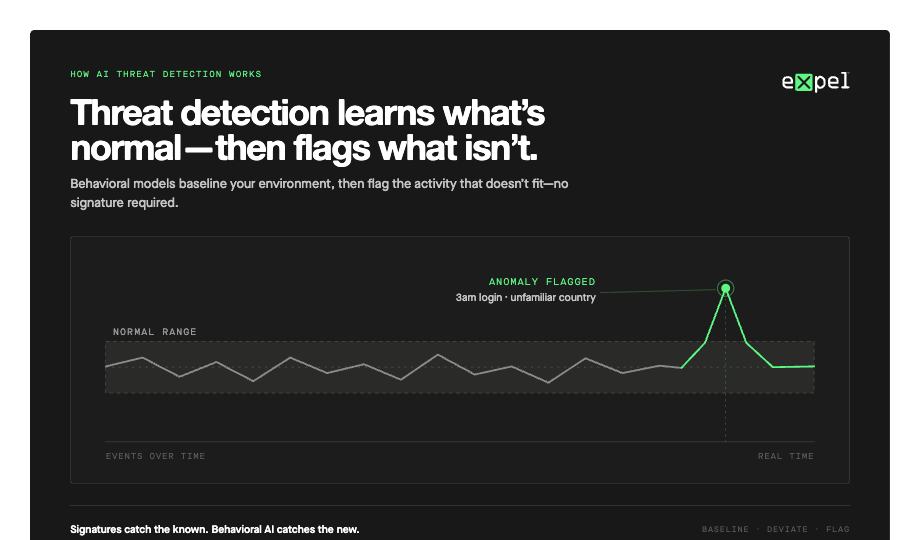
Behavioral analysis is one of the most powerful AI detection capabilities because it doesn’t require knowing what an attack looks like in advance. Instead of matching against known threat signatures, behavioral AI establishes what normal looks like for your specific environment—typical login times and locations for each user, expected processes on each endpoint, normal network traffic patterns for each system—and flags meaningful deviations.
An account that has never logged in outside business hours suddenly authenticates at 3am from an unfamiliar country. A service account that has never queried Active Directory suddenly enumerates domain controllers. A process that has never made external network connections suddenly reaches out to an unusual IP address. None of these require a specific rule. Behavioral AI recognizes them as anomalies worth investigating.
Building accurate behavioral baselines requires time (models need sufficient historical data to learn what “normal” looks like) and ongoing maintenance (baselines must update as environments legitimately change).
Anomaly detection vs. signature-based detection
Signature-based detection matches incoming events against a library of known bad indicators—file hashes, IP addresses, domain names, malware signatures. It’s fast, precise, and transparent. Its fundamental limitation is that it only catches what’s already known.
Anomaly detection identifies deviations from established baselines without requiring advance knowledge of the specific threat. It can find novel attacks, insider threats, and attacker techniques that have never been documented. Its limitations are higher false positive rates (not every anomaly is malicious) and less explainability (why exactly did this trigger?).
Modern AI-powered detection systems use both in combination: signature matching for high-confidence known threats where speed and precision matter, anomaly detection for novel and sophisticated threats where pattern-based matching fails.
ML model types used in threat detection
Different machine learning approaches are suited to different threat detection problems:
Supervised learning trains models on labeled datasets of known malicious and benign activity. The model learns to classify new inputs based on patterns from the training data. Effective for detecting known threat categories but limited by the quality and breadth of training labels.
Unsupervised learning identifies clusters and anomalies in data without labeled examples. The model finds patterns in the data itself rather than learning from predefined categories, which is particularly useful for detecting unknown threats and establishing behavioral baselines.
Ensemble methods (like random forests and gradient boosting) combine multiple models to improve accuracy and reduce overfitting. Widely used in production security AI systems because they’re robust and interpretable compared to deep learning approaches.
Neural networks and deep learning excel at recognizing complex patterns in high-dimensional data. These are particularly useful for malware analysis, network traffic classification, and natural language processing for phishing detection.
Real-time processing and alert generation
Effective AI threat detection operates in real time or near-real time—the value of detecting a threat decreases rapidly as time passes. An attacker who has been in your environment for hours has had time to move laterally, escalate privileges, and stage data. Detection that takes minutes rather than days dramatically changes security outcomes.
Real-time AI detection requires infrastructure capable of processing high-velocity data streams, not batch processing logs after the fact. This is one reason cloud-native security data architectures have become increasingly important: they provide the elastic compute needed to run ML inference at data-stream speed.
False positive management and model tuning
High false positive rates are one of the most practical challenges in AI threat detection. A detection model that flags 10,000 events per day as suspicious—the vast majority of which are benign—creates more analyst burden than it relieves. False positive management is what separates useful AI detection from AI-generated noise.
Managing false positives requires continuous feedback loops: analyst decisions about alerts (true positive vs. false positive) feed back into model training, progressively improving accuracy. It requires threshold tuning (adjusting confidence thresholds to balance detection sensitivity against false positive volume), and it requires environmental context (models that understand your specific environment generate fewer false positives than generic models applied without customization).
Limitations of AI threat detection
Hallucinations: AI systems can confidently fabricate incorrect information. In security contexts, a hallucinated threat indicator, fabricated user history, or incorrect context assembled during triage can lead analysts toward wrong conclusions based on AI-generated content that has no basis in the actual data.
Adversarial ML: Sophisticated attackers can craft inputs specifically designed to evade AI detection by subtly modifying malware to avoid classification, mimicking normal behavior patterns, or exploiting model blind spots. As AI becomes more prevalent in security, adversarial evasion becomes a more significant concern.
Training data dependency: AI models reflect their training data. Models trained on data that doesn’t represent your environment or doesn’t include recent attack techniques will miss threats that fall outside their training distribution.
Model drift: Your environment changes over time with new systems, new users, and new applications. AI models trained on historical data gradually become less accurate as the environment they were trained on diverges from the current environment. Models require ongoing monitoring and periodic retraining.
Explainability gaps: Understanding why an AI model flagged a specific event requires explainability features. Not all AI detection tools provide adequate explanation of model decisions.
Using AI to proactively search for hidden threats rather than just flag incoming events extends these detection capabilities significantly.
Expel’s take
The detection sequence matters less than what you do with the output. A lot of security tools run ML models and surface anomalies—the gap is in what happens next. At Expel, AI doesn’t just flag suspicious activity; it correlates signals across endpoint, identity, network, and cloud, enriches findings with threat intelligence and historical context, and scores alerts before they reach an analyst. By the time a human reviews a finding, the investigation is already largely built.
But detection speed is only useful if the signal is accurate—fast detection of noise just burns analyst time faster. The tuning work that keeps false positives low is ongoing, and it’s human-driven: analysts reviewing findings and feeding that judgment back into detection logic. The AI gets better because people tell it where it’s wrong.
Frequently asked questions
What is anomaly detection in cybersecurity?
Anomaly detection uses AI to establish baseline behavior patterns for users, systems, and networks, then flags deviations that may indicate threats. It excels at detecting novel attacks that signature-based tools miss.
Can AI detect zero-day attacks?
AI can detect zero-day threats by identifying suspicious behavior patterns rather than known attack signatures. However, highly novel attacks and adversarial AI designed to evade detection remain challenges.
How accurate is AI threat detection?
Accuracy varies enormously by implementation. Well-implemented AI detection at leading MDR providers achieves false positive rates below 10%, with detection accuracy continuously improving through analyst feedback loops. Poorly implemented AI detection can generate significant noise while missing real threats. Model quality, training data, and feedback loop quality all determine accuracy.
How does AI reduce false positives in security alerts?
AI reduces false positives by correlating events across multiple data sources, applying behavioral baselines, and using trained models to distinguish genuine threats from benign anomalies—reducing analyst alert fatigue.
What data sources does AI threat detection need?
Effective AI threat detection needs broad, high-quality data coverage: endpoint telemetry (process execution, file activity, network connections), identity and authentication logs, network traffic data, cloud audit logs, application events, and identity signals. The more comprehensive and higher-quality the data, the more effective the AI detection. Gaps in data coverage create blind spots that AI cannot see around.