

The benefits and limitations of AI in cybersecurity break down like this: AI speeds up detection, reduces analyst burden, and scales with your environment—but it’s susceptible to adversarial manipulation, prone to false positives, and only as effective as the data it’s trained on.
Key takeaways
- AI brings real advantages to cybersecurity—speed, scale, and 24×7 operation—but also introduces serious limitations like hallucinations, model drift, and false positive amplification that require human oversight.
- AI excels at high-volume, pattern-driven tasks like log analysis and behavioral baselining; it struggles with contextual judgment calls that require human expertise and accountability.
- Vendor claims like “eliminates false positives” or “autonomous security” are red flags—no AI system is immune to the limitations of its training data or adversarial manipulation.
- The human-AI partnership isn’t a philosophical preference—it’s a practical necessity, especially for decisions with real-world consequences like blocking user accounts or isolating systems.
AI delivers real, measurable security benefits like faster threat detection, scale that human teams can’t match, 24×7 operation, and automation of work that leads to analyst burnout. It also has genuine limitations: adversarial attacks, training data dependency, explainability challenges, and the risk of over-reliance. Understanding both sides honestly is what allows security leaders to deploy AI where it genuinely helps rather than where it just makes a good slide.
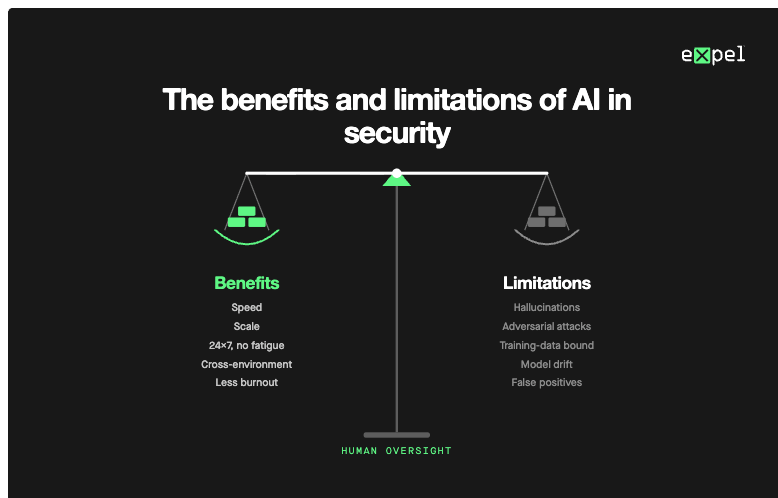
Benefits of AI in cybersecurity
Speed: AI processes security events and generates detections in milliseconds. Human analysts review in minutes to hours. For threats that move quickly, such as ransomware staging, credential-based lateral movement, data exfiltration, the gap between AI-speed detection and human-speed detection has direct security consequences. Early detection limits damage; delayed detection limits options.
Scale: Human analysts cannot review billions of daily security events. AI can. ML models that process the full data stream and surface a small number of high-confidence findings represent a capability that has no human equivalent. Scale isn’t just efficiency, it’s detection coverage that simply doesn’t exist without AI.
Continuous operation: AI doesn’t get tired, doesn’t need breaks, and doesn’t have off-hours. 24×7 monitoring without fatigue is a meaningful security benefit, particularly given that attackers deliberately time operations for evenings, weekends, and holidays when analyst coverage is thinner.
Pattern recognition across environments: ML models trained on data from many customer environments recognize attack patterns that individual organizations would never see in their own data. Cross-environment learning produces detection capabilities no single organization could build independently.
Reduction of analyst burnout: Alert fatigue is one of the most serious operational problems in security. AI that dramatically reduces the volume of alerts requiring human review directly addresses the burnout problem, allowing analysts to do meaningful investigation work rather than grinding through noise.
Continuous improvement: Well-implemented ML models improve over time through feedback loops. Analyst decisions about alerts feed back into model training, producing progressively better accuracy without requiring model rebuilds.
Limitations of AI in cybersecurity
Hallucinations: AI systems can confidently fabricate incorrect information. In security operations, hallucinated threat context or fabricated enrichment data can lead analysts to incorrect determinations. This is a core reason human review of AI-produced investigation summaries remains non-negotiable.
Adversarial attacks: AI security systems can be deliberately defeated. Adversarial ML techniques allow sophisticated attackers to craft inputs that specifically evade AI classifiers by subtly modifying malware to avoid detection, mimicking normal behavioral patterns to defeat anomaly detection, or injecting false training data to degrade model accuracy over time. As AI becomes more prevalent in security, adversarial evasion becomes a more serious concern.
Training data dependency: AI models reflect their training data completely. Models trained on outdated data miss new attack techniques. Models trained on data from different environments may perform poorly in yours. Models with noisy or biased training labels learn the wrong patterns. The quality of AI security capabilities is directly bounded by the quality of training data, which is rarely as good as vendor materials suggest.
Explainability challenges: Complex ML models—particularly deep neural networks—are difficult to interpret. Understanding exactly why a model flagged a specific alert is important for analyst trust, investigation quality, and regulatory accountability. Many production AI security systems have limited explainability, which creates challenges for analyst confidence and auditability.
Model drift: Environments change; attacker techniques evolve; normal behavior patterns shift. AI models trained on historical data gradually become less accurate as the world changes around them. Maintaining model accuracy requires ongoing monitoring, data collection, and periodic retraining, which is an investment that not all vendors or security teams make consistently.
False positive amplification: Poorly tuned AI can generate more noise than it reduces. An AI model with a 5% false positive rate applied to billions of daily events produces enormous false positive volumes. AI false positive management requires significant ongoing investment.
Over-reliance risk: The most insidious AI limitation is the risk of treating AI-generated outputs as more certain than they are. AI systems fail in ways that are hard to predict, especially on inputs that fall outside their training distribution. Security teams that defer entirely to AI outputs without maintaining human judgment capabilities are vulnerable to systematic AI failures.
Challenges of AI implementation in cybersecurity
Deploying AI in a production security environment is harder than vendor demos suggest. These are the implementation challenges that don’t show up until after purchase.
Data quality and normalization. AI models are only as good as the data they ingest. Inconsistent log formats, incomplete telemetry, and collection gaps create blind spots AI can’t see around—and no amount of model sophistication fixes a bad data pipeline.
Integration complexity. AI tools have to work alongside existing SIEM, EDR, SOAR, and identity platforms, often with proprietary APIs and years of technical debt. Integration that looks clean in a proof of concept frequently requires significant engineering time in production.
Ongoing model maintenance. Models drift as environments change and attacker techniques evolve. Maintaining accuracy requires continuous monitoring, feedback loop management, and periodic retraining. Organizations that treat AI deployment as a one-time project typically see performance degrade within months.
Organizational trust and skill gaps. Analysts who don’t understand how a model works either over-trust its outputs or ignore them. Governing AI effectively also requires skills—recognizing drift, evaluating vendor claims, designing human oversight frameworks—that most security teams weren’t trained for.
Explainability and compliance. The NIST AI Risk Management Framework and EU AI Act both impose transparency and explainability requirements on AI systems. Many production security AI tools have limited native explainability, which creates a real compliance challenge in regulated environments.
AI washing. “AI-powered” is applied to everything from genuine ML to basic rule-based automation. Ask vendors for specifics: model type, training data, production false positive rates, retraining cadence. Vendors who can’t answer aren’t selling the capability—they’re selling the label.
Where AI works best (and where it doesn’t)
AI delivers the most value in high-volume, pattern-driven tasks where speed and scale matter more than contextual judgment: alert triage at scale, behavioral anomaly detection, IOC matching across large datasets, routine investigation step automation, and vulnerability prioritization.
AI delivers the least value and introduces the most risk in tasks requiring contextual judgment, novel situation assessment, business context understanding, and high-stakes decisions with limited reversibility. These remain human tasks.
The most common AI deployment mistakes in security are applying AI where human judgment is essential (treating AI outputs as decisions rather than inputs to decisions) and not applying AI where scale makes human approaches inadequate (manually triaging alert volumes that AI should be handling).
Why human oversight remains essential
Every AI limitation has a human mitigation: adversarial attacks are caught by analysts who notice when AI detection seems wrong; training data gaps are compensated by human threat hunters finding what automated detection misses; model drift is caught by humans monitoring detection performance over time; explainability gaps are bridged by experienced analysts who understand what the AI is doing even when the model can’t fully explain itself.
The human-AI partnership in cybersecurity isn’t a philosophical preference—it’s a practical necessity. AI without human oversight has systematic failure modes that only humans can catch. Humans without AI support can’t match the scale demands of modern security operations.
Evaluating AI security claims honestly
The security industry’s AI marketing has significantly outpaced its AI reality. Common claims to scrutinize:
| If a vendor says… | You should ask… | Because… |
|---|---|---|
|
“AI-powered” |
What does the AI do, and how is its accuracy measured? | Many tools label simple automation or basic statistical methods as AI-powered, rather than genuine ML. |
|
“Eliminates false positives” |
What are the false positive rates in product deployments? | No AI system eliminates false positives. |
|
“Autonomous security” |
What specific actions are autonomous?
What’s the governance model used? What happens when the AI is wrong? |
You need to know specifics of any action being taken without human judgment involved. |
|
“Trained on billions of events” |
Does the training data represent my environment and attack landscape?
How recently was the model trained? |
The quality of the data matters more than the volume. |
Expel’s take
The honest answer is that AI delivers real value for specific, well-defined security tasks and creates real risk when it’s misapplied or over-trusted. Expel’s AI and automation engine handles alert triage and routine investigation steps that would otherwise consume analyst capacity—the scale benefit is genuine. But the most important thing we’ve learned is that the human-AI partnership isn’t just a marketing preference; it’s a practical necessity. AI fails in ways that are hard to predict, and the only reliable mitigation is keeping experienced analysts in the loop at the decision points that matter.
Frequently asked questions
What are the top benefits of AI in cybersecurity?
The top benefits include: faster threat detection across massive data volumes, 24×7 monitoring without human fatigue, reduced false positives through behavioral modeling, automated alert triage and enrichment, cross-environment threat correlation, and continuous improvement from analyst feedback.
What are the main limitations of AI in cybersecurity?
Key limitations include: adversarial ML attacks that fool models, dependence on high-quality and representative training data, limited explainability of AI decisions, model drift as threats evolve, high false positive rates in noisy environments, and inability to understand business context.
What are the challenges of implementing AI in cybersecurity?
Implementation challenges include data quality and normalization, integration with existing security tools, ongoing model maintenance, organizational trust in AI recommendations, skill gaps in AI governance, explainability requirements for compliance, and vendor AI washing.
Can AI be tricked by cyberattackers?
Yes. Adversarial machine learning involves attackers crafting inputs specifically designed to fool AI security models. Techniques include data poisoning (corrupting training data) and evasion attacks (modifying malware to avoid detection). Robust AI systems require adversarial testing and human oversight.
How do the benefits of AI in cybersecurity outweigh the limitations?
When combined with human expertise, AI’s speed and scale advantages significantly outweigh its limitations. Humans provide context, judgment, and oversight that catch AI errors—while AI handles the data volume and repetitive analysis no human team can match alone.