

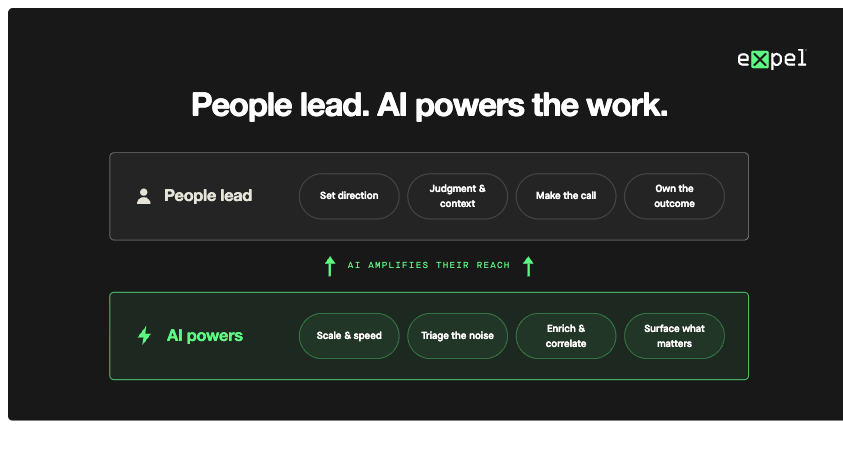
Human-led, AI-powered cybersecurity is a security operations model where human expertise drives strategy, decision-making, and oversight while AI handles data processing, pattern recognition, and task automation at scale. The combination outperforms either approach alone, and it’s the operating model behind the most effective security programs today.
Key takeaways
- “Human-led” isn’t a tagline—it’s a specific operational commitment. Consequential security decisions are made by humans with the expertise and accountability to make them well. AI informs those decisions; it doesn’t make them.
- “AI-powered” means AI is doing the work humans genuinely can’t do at scale: processing billions of events, baselining behavior across the environment, running routine investigation steps in seconds. Not AI making security decisions autonomously.
- Human-only security can’t keep pace with modern threat volume. AI-only security fails at the judgment and context tasks that outcomes depend on. The combination isn’t a compromise—it addresses the real limitations of each approach.
- Effective human-led, AI-powered security rests on five things: transparency in how AI operates, human override capability, graduated autonomy based on demonstrated reliability, continuous learning through analyst feedback, and clear human accountability for outcomes.
- Measure this model by security outcomes—mean time to detect, mean time to respond, false positive rates, detection coverage—not by how much AI is in use. AI deployment is an input; threat outcomes are what matter.
What “human-led” means in practice
“Human-led” is a specific operational commitment, not a marketing phrase. It means that consequential security decisions (is this a genuine threat, what response is appropriate, what are the business implications of this incident) are made by humans with the expertise and accountability to make them well.
In practice, human-led security looks like: human analysts determine the threat status of high-confidence alerts, rather than relying on models alone. Humans authorize high-impact response actions, even when AI recommends them. Humans maintain oversight of AI system performance and catch systematic failures. Humans provide the organizational context that AI cannot access. Humans are accountable for security outcomes.
Human-led does not mean humans do everything manually. It means humans direct the operation, make the decisions that matter, and maintain meaningful oversight of the AI systems doing the analytical work.
What “AI-powered” means in practice
“AI-powered” means that AI is doing the work that humans genuinely cannot do at the scale and speed modern security demands.
AI-powered security looks like: ML models processing billions of daily security events and surfacing hundreds of high-quality findings for analyst review. Behavioral analytics establishing environmental baselines and flagging deviations that rule-based detection would miss. Automated enrichment assembling investigation context in seconds that analysts would spend hours gathering manually. Agentic investigation agents executing routine evidence-gathering workflows without consuming analyst time on each step.
AI-powered does not mean AI makes security decisions without human-designed governance. It means AI handles the data volume, speed, and repetitive work that would otherwise make effective security operations impossible at scale.
Why neither approach alone is sufficient
Human-only security operations cannot keep pace with modern threat volume and speed. Security environments generate data at scales that no human team can manually process. Attackers move in minutes; human-only investigation often takes hours or days. Alert volumes that overwhelm analyst capacity lead to burnout and missed threats. Human-only security is increasingly inadequate not because humans lack capability but because the scale demands exceed what any human team can match.
AI-only security operations fail at the judgment and context tasks that security outcomes depend on. AI systems fail in novel situations outside their training distribution, which are also exactly the scenarios that matter most (sophisticated, novel attacks). AI cannot understand the business context that determines whether anomalous activity is malicious or legitimate. AI takes actions without accountability for the organizational consequences. Fully autonomous security programs are vulnerable to systematic AI failures that no human oversight catches.
The combination isn’t a compromise. It addresses the genuine limitations of each approach by pairing AI’s scale and consistency with human expertise and judgment.
The five principles of human-led AI-powered security
Transparency: AI systems operate in ways that human analysts can understand and evaluate. Model decisions are explainable; AI actions are logged; humans can interrogate why the AI did what it did. Black-box AI that analysts cannot evaluate is incompatible with effective human oversight.
Human override: Humans can always override AI recommendations and actions. No AI system operates with such autonomy that human correction is impossible or impractical. The ability to override isn’t just a safety mechanism, it’s the foundation of accountable security operations.
Graduated autonomy: AI authority expands as reliability is demonstrated in specific, well-defined scenarios, not granted broadly based on general capability claims. Routine, reversible actions with consistent accuracy are automated first; high-stakes, irreversible, or novel scenarios retain human decision authority.
Continuous learning: AI systems improve through structured feedback from human decisions. Analyst determinations about alerts, incident analysis, and hunt findings feed back into model improvement, creating a virtuous cycle where human expertise continuously makes AI more accurate.
Accountability: Humans are accountable for security outcomes, including the outcomes of AI systems operating under their oversight. This accountability isn’t a burden. It’s the organizational commitment that ensures AI systems are governed responsibly and that errors are caught and corrected.
AI security monitoring with human oversight
Human-led, AI-powered security is a specific operational workflow, not just a philosophy. It includes things like:
AI monitors continuously. ML models ingest telemetry 24×7 across endpoints, network, identity, and cloud—flagging behavioral anomalies and surfacing findings with context and confidence scores.
Humans validate against reality. Analysts apply what AI doesn’t have: organizational context. Is this anomalous authentication a genuine compromise or an executive traveling internationally? AI surfaces the signal; humans determine whether it’s actually a threat.
Humans authorize containment. For all but the most well-defined, reversible actions, a human approves before anything consequential happens. Human judgment is the checkpoint that prevents AI errors from becoming operational incidents.
Analyst feedback sharpens the AI. Every analyst determination feeds back into model training. False positives get flagged; missed detections get analyzed. This feedback loop is what separates AI that continuously improves from AI that plateaus at its initial training performance—and it’s what creates a compounding advantage over programs that treat AI as a static tool.
How MDR services implement this model
MDR services are the most visible implementation of human-led, AI-powered security in practice. The model is operational, not theoretical: AI processes telemetry, triages alerts, enriches findings, and automates routine investigation steps. Human analysts investigate confirmed and likely threats, exercise judgment in ambiguous situations, authorize response actions, communicate with customers, and maintain oversight of AI performance.
The evidence that this model outperforms either alternative is measurable: MDR providers running human-led AI-powered operations achieve response times, detection coverage, and false positive rates that neither human-only nor AI-only approaches can match.
Measuring effectiveness of the combined approach
The human-led, AI-powered model should be evaluated on security outcomes, not operational metrics:
Mean time to detect (MTTD): How quickly are genuine threats identified? AI-powered detection should reduce this significantly compared to rule-only or human-only approaches.
Mean time to respond (MTTR): How quickly are confirmed threats contained? AI investigation automation and response automation should significantly reduce this time-to-containment.
False positive rate: What percentage of AI-generated alerts turn out to be benign noise?
Detection coverage: What percentage of the environment and threat landscape has meaningful detection coverage? AI-powered programs should achieve broader coverage than rule-only programs.
Analyst effectiveness: Are analysts spending their time on complex, high-judgment work, or on routine data gathering that AI should be handling? The right metric is investigation quality, not investigation volume.
Expel’s take
“Human-led, AI-powered” gets used as marketing shorthand by enough vendors that it’s worth being specific about what it actually means in practice. At Expel, it means our analysts are accountable for every security decision that matters. What AI handles is the work that would otherwise make that accountability impossible at scale: processing the telemetry, running the investigation steps, surfacing the findings. Our 13-minute mean time to respond (MTTR) isn’t an AI number or a human number—it’s what happens when AI handles the speed and scale problem and humans handle the judgment problem, and neither is doing the other’s job.
Frequently asked questions
What is human-centered security?
Human-centered security is an approach that prioritizes human expertise, judgment, and oversight while leveraging AI to support and enhance human capabilities. It recognizes that security decisions have business, legal, and human consequences requiring human understanding that AI cannot fully replicate.
What does AI security monitoring with human oversight look like in practice?
AI continuously monitors telemetry, detects anomalies, and surfaces potential threats with context and confidence scores. Human analysts review AI findings, validate against business context, apply judgment for ambiguous cases, approve containment actions, and provide feedback that improves AI accuracy over time.
Why is human oversight important in AI-powered security?
AI can produce false positives, miss context-dependent threats, and make errors that propagate at machine speed. Humans provide business context, understand organizational priorities, communicate with stakeholders, make judgment calls in ambiguous situations, and remain legally accountable for security outcomes.
How do you measure effectiveness of AI + human security?
Key metrics include mean time to detect (MTTD), mean time to respond (MTTR), false positive rate reduction, analyst utilization (time on high-value vs. repetitive work), detection coverage expansion, and analyst satisfaction as indicators of sustainable operations.
What is the difference between human-led AI security and fully autonomous security?
Human-led AI security maintains human decision authority for high-impact actions while using AI for data processing and routine automation. Fully autonomous security removes humans from the decision loop—an approach that currently lacks the business context, accountability, and novel threat handling that human expertise provides.