

AI is transforming cybersecurity work by automating repetitive tasks and expanding what analysts can do, but it’s unlikely to fully replace human professionals who bring judgment, creativity, and contextual understanding to complex investigations.
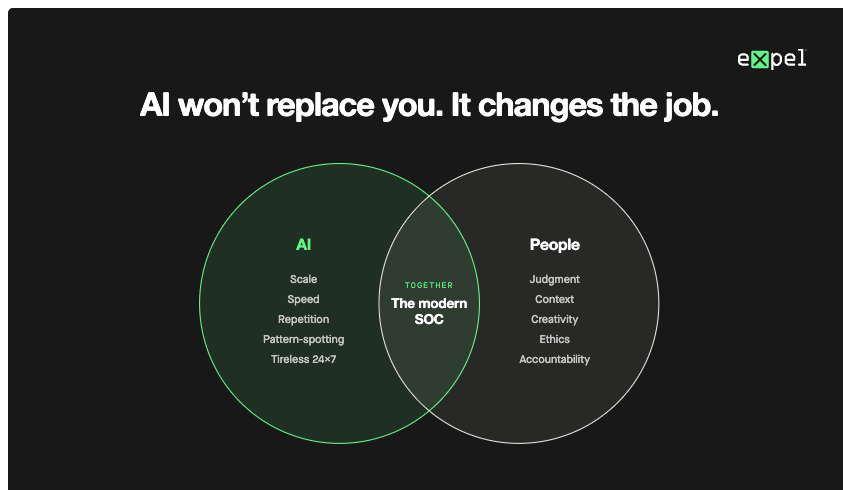
No, AI will not replace cybersecurity professionals. But it will fundamentally change what they do. AI excels at processing massive datasets, recognizing patterns at scale, and executing repetitive tasks consistently. Humans excel at contextual judgment, creative problem-solving, adapting to novel situations, and making strategic decisions. Effective security operations require both. The future isn’t AI vs. humans, it’s AI handling the work humans can’t do at scale, while humans focus on the work AI can’t do at all.
Key takeaways
- AI will not replace cybersecurity professionals—but it will change what they spend their time on. Routine triage, enrichment, and investigation steps increasingly go to AI; judgment, complex investigation, and accountability stay with humans.
- The skills that make security professionals valuable—analytical thinking, attacker mindset, contextual judgment—aren’t becoming obsolete. The tasks those skills get applied to are shifting toward the harder, more ambiguous work that AI can’t do.
- The organizations with the best security outcomes aren’t running AI-only or human-only operations. They’re running both together: AI handling scale and repetition, humans handling complexity and decisions.
- Roles focused on high-volume, repeatable tasks will see the most disruption. Roles that require judgment, creativity, and domain expertise will see augmentation—not replacement.
- The emerging skill that matters most: AI literacy. Understanding how AI security tools work, where they fail, and how to catch their errors is quickly becoming a baseline expectation for security professionals.
Why this question matters: the real concern behind it
The search for “will AI replace cybersecurity professionals” isn’t really asking a technical question, it’s asking a career anxiety question. Security professionals who have spent years developing expertise want to know whether that expertise is becoming obsolete. CISOs want to know whether their team investment is at risk. Organizations want to know whether AI changes their hiring needs.
The honest answer addresses the real concern: your expertise is not becoming obsolete. The nature of what that expertise is applied to is changing—and that change, handled well, makes security professionals more effective rather than less necessary.
What AI can and cannot do in cybersecurity today
What AI does well today: Processing billions of security events to surface a small number of genuine threats. Executing repetitive investigation steps (IP lookups, domain reputation checks, user history queries) consistently and instantly. Maintaining continuous 24×7 monitoring without fatigue. Recognizing patterns across massive datasets (including patterns no human analyst would have seen before). Automating routine response actions (account suspension, endpoint isolation) when the situation meets defined criteria.
What AI does not do well today: Understanding whether a specific security event is actually threatening given your organization’s business context. Adapting creatively to novel attacker techniques that fall outside training data. Making judgment calls in genuinely ambiguous situations where the evidence doesn’t clearly point in one direction. Communicating findings effectively to non-technical stakeholders. Exercising ethical judgment and organizational accountability. Investigating incidents that require asking questions the AI wasn’t programmed to ask.
The honest assessment: AI is genuinely transformative for the first set of capabilities. It is genuinely limited for the second. Both sets are essential to security operations.
| What AI does best | What humans do best | Collaboration zone |
|---|---|---|
|
Processing billions of security events continuously without fatigue |
Exercising judgment in ambiguous or novel situations | Analyst reviews AI-generated investigation summaries and makes the containment call |
|
Recognizing patterns across massive datasets that no human team could review manually |
Understanding organizational and business context that AI doesn’t have access to | AI scores and prioritizes the alert queue; humans focus time on the highest-risk findings |
|
Operating 24×7 with consistent accuracy regardless of time or volume |
Adapting creatively to attacker behavior that falls outside trained patterns | AI handles routine triage at scale; humans investigate the edge cases AI flags as uncertain |
|
Executing repetitive investigation steps—enrichment, indicator lookups, log correlation—in seconds |
Communicating findings, risk, and decisions to stakeholders across the business | AI produces the investigation summary; humans translate it into action and accountability |
|
Correlating signals across multiple data sources simultaneously |
Making high-stakes decisions with real-world consequences and clear accountability | AI surfaces the evidence and recommends a response; humans authorize actions with significant impact |
|
Improving detection accuracy over time through feedback loops |
Questioning AI outputs and catching model errors before they cause harm | Analyst feedback on true and false positives feeds directly into model retraining |
Tasks AI will increasingly handle
As AI capabilities mature, the share of security work handled autonomously will expand, primarily in the domain of well-defined, data-driven tasks:
Alert triage at scale: The majority of alert investigation for known, well-characterized threat types will be handled by AI with analyst review rather than analyst-led investigation.
Routine incident response: Standard containment actions for common incident scenarios will execute automatically, with humans managing communication and strategic decisions.
Threat intelligence processing: Ingesting, correlating, and operationalizing threat intelligence from multiple sources will be primarily AI-driven.
Detection content development: AI assistance in generating and testing detection logic will accelerate detection engineering significantly, though human judgment on what to detect and how to validate remains essential.
Reporting and documentation: Investigation reports, incident timelines, and compliance documentation will be largely AI-generated from structured evidence, with human review and sign-off.
Tasks that will always require humans
Complex investigation: When an incident doesn’t fit known patterns, when evidence is ambiguous, when an attacker is specifically evading detection—this is where human investigative skill, creativity, and persistence are irreplaceable.
Business context judgment: Is this anomalous behavior a threat or a legitimate business process? Does this incident warrant executive notification? What’s the right response balance between security and operational continuity? These decisions require organizational knowledge that AI systems don’t have.
Novel threat analysis: Attackers constantly develop new techniques. Recognizing that something new is happening, and understanding what it means before there’s training data for it, requires the kind of pattern-breaking thinking that human analysts excel at.
Stakeholder communication: Explaining what happened, why it matters, and what needs to happen next to audiences ranging from technical responders to boards of directors requires human communication and judgment.
Oversight of AI systems: As AI takes on more consequential roles in security operations, someone needs to evaluate whether the AI is performing correctly, catch systematic failures, and make governance decisions about AI authority. This is a distinctly human responsibility.
How security roles are evolving
Security roles aren’t disappearing, they’re changing in focus and scope. The shift looks like this:
Analysts spend less time on data gathering and routine triage, and more time on complex investigation, AI-generated finding review, and high-judgment decisions. Threat hunters develop increasingly sophisticated hypotheses, leveraging AI tools that handle the data processing while humans provide the analytical direction. Detection engineers work alongside AI tools that accelerate rule development, focusing human expertise on what to detect and how to validate rather than the mechanics of query writing. Security leaders focus more on AI governance, program strategy, and outcomes measurement as AI handles more operational execution.
Across every role, the underlying skill set that makes security professionals valuable—analytical thinking, attacker mindset, security domain expertise, judgment under uncertainty—remains essential. What changes is which tasks those skills are applied to.
The AI + human model in practice
The organizations achieving the best security outcomes in 2026 are neither running human-only security operations (overwhelmed by volume and speed) nor trying to run AI-only operations (vulnerable to novel threats, context gaps, and systematic AI failures). They’re running AI-augmented operations where AI handles scale and routine, and humans focus on judgment and complexity.
This model is most clearly embodied in MDR services: AI processes telemetry, triages alerts, enriches findings, and automates routine investigation steps. Human analysts investigate confirmed and likely threats, exercise judgment in ambiguous situations, authorize response actions, and manage customer communication. Neither could provide the service the other enables.
Skills to develop for an AI-augmented future
Security professionals who invest in the following skills are well-positioned for the AI-augmented future:
AI literacy: Understanding how AI security tools work (their capabilities, limitations, and failure modes) allows analysts to use them effectively and catch their errors.
Prompt engineering and AI tool use: Effectively directing AI tools, querying security data in natural language, and evaluating AI-generated outputs are becoming baseline analyst skills.
Complex investigation: As AI handles routine cases, the cases that reach human analysts will skew toward the harder, more ambiguous, more novel ones. Deep investigation skills become more valuable, not less.
Communication: Explaining security findings to technical teams, to executives, and to boards remains entirely human. Strong communication skills differentiate security professionals as AI handles more of the analytical work.
AI governance: Understanding how to evaluate, oversee, and course-correct AI security systems is an emerging skill with significant career value as AI takes on more consequential roles.
Expel’s take
The question we hear most often isn’t “will AI replace my team?”—it’s “how do I justify headcount when leadership thinks AI should be doing this work?” The honest answer is that AI changes the math on what a security team can cover, not whether you need one. At Expel, AI handles the investigation steps that would otherwise consume analyst capacity—enrichment, correlation, routine triage—so our analysts spend their time on the findings that actually require a human to look at. That’s not a smaller team doing the same work. It’s the same team doing more meaningful work, on harder problems, with better context. The analysts who thrive in that model aren’t the ones who resist AI—they’re the ones who get good at directing it, questioning it, and catching it when it’s wrong.
Frequently asked questions
Will cybersecurity be automated?
Parts of cybersecurity are already automated, including alert triage, data enrichment, and routine incident documentation. Full automation is not realistic because threats constantly evolve, attacks require contextual understanding, and response decisions have business and legal consequences requiring human judgment.
Is cybersecurity a good career if AI is advancing?
Yes—cybersecurity remains one of the strongest career fields regardless of AI advances. AI creates new attack surfaces and defensive needs, and security professionals who understand both cybersecurity and AI are in exceptionally high demand.
What cybersecurity jobs are most affected by AI?
Roles focused on repetitive, high-volume tasks such as Tier 1 alert triage will see the most transformation. These roles are evolving into higher-value positions focused on AI oversight, detection engineering, complex investigation, and strategic security planning.
What benefits does human oversight provide in AI security systems?
Human oversight ensures AI recommendations are validated against business context, catches AI errors before they propagate, maintains accountability for security decisions.
How does AI work with human analysts in a SOC?
In an AI-augmented SOC, AI handles the data processing and routine analytical work that would otherwise consume most analyst time, such as triage, enrichment, and standard investigation steps. Human analysts focus on the findings AI surfaces, exercising judgment on threat status, authorizing response, and managing the complex investigations that require contextual knowledge and creative thinking. For a deeper look at the AI-augmented SOC model, see our guide to AI-augmented security operations.