

AI-augmented SOC is a security operations center where AI and machine learning are integrated into analyst workflows to enhance detection, investigation, and response, not to replace the analysts running them. AI handles data volume, routine triage, and automated enrichment; human analysts focus on the complex, judgment-intensive work that determines security outcomes.
Key takeaways
- An AI-augmented SOC isn’t about replacing analysts—it’s about changing what analysts do. AI handles data volume, routine triage, and automated enrichment so humans can focus on the complex, judgment-intensive work that determines security outcomes.
- The difference from a traditional SOC is where analytical work happens. In a traditional SOC, analysts are the analytical engine. In an AI-augmented SOC, analysts receive pre-analyzed findings and focus on evaluation, judgment, and response—not data gathering.
- A fully autonomous SOC isn’t the goal. Attackers specifically target gaps in automated defenses, and sophisticated threats require human investigators who can recognize that something new is happening without being constrained by predefined patterns.
- The collaboration layer—the workflows and feedback mechanisms connecting AI outputs to human decisions, and human decisions back to AI improvement—is the most underinvested part of most AI-augmented SOC builds, and the most critical to whether it actually works.
- MDR is how most organizations access AI-augmented SOC capabilities without building them internally. The AI infrastructure, cross-customer intelligence, and analyst expertise that make the model effective take years to build and are difficult to justify at individual organization scale.
What makes a SOC “AI-augmented”
The distinction between a traditional SOC and an AI-augmented SOC isn’t the presence of security tools—both have those. It’s how deeply AI is integrated into the analytical workflow and how fundamentally that integration changes what analysts do.
In a traditional SOC, analysts receive alerts from security tools and manually investigate them by gathering context from multiple systems, stitching them together manually, applying knowledge of attacker behavior, and determining threat status. The analyst is the analytical engine; tools provide raw data.
In an AI-augmented SOC, AI handles the analytical heavy lifting. ML models process incoming telemetry and surface high-confidence findings. Behavioral analytics identify anomalies that rules miss. Automated enrichment assembles investigation context before the alert reaches an analyst. The analyst receives a pre-analyzed finding rather than a raw alert, and focuses on evaluation, judgment, and decision-making rather than data gathering.
The practical result: analysts in AI-augmented SOCs handle more investigations, at higher quality, with faster response times. Not because they work harder, but because AI removes the work that shouldn’t require human analysts in the first place.
The three-layer operating model
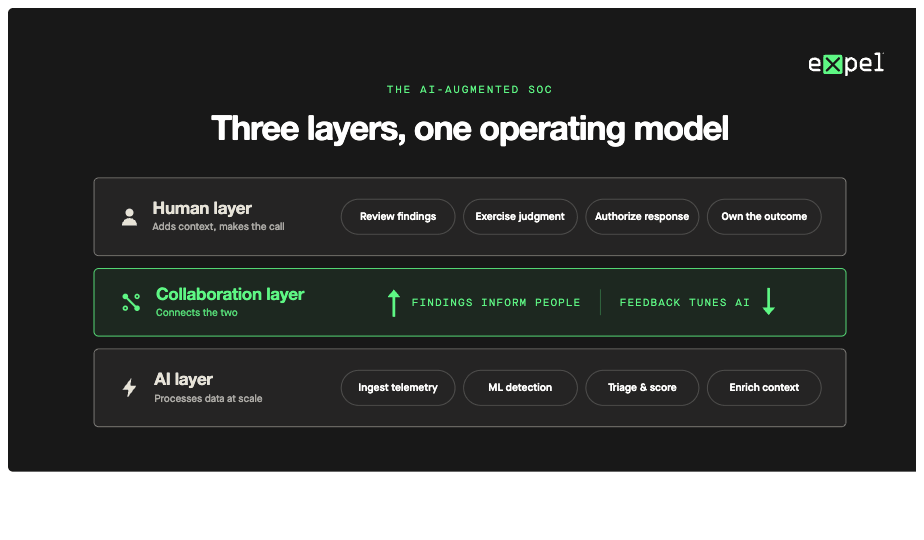
An AI-augmented SOC operates across three interconnected layers:
The AI layer processes data at scale, ingesting telemetry from across the environment, applying ML detection models, running behavioral analytics, triaging and scoring alerts, and assembling enrichment context. This layer operates continuously and at speeds no human team can match.
The human layer adds business context, makes decisions, reviewing AI-surfaced findings, exercising judgment on threat status, authorizing response actions, investigating complex or novel threats that require human expertise, and maintaining oversight of AI system performance.
The collaboration layer connects the two, the workflows, interfaces, and feedback mechanisms that allow AI outputs to effectively support human decisions, and human decisions to continuously improve AI performance. This layer is often underinvested but is critical to whether the model actually works in practice.
What role does AI play in security operations centers?
AI in security operations centers processes telemetry continuously across endpoints, network, identity, and cloud—correlating events across tools and environments, identifying high-confidence threats, and suppressing the false positives that consume analyst capacity. It enriches alerts with contextual information before they reach an analyst and generates investigation recommendations for well-understood threat types. The result is analyst teams that achieve broader detection coverage and faster response times than human-only operations can deliver at scale, without proportional headcount growth.
Key AI capabilities in an augmented SOC
AI-powered detection: ML models that identify both known attack patterns and novel behavioral anomalies, extending detection coverage beyond what rule-based systems can achieve.
Alert triage and prioritization: AI classification models that score incoming alerts by threat confidence and risk level, suppressing clear false positives and ensuring analysts review the most critical findings first.
Automated enrichment: AI systems that automatically gather contextual information for each alert (user behavior history, endpoint status, threat intelligence matches, related events) before the alert reaches an analyst.
Investigation automation: For well-defined alert types, AI executes investigation workflows and produces determination summaries that analysts review rather than build from scratch.
Cross-environment intelligence: AI models trained on threat data from multiple environments that recognize attack patterns invisible from any single organization’s data.
Why a fully autonomous SOC isn’t the goal
The concept of a “lights-out SOC”—security operations running entirely without human involvement—surfaces regularly in vendor marketing and industry discussion. It’s worth addressing directly: while autonomous execution of specific, routine tasks is valuable, a fully autonomous end-to-end security operation isn’t the goal, and isn’t currently achievable.
Attackers specifically target the gaps in automated defenses. Novel techniques, living-off-the-land attacks, and carefully crafted evasion are designed to bypass exactly what automated systems look for. Human analysts who can recognize that something new is happening, and investigate without the constraint of predefined patterns, remain essential for catching sophisticated threats.
More fundamentally, security decisions carry consequences that require human accountability. Containing a compromised account that turns out to be legitimate, or missing a genuine threat because of an AI blind spot, has real organizational impact. That accountability belongs with humans, not AI systems.
When comparing an AI-driven SOC vs. autonomous SOC, the AI-augmented SOC isn’t a step toward removing humans, it’s the operational model that makes human expertise most effective.
How MDR providers operate as AI-augmented SOCs
MDR providers are the clearest real-world example of AI-augmented SOC operations. They’ve built the AI infrastructure, analyst workflows, and collaboration models that make human-led AI-powered security operations work at scale, and they deliver those capabilities as a service.
For organizations that can’t build an AI-augmented SOC internally, MDR is how the model becomes accessible. The AI infrastructure, cross-customer intelligence, and analyst expertise that MDR providers have invested in over years are available immediately rather than requiring internal development from scratch.
Skills and roles in an AI-augmented SOC
The analyst roles in an AI-augmented SOC look different from traditional SOC roles. Not fewer people, but different applications of expertise.
Analysts spend less time on data gathering and routine triage, and more time on complex investigation, AI finding evaluation, and high-judgment decisions. The work is harder and more interesting—AI handles the routine, humans handle the complex.
Detection engineers work alongside AI tools that accelerate content development, focusing on what to detect and how to validate rather than the mechanics of query writing.
Threat hunters leverage AI-powered data access and analysis tools to pursue more sophisticated hypotheses—AI handles the data gathering while hunters focus on the analytical direction.
AI oversight is an emerging role filled by security professionals who evaluate AI system performance, catch systematic failures, tune models, and govern AI authority. This capability is increasingly essential as AI takes on more consequential roles.
Expel’s take
The hardest part of building an AI-augmented SOC isn’t the AI—it’s the collaboration layer. Getting ML models to surface good findings is a solved problem. Getting those findings into analyst hands in a format that actually accelerates their decision-making, and getting analyst decisions to feed back into model improvement, is where most implementations fall short. At Expel, we’ve spent years tuning that loop—how findings are presented, what context analysts need to make a call quickly, how feedback flows back into detection. Our 13-minute MTTR is a product of that loop working well, not just AI working fast. If you’re evaluating AI-augmented SOC capabilities, ask vendors not just what the AI detects, but how it hands off to humans and how human decisions make it better over time.
Frequently asked questions
How is an AI-augmented SOC different from a traditional SOC?
A traditional SOC relies primarily on human analysts manually reviewing alerts from security tools. An AI-augmented SOC integrates AI to automatically triage alerts, enrich investigations, correlate threats across environments, and route work to analysts—allowing humans to focus on complex investigation and decision-making rather than data gathering.
What role does AI play in security operations centers?
AI in security operations centers processes telemetry continuously, correlates events across tools and environments, identifies high-confidence threats, suppresses false positives, enriches alerts with context, and generates investigation recommendations—enabling analyst teams to achieve greater coverage and faster response at scale.
What is an autonomous SOC?
An autonomous SOC is a theoretical concept where AI systems handle security operations without human intervention. In practice, no security organization operates a fully autonomous SOC—the complexity of real threats, business context requirements, and accountability needs make human oversight essential.
How does an AI-augmented SOC reduce analyst burnout?
By handling the high-volume, repetitive work of alert triage and data enrichment, AI frees analysts to focus on complex, intellectually engaging investigation work. This reduces the manual data-gathering labor that drives burnout while elevating the quality and strategic value of analyst work.
How does MDR provide AI-augmented SOC capabilities?
MDR providers like Expel operate AI-augmented SOC capabilities as a service—delivering the AI infrastructure, trained models, analyst expertise, and 24×7 coverage that most organizations cannot build internally at comparable scale or cost.