

AI detection and response (AIDR) is an emerging security category focused on detecting and responding to threats created by AI, including attacker use of AI, risky agentic AI behavior, and prompt-level manipulation, not just AI-assisted analysis of traditional threats.
Key takeaways
- AI detection and response (AIDR) is an emerging category focused on threats created by AI, not just AI-assisted detection of traditional threats.
- AIDR isn’t a replacement for XDR or MDR—it’s a coverage layer most of them don’t fully address yet.
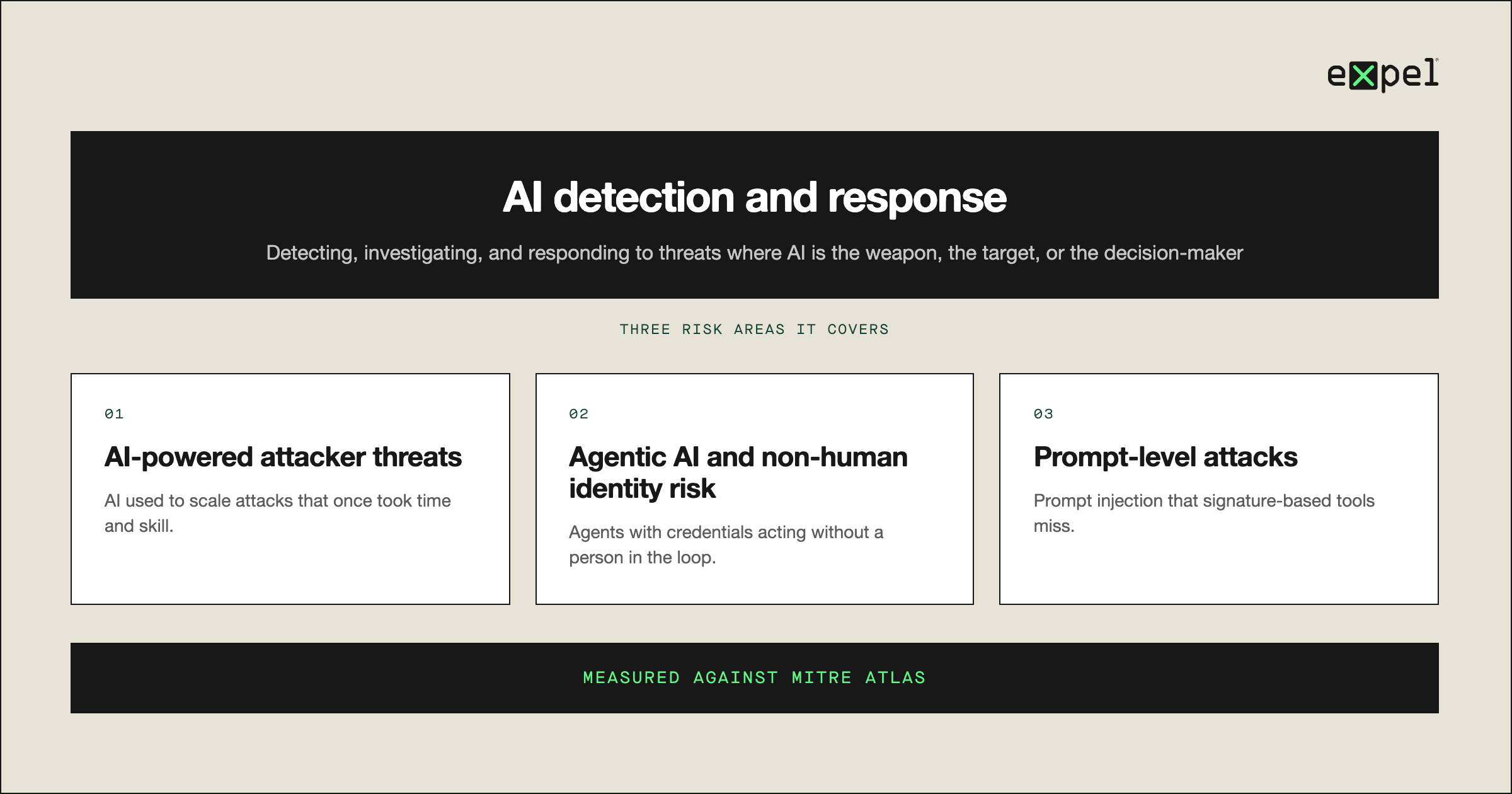
- AIDR covers three risk areas: AI-powered attacker threats, agentic AI and non-human identity risk, and prompt-level attacks.
- MITRE ATLAS is becoming the go-to checklist for whether an AIDR provider’s coverage claims actually hold up.
- Expel delivers AIDR as an extension of its human-led, AI-powered MDR approach, under our dedicated MDR for AI offering.
AI is now a tool bad actors use to attack faster, and it’s also showing up inside businesses as agents, copilots, and automations with their own access and identity. Both realities need coverage, and neither is fully covered by the security stack most teams already have. That gap is why AI detection and response (AIDR) is emerging as its own category, distinct from the AI threat detection mechanics baked into existing tools. This page breaks down what AIDR actually means, and how it compares to extended detection and response (XDR) and managed detection and response (MDR).
What is AI detection and response (AIDR)?
AI detection and response is the practice of detecting, investigating, and responding to threats that involve AI, whether AI is the weapon, the target, or the thing quietly making decisions inside your environment.
That’s three distinct problem sets. Cybercriminals are using AI to write more convincing spear-phishing emails, generate malware variants faster, and automate reconnaissance. Organizations are deploying AI agents and copilots that act like non-human employees with credentials, permissions, and the ability to take action on their own (and that’s for both approved and shadow AI). And attackers are learning to manipulate AI systems directly, through prompt injection and other prompt-level attacks that don’t look like traditional malware at all.
AIDR is the category built to catch all three. It’s not a rebrand of AI-powered detection tooling—plenty of security products already use AI to spot threats faster, and that’s a mechanics question, not a category question. AIDR is about what you’re watching for, not what’s doing the watching.
| XDR | MDR | AIDR | |
|---|---|---|---|
|
What it is |
A detection platform that correlates signals across endpoint, network, and cloud | A managed service that operates detection and response for you, 24×7 | An emerging category (platform or service) focused specifically on AI-related threats |
|
What it watches |
Traditional telemetry—endpoints, identities, network traffic | Whatever the underlying tooling covers, operated by analysts | Attacker use of AI, agentic AI behavior, non-human identities, prompt-level manipulation |
|
Who operates it |
Your team, using the vendor’s console | The MDR provider’s SOC, on your behalf | Varies—bolt-on feature, standalone tool, or delivered as a managed service |
|
Maturity |
Established, widely adopted | Established, widely adopted | Early—most vendors are still defining scope |
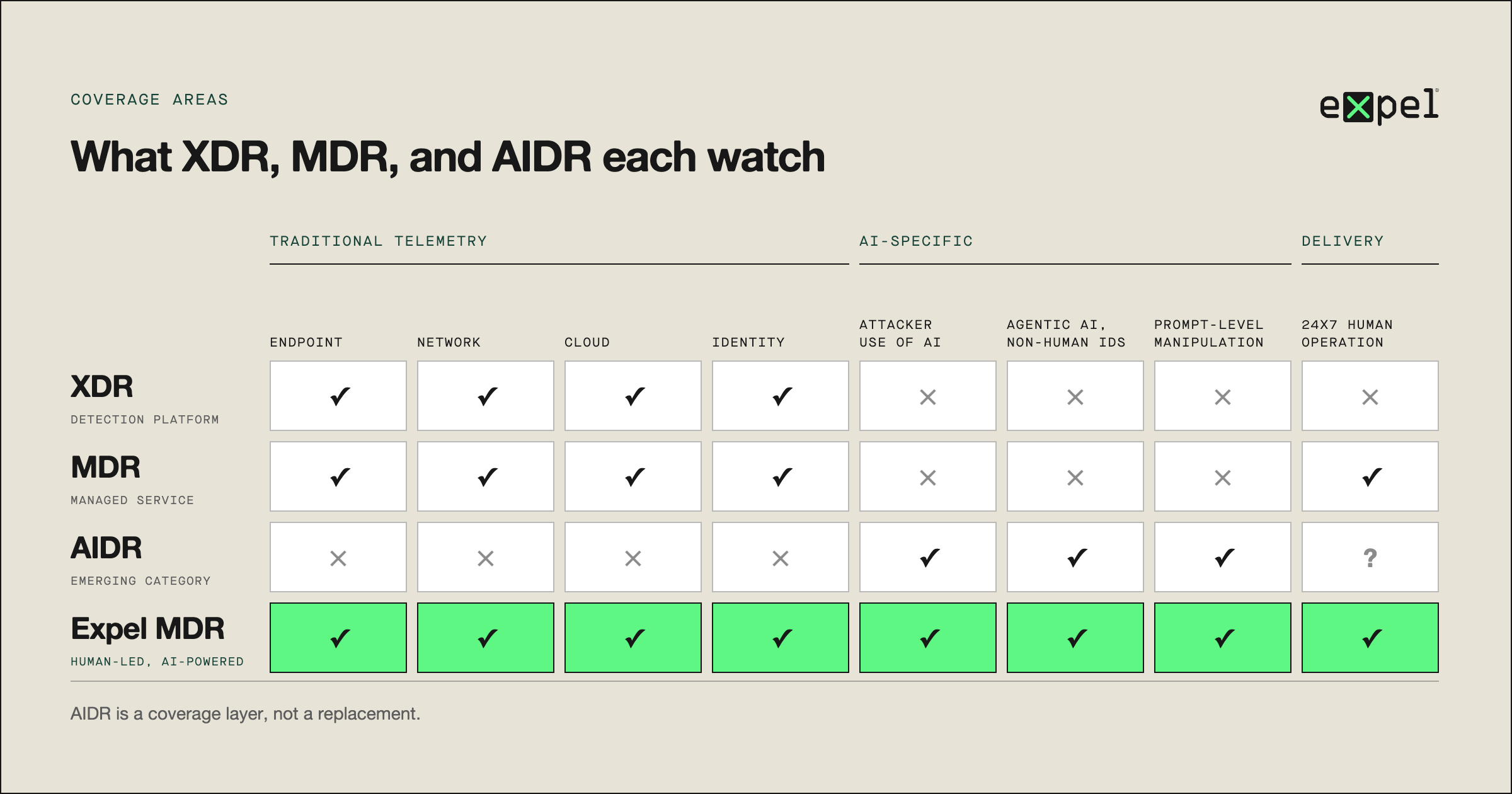
The short version: if you have MDR today, you likely have strong coverage for traditional threats and a gap for AI-specific ones. AIDR is what closes that gap.
What is AI detection and response for cybersecurity?
For cybersecurity teams, AIDR means having a way to see and respond to AI as both an attack surface and an attack tool, not just as a feature inside your existing detection stack.
That distinction matters because “AI security” gets used to describe a lot of different things: model governance, data privacy for AI tools, and responsible AI policies. AIDR is narrower and more operational. If a security conversation about AI doesn’t end with “and here’s what we do when we catch it,” it’s not AIDR, it’s AI policy.
What AIDR covers
AI-powered attacker threats. Cybercriminals are using AI to scale attacks that used to require more time and skill. See AI-powered cyberattacks for how these threats actually show up in the wild.
Agentic AI and non-human identity risk. AI agents can hold credentials, take actions, and make decisions without a person in the loop for every step. Read more on agentic AI security risks.
Prompt-level attacks. Prompt injection and related techniques target the AI system itself, which means signature-based tools often miss them entirely. See what prompt security means for how this attack class works.
How AIDR differs from general AI threat detection mechanics
AIDR is the category. AI threat detection mechanics are the engineering underneath it, and conflating the two is one of the most common mistakes in how this space gets talked about.
AI threat detection mechanics cover how detection actually works when AI is involved: the models, the signals, the correlation logic. We’ve written about it separately in how AI threat detection works, which focuses on mechanics, not category definition.
A vendor can have strong AI-powered detection mechanics without having any AIDR coverage at all, if none of that detection logic is actually built to catch AI-specific threats like agentic identity abuse or prompt injection.
How MITRE ATLAS fits into AIDR
MITRE ATLAS is the closest thing the industry has to a shared reference point for adversarial AI tactics, and it’s becoming a foundational piece of how AIDR gets defined and measured.
Where MITRE ATT&CK maps tactics for traditional cyberattacks, MITRE ATLAS does the same thing for attacks against AI systems. For AIDR specifically, ATLAS matters in two ways: it’s a checklist for what a real AIDR service should be able to point to, and it’s a maturity signal. A vendor that can’t map its coverage to ATLAS techniques probably hasn’t built detection logic specific to AI threats yet.
How to evaluate an AIDR provider
Ask what specific threats it detects. “AI-powered security” is not a complete answer. Agentic identity abuse, prompt injection, and AI-generated phishing are. Ask how it maps to MITRE ATLAS. Ask who responds when something fires.
Ask how it fits what you already have. If you already work with an MDR provider, the real question is whether AI-specific coverage extends what they’re already doing for you or sits off to the side as a separate tool you now have to manage yourself.
How Expel defines and delivers AIDR: MDR for AI
AI detection and response is synonymous with our MDR for AI coverage. It extends the same human-led, AI-powered approach we already use across endpoint, cloud, and identity, and applies it specifically to AI-powered attacker behavior, agentic AI and non-human identity risk, and prompt-level attacks. It’s not a bolt-on feature. It’s coverage built into how our SOC already investigates and responds.
Frequently asked questions
What does AIDR stand for?
AIDR stands for AI detection and response, or the practice and emerging category of detecting and responding to threats that involve AI, whether AI is being used as an attack tool, running as an agent inside your environment, or being manipulated directly through prompts.
How is AIDR different from XDR or MDR?
AIDR is defined by what it watches for, while XDR and MDR are defined by how detection and response gets delivered. AIDR can layer on top of either, adding coverage for AI-powered attacks, agentic AI risk, and prompt-level manipulation.
What kinds of threats does AIDR cover?
Three main risk areas: AI-powered attacker threats, agentic AI and non-human identity risk, and prompt-level attacks. Each requires distinct detection logic.
How does MITRE ATLAS relate to AIDR?
MITRE ATLAS is the industry reference framework for adversarial AI tactics, and it’s becoming the standard way to measure whether an AIDR service actually covers real AI threats.
How does Expel deliver AI detection and response?
Expel delivers AIDR as an extension of its existing human-led, AI-powered MDR approach, applied specifically to AI-powered attacks, agentic AI risk, and prompt-level manipulation, backed by a 2.41-minute median time to detect (MTTD).