

Shadow AI refers to artificial intelligence tools, apps, or models that employees use for work without IT or security approval, oversight, or visibility. It ranges from personal ChatGPT sessions to unsanctioned AI browser plugins and homegrown automations, all operating outside your organization’s governance and monitoring.
Key takeaways
- Shadow AI is any AI tool employees use for work without IT or security approval, oversight, or visibility.
- It’s harder to detect than shadow IT because AI traffic often looks like normal browser or API activity, not a new app or login screen.
- Only 37% of organizations govern shadow AI deployments today, according to IBM/OWASP 2026 research.
- The core risks are data leakage, compliance exposure, and unvetted third-party models, none of which require malicious intent to cause damage.
- A workable governance policy starts with an honest inventory of what’s already in use, not a ban.
Shadow AI is one of the fastest-growing blind spots in AI in cybersecurity today because employees don’t wait for policy—they paste sensitive data into ChatGPT, plug unauthorized AI plugins into their browsers, or build their own automations with tools nobody in IT has vetted. It’s not usually malicious. It’s people trying to get work done faster. But every unmonitored AI interaction is a potential exposure: proprietary data leaving your perimeter, compliance violations nobody flagged, and models nobody assessed for security. This page breaks down what shadow AI actually is, how it differs from shadow IT, and what your security team should do about it.
What is shadow AI?
Shadow AI is any AI tool or application employees use for work that IT and security teams haven’t approved, deployed, or even seen. It’s the AI-era version of an old problem: people finding faster ways to work and skipping the approval line to get there.
That could mean a marketer running a report through a free chatbot, a developer wiring an AI coding assistant into a private repo, or a whole team quietly standardizing on a tool that never went through procurement. None of it happens with malicious intent. Most of it happens because the approved alternative is slower, clunkier, or doesn’t exist yet.
The problem isn’t that employees are using AI. It’s that security teams can’t protect what they can’t see. Shadow AI creates gaps in data governance, vendor risk management, and access control, and these gaps grow faster than most security programs can track.
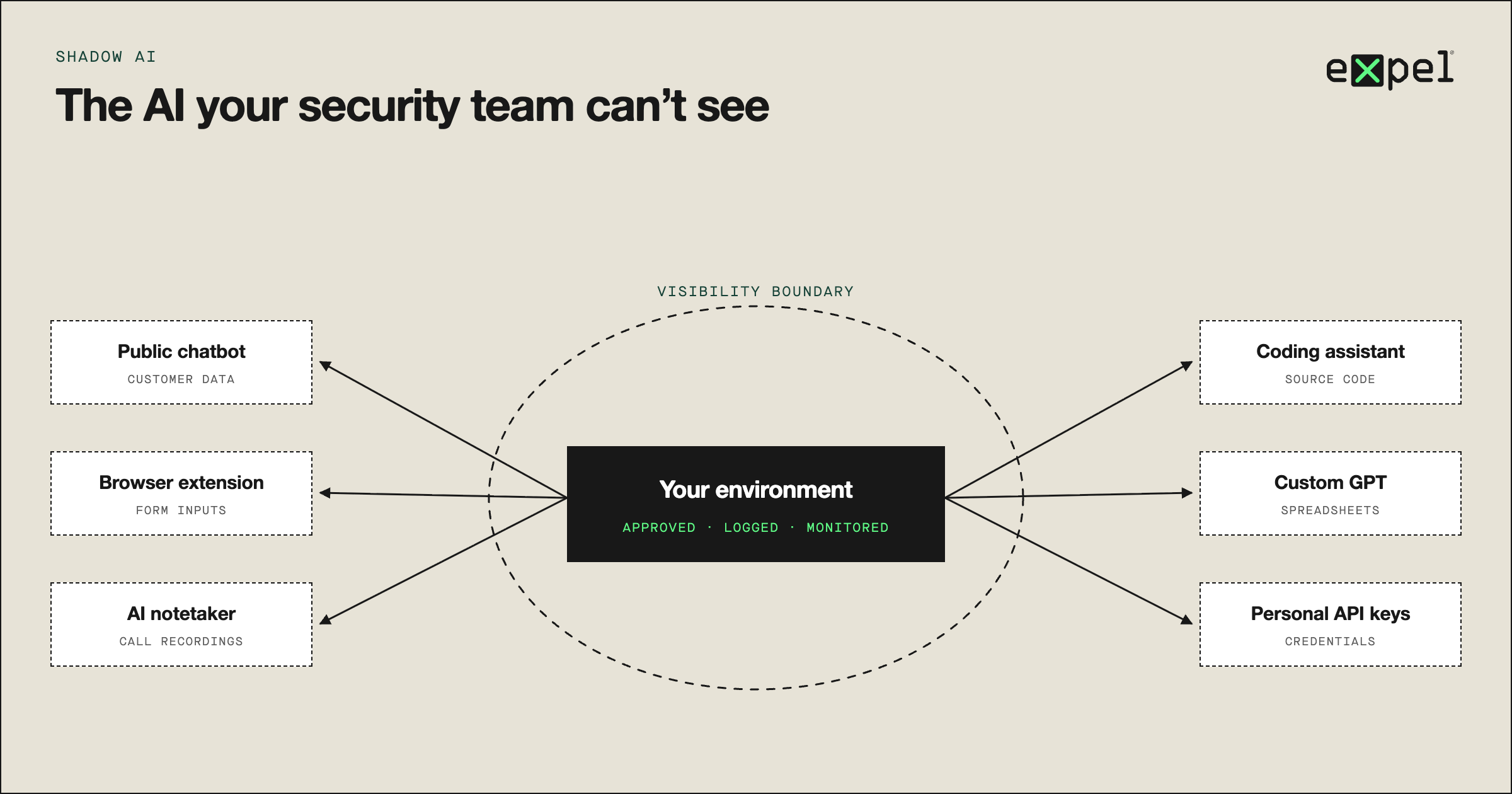
As agentic AI tools take on more autonomous tasks—not just answering questions, but taking actions—the shadow AI problem compounds. An unvetted chatbot is a data exposure risk. An unvetted AI agent with system access is something bigger.
Shadow AI vs. shadow IT
Shadow AI and shadow IT share the same root cause: employees adopting tools outside official channels because it’s faster than waiting for approval. But the risk profiles aren’t identical.
Shadow IT is usually a visibility problem. An unsanctioned file-sharing app or SaaS tool is still discoverable through network monitoring, expense reports, or a browser extension audit. Shadow AI is harder to catch. A chatbot conversation or an AI plugin call often looks like normal web traffic.
| Shadow IT | Shadow AI | |
|---|---|---|
|
What it is |
Unauthorized apps, devices, or cloud services | Unauthorized tools, models, or plugins |
|
Typical example |
A team spinning up its own file-sharing app | An employee pasting a contract into a public chatbot |
|
Data exposure |
Data sits in an unmanaged app or account | Data can be absorbed into a model’s training or logging pipeline, sometimes permanently |
|
Visibility challenge |
Discoverable through network and SaaS monitoring | Often looks like normal browser or API traffic |
|
Governance maturity |
Most organizations have some shadow IT policy | Only 37% of organizations govern shadow AI deployments |
Common examples of shadow AI in the workplace
Shadow AI shows up in nearly every department—not just engineering—such as:
- An employee pasting confidential customer data into a public chatbot to draft an email.
- A marketing team using an AI image or copy generator that was never reviewed for data handling practices.
- A developer connecting an AI coding assistant to a private repository without a security review.
- A sales rep using an AI notetaker that records and transcribes customer calls.
- A finance team building a custom GPT or automation that references sensitive spreadsheets.
- An employee installing a browser extension that quietly routes form data through an AI model.
Why shadow AI is a board-level question now
Shadow AI used to be a security team’s problem to flag and move on from. That’s changed. Regulators are writing AI-specific rules into existing privacy and data protection laws. Cyber insurers are asking pointed questions about AI governance during renewal, and boards are realizing that “we didn’t know employees were using that tool” isn’t a defense.
The shift from generative AI to agentic AI raises the stakes further. An unvetted AI agent with the ability to take actions is an operational risk with a much shorter runway to an actual incident—which is exactly why understanding what to look for in agentic AI security solutions matters before that risk arrives.
The risks: Data leakage, compliance exposure, and unvetted third-party models
Data leakage: Once sensitive data goes into a public AI tool, you’ve lost control of it. Depending on the vendor’s terms, that data might get retained, used for model training, or exposed in a future breach.
Compliance exposure: Regulations like GDPR, HIPAA, and a growing list of AI-specific rules don’t care whether IT approved the tool. If regulated data ends up in an unvetted AI system, the violation still happens.
Unvetted third-party models: Every AI tool is really a third-party relationship, whether anyone treated it that way or not. That’s supply chain risk wearing a friendlier interface.
How Expel’s SOC sees shadow AI across customer environments
Most conversations about shadow AI stay theoretical. Here’s what it actually looks like from inside a security operations center.
Shadow AI rarely announces itself. It shows up as a new OAuth grant to an AI browser extension, an unusual spike in outbound traffic to an AI API endpoint, or a service account suddenly authorized against a generative AI platform nobody provisioned.
With visibility spanning 160+ coverage areas, Expel’s SOC regularly spots the fingerprints of unsanctioned AI activity—new plugin authorizations, unexpected API traffic, and unfamiliar service accounts—well before it surfaces in a compliance review.
How to build a shadow AI governance policy: 5 starting points
- Inventory what’s already in use. Survey teams directly, check expense reports, and review network and SaaS logs for known AI domains.
- Set clear approval criteria. Define what data classes can touch AI tools, what vendor security questions must be answered first, and who signs off.
- Give employees an approved alternative. Shadow AI thrives when the sanctioned option is slower or doesn’t exist.
- Monitor for shadow AI activity, don’t just outright ban it. Bans without visibility just push usage further underground.
- Revisit the policy every quarter. AI tools and threats change faster than most governance cycles.
Frequently asked questions
What is shadow AI in simple terms?
Shadow AI is when employees use AI tools for work without their IT or security team knowing about it. It happens because the AI tool is faster or easier than whatever’s officially approved, and it creates a gap between what security teams think is running in their environment and what’s actually running.
How is shadow AI different from shadow IT?
Shadow AI is a specific, harder-to-detect version of the broader shadow IT problem. Shadow IT is usually discoverable through normal network or SaaS monitoring, while shadow AI often looks like ordinary browser or API traffic and carries added data retention risk.
What are examples of shadow AI at work?
Common examples include pasting sensitive data into public chatbots, using unreviewed AI content generators, connecting AI coding assistants to private repositories, and using AI notetakers on customer calls.
Why is shadow AI a security risk?
It creates untracked exposure through data leakage, compliance violations, and unvetted third-party models nobody’s assessed for security.
How do I create a shadow AI policy?
Start by finding out what AI tools your employees are already using, set clear criteria for what data can touch AI tools, offer an approved alternative, add monitoring, and revisit the policy every quarter.