

Agentic AI security solutions are tools and managed services that monitor, govern, and control autonomous AI agents—tracking their identities, permissions, and actions so a compromised or misbehaving agent doesn’t become your next attack path.
Key takeaways
- Agentic AI security solutions monitor, govern, and control autonomous AI agents, not just the data or systems those agents touch.
- Traditional EDR and IAM tools weren’t built to catch machine-speed, agent-to-agent behavior, which is why they fall short here.
- Five buying criteria matter most: call-chain visibility, non-human identity governance, permission auditing, stack coverage, and managed vs. self-operated delivery.
- Ask vendors to show you a real agent-to-agent call chain, not just a dashboard showing agent identities.
- Expel applies its human-led, AI-powered MDR approach to agentic AI specifically, without requiring you to route agents through a proprietary platform.
Agentic AI is showing up in your stack faster than most security teams can vet it, in places like SOAR playbooks, ticketing bots, and even custom scripts that call APIs and take action without a human clicking approve. If you’re still catching up on what AI in cybersecurity actually means before you get into agent-specific tooling, start here. For full context on the broader attack surface AI creates, that’s worth reading first too. This page is for security leaders who already get the risk and need to evaluate agentic AI security solutions against real criteria.
What are agentic AI security solutions?
Agentic AI security solutions are tools and managed services that monitor, govern, and control autonomous AI agents, which is software that plans, decides, and takes action with limited human oversight.
Traditional security tools were built to watch people and endpoints. Agentic AI breaks that model because an agent might spin up new processes, call a dozen APIs in a single workflow, or hand a task off to another agent, all within seconds and often without leaving the kind of trail a person would leave. In practice, agentic AI security solutions cover identity and permission management for non-human accounts, visibility into agent-to-agent and agent-to-tool calls, anomaly detection on agent behavior, and policy enforcement that can pause or shut down an agent acting outside its lane.
Why traditional security tools fall short for agentic AI
Your endpoint detection and response (EDR) tool wasn’t built to know that a script calling three internal APIs and one external one—in under two seconds—is an agent doing its job or an agent that’s been hijacked. It’s the same problem with identity and access management (IAM) systems built around human login patterns.
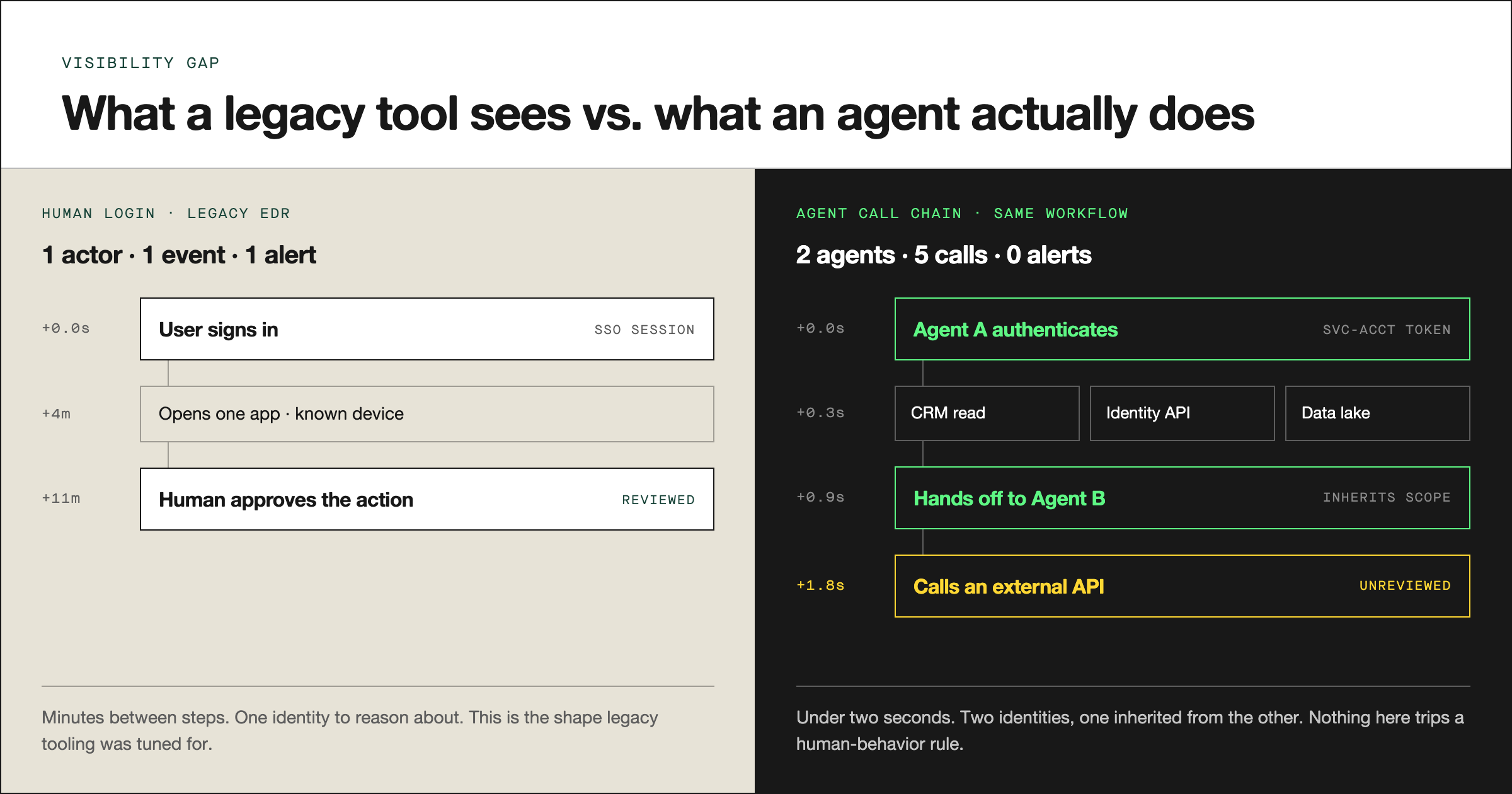
We cover the underlying risk in more depth in our breakdown of agentic AI security risks, which is worth reading first if you haven’t already. The TL;DR version: Legacy tools flag anomalies in human behavior. Agentic AI needs tools built to understand machine-to-machine behavior, at machine speed, across a chain of agents that might touch a dozen systems before a person ever sees an alert.
Five buying criteria for agentic AI security solutions
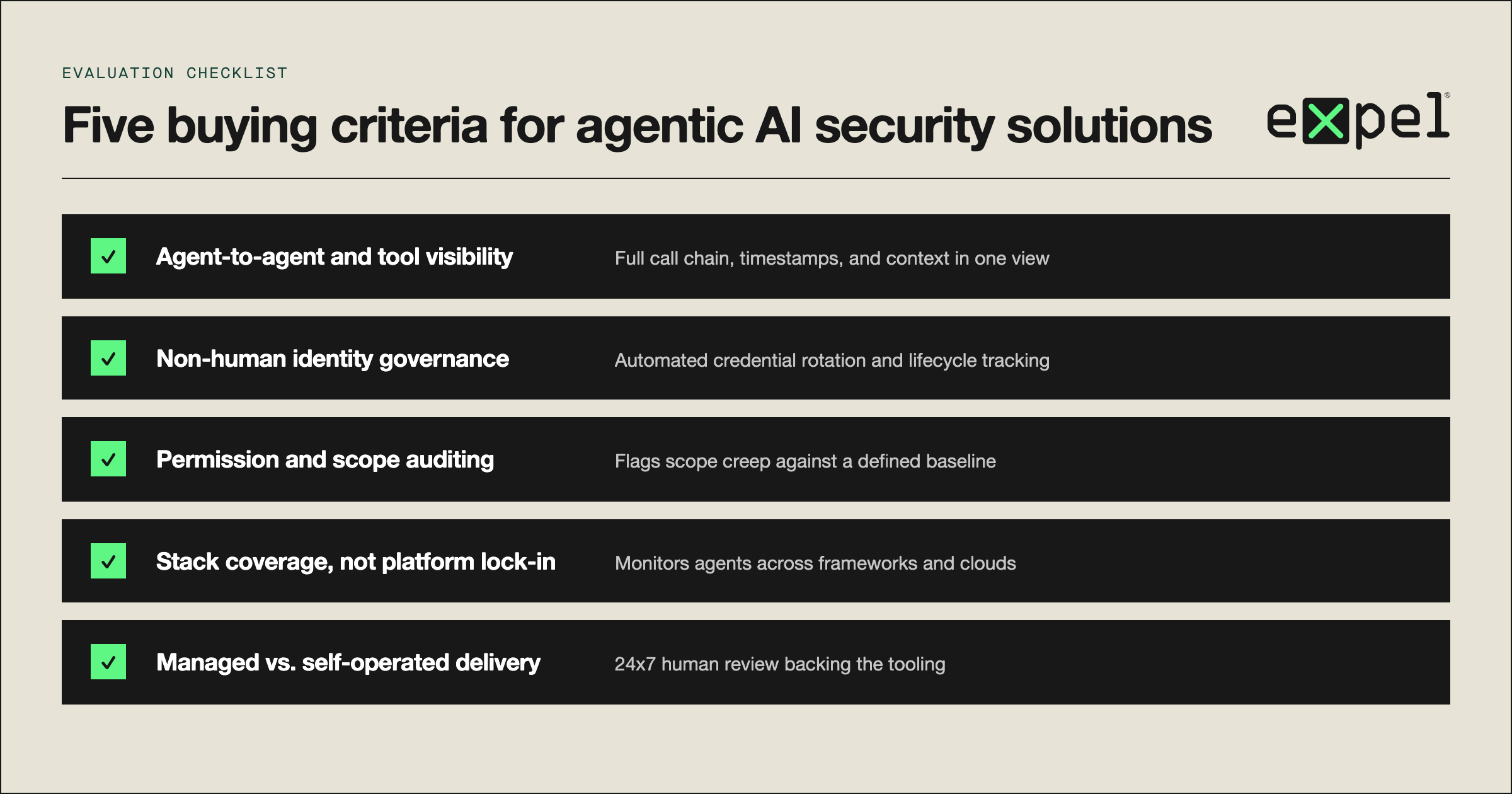
Visibility into agent-to-agent and agent-to-tool calls. Can the tool actually see what an agent is calling, in what order, and why?
Non-human identity governance. Agents need identities, too, including service accounts, API keys, and tokens.
Permission and scope auditing. Agents accumulate permissions the same way employees do: slowly, and rarely with anyone checking whether they still need them.
Coverage across your stack vs. platform lock-in. Some vendors want agents routed through their platform exclusively. Others plug into what you already run. Coverage across your existing stack beats a rebuild.
Managed vs. self-operated delivery. A dashboard full of alerts about agent behavior isn’t a security program if nobody’s watching it 24×7.
| Buying criteria | What good looks like | Red flag |
|---|---|---|
|
Agent-to-agent/tool visibility |
Full call chain, timestamps, and context in one view | Only shows agent identity, not its actions |
|
Non-human identity governance |
Automated credential rotation and lifecycle tracking | Treats service accounts like static, set-and-forget logins |
|
Permission and scope auditing |
Flags scope creep against a defined baseline | Only checks permissions at initial setup |
|
Stack coverage vs. lock-in |
Monitors agents across frameworks and clouds | Requires migrating agents onto their platform |
|
Managed vs. self operated |
24×7 human review backing the tooling | Alerts only, no one accountable for triage |
Ask vendors to show you a real agent-to-agent call chain in their dashboard, how they handle credential rotation for non-human identities, and what happens when an agent’s permissions no longer match its actual behavior.
How Expel approaches agentic AI security
We built our approach to agentic AI security the same way we built Expel Managed Detection and Response (MDR) for everything else in your environment: it’s human-led and AI-powered, with Ruxie, our AI SOC manager, handling repetitive analysis so our analysts can focus on the judgment calls an algorithm shouldn’t make alone.
For agentic AI specifically, that means our analysts look at agent behavior the same way they look at any other identity in your environment—what it’s allowed to do, what it’s actually doing, and whether those two things have started to drift. We’re not asking customers to route their agents through a proprietary platform. Instead, we work across the coverage areas you already have. We also cover the full AI attack surface.
Frequently asked questions
What are agentic AI security solutions?
Agentic AI security solutions are tools and managed services built to monitor, govern, and control autonomous AI agents by tracking their identities, permissions, and actions so a misbehaving or compromised agent gets caught before it causes damage.
Why don’t traditional security tools cover agentic AI well?
They were built to recognize human behavior patterns, not machine-speed decision chains. Agents authenticate constantly through service accounts and call multiple APIs in seconds, none of which trips the alerts legacy tools were tuned for.
What should I look for when evaluating an agentic AI security vendor?
Look for visibility into agent-to-agent and agent-to-tool calls, non-human identity governance, ongoing permission auditing, coverage across your existing tool stack, and clarity on whether you’re buying a tool or a managed service.
Should I choose a managed or self-operated agentic AI security tool?
That depends on whether your team has the capacity to review agent behavior 24×7, and most teams don’t yet, which is why a managed option often makes more sense.
How does Expel approach agentic AI security?
Expel applies its human-led, AI-powered MDR approach to agentic AI specifically, with detections built from real incidents and coverage across a customer’s existing tool stack.