

Agentic AI security risks are the vulnerabilities and attack vectors that emerge when AI systems are given the ability to take autonomous actions—accessing data, calling external tools, executing code, and making decisions without human approval at every step. Unlike traditional software, agentic AI creates a new attack surface where the AI itself can become both the target and the vector of an attack.
Key takeaways
- Agentic AI’s security risks are distinct from traditional software—the AI system itself can be weaponized by attackers to take actions on their behalf
- The six core risks are: prompt injection, excessive agency, MCP supply chain attacks, lateral movement, accountability gaps, and data exfiltration
- Risk scales directly with capability—the more an AI agent can do, the larger the blast radius of a compromise
- Existing cybersecurity frameworks (NIST AI RMF, OWASP LLM Top 10, MITRE ATLAS) are beginning to address agentic AI, but the threat landscape is moving faster than governance
- The mitigation principles aren’t new—least privilege, human oversight, audit logging—but they require deliberate application to AI systems, not just assumption
Why agentic AI creates a new attack surface
Traditional software security focuses on protecting systems from external attackers. Agentic AI security requires a different mental model: the AI system itself can be manipulated into becoming the attacker’s tool.
When an AI agent has access to email, file systems, databases, external APIs, or the ability to execute code, a successful manipulation of that agent doesn’t just affect the AI—it affects everything the AI can reach. An attacker who can redirect an AI agent’s behavior through prompt injection or a compromised tool integration gains access to the AI’s full permission set, often without triggering the security controls designed to catch human attackers.
The scale and speed compound the risk. AI agents operate continuously and can take thousands of actions in the time a human analyst would investigate a single alert. Errors—whether from adversarial manipulation or AI system failure—propagate at machine speed.
The six security risks of agentic AI
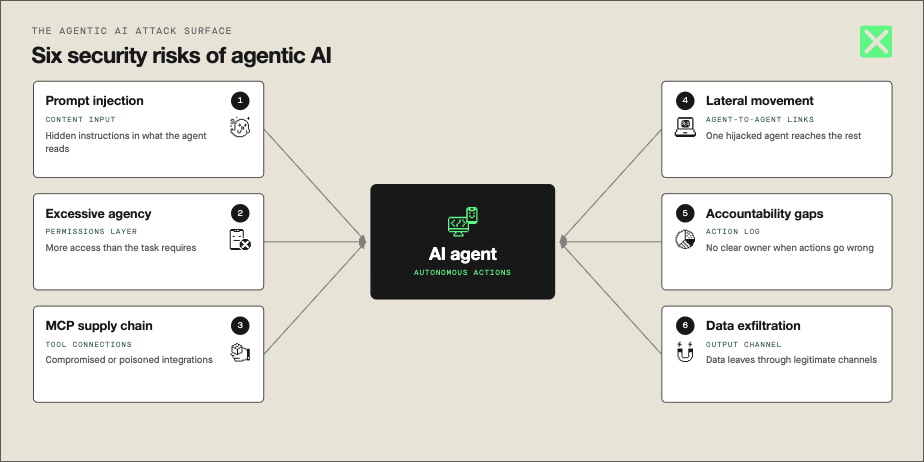
1. Prompt injection
Malicious instructions embedded in content an AI agent processes—emails, documents, web pages, tool outputs—can override the agent’s intended behavior and redirect it to serve the attacker’s goals. Prompt injection is the foundational risk of agentic AI, identified as the #1 vulnerability in the OWASP LLM Top 10, and maps to six of the ten risk categories in OWASP’s 2026 agentic AI security report.
Indirect prompt injection is the highest-risk variant: the attacker never directly interacts with the AI. They simply place malicious instructions somewhere the AI is likely to retrieve them.
2. Excessive agency
An AI agent with more system access, permissions, or capabilities than its task requires creates unnecessary blast radius. If a document-summarization agent has email send permissions, a successful prompt injection can exfiltrate data through the email system. If a code review agent has production deployment permissions, a compromise could push malicious code to production.
Excessive agency is both a design risk and a governance risk. Capability matters less than authorization: has anyone explicitly evaluated whether the AI should have these permissions?
3. MCP supply chain risks
Model Context Protocol (MCP) is a standard that lets AI agents connect to external tools and data sources—search engines, databases, APIs, productivity suites, code execution environments. This connectivity is what makes agentic AI useful at scale. It’s also a meaningful and underappreciated attack surface.
A malicious or compromised MCP server can feed poisoned content to AI agents, inject instructions into tool outputs, exfiltrate data through API calls that look legitimate, or execute code in the AI’s environment. OWASP’s 2026 agentic security report documented the first malicious MCP server caught in the wild: a package that shipped 15 clean versions to build trust and legitimacy before quietly adding a single line of exfiltration code on the 16th update.
The supply chain risk extends beyond MCP servers themselves. Tool outputs—the content that external tools return to the AI—are an indirect prompt injection surface. An attacker who can influence what a tool returns to an AI agent can redirect the agent’s behavior without ever touching the AI system directly.
Security teams that apply software composition analysis to code dependencies need to extend equivalent discipline to AI tool integrations: inventory every MCP connection, vet the source and update cadence, and monitor tool outputs for anomalous content.
4. Lateral movement
In multi-agent systems—where multiple specialized AI agents work in coordination—a compromised agent doesn’t stay isolated. Agents share memory, pass instructions to each other, and operate through orchestration layers that coordinate their work. A compromised agent can exploit these trust relationships to pass malicious instructions to other agents, access systems beyond its own permission boundary, escalate privilege through the agent network, or poison shared memory that other agents read.
Lateral movement in AI systems follows the same logic as lateral movement in traditional networks: compromise one node, use it to reach others. But several properties of AI agents make containment harder than in traditional environments. Agents communicate in natural language rather than structured protocols, making malicious inter-agent instructions harder to detect. They operate continuously and at speed. And the trust relationships between agents are often implicit—agents are designed to follow instructions from orchestrators without validating their source.
Containing lateral movement in multi-agent systems requires explicit trust boundaries between agents, monitoring of inter-agent communication, and isolation of agent permissions from shared systems.
5. Accountability and auditability gaps
When an AI agent takes an action autonomously—sends an email, modifies a file, calls an external API, executes a transaction—who is responsible? If that action was triggered by prompt injection rather than a legitimate instruction, the accountability chain becomes genuinely complex: the user didn’t authorize the action, the AI acted on manipulated inputs, and the organization may still be legally liable for the outcome.
This is the AI principal-agent problem applied to security: the AI acts as an agent on behalf of a principal (the user or organization), but when the AI is compromised or misdirected, the principal bears the consequences without having authorized the action.
Accountability gaps compound when agentic AI operates at scale. An agent that sends 10,000 emails, modifies 500 records, or makes 200 API calls before a problem is detected creates an investigation challenge that manual audit trails weren’t designed to handle. Regulators are beginning to respond: DORA requires four-hour incident notification, NIS2 requires 24-hour early warning, and the EU AI Act establishes human oversight requirements specifically for high-risk AI applications.
Without comprehensive audit logging—every action, its triggering input, its reasoning, its confidence level, its outcome—organizations can’t investigate anomalous AI behavior, demonstrate regulatory compliance, or establish accountability when AI-driven actions cause harm.
6. Data exfiltration
AI agents with broad data access—email, documents, databases, code repositories—create concentrated exfiltration risk. An attacker who successfully manipulates an agent can use it to aggregate sensitive data and exfiltrate it through the agent’s legitimate communication channels, making the exfiltration harder to distinguish from normal AI activity.
The “lethal trifecta” identified by security researcher Simon Willison describes the highest-risk combination: an AI agent with access to private data, exposure to untrusted external content, and the ability to communicate externally. Any agent combining all three requires particularly careful controls.
Assessing and governing agentic AI risk
What’s distinct to organizational risk governance is the decision framework applied before and during deployment:
Before deployment—five questions every agentic AI deployment needs answers to:
- What data can this agent access, and is that scope limited to what the task actually requires?
- What actions can it take autonomously, and which require human authorization?
- What happens if it’s compromised or misdirected—what’s the worst-case blast radius?
- Who is accountable for its decisions and actions, including edge cases and failures?
- How will you know if something goes wrong—what monitoring exists and who reviews it?
If an organization can’t answer all five before deployment, the deployment isn’t ready.
Ongoing governance: The mitigation table below maps each risk to the governance-level control that limits its blast radius—not the technical implementation detail, but the organizational decision that needs to be made.
| Risk | Primary mitigation | Secondary mitigation |
|---|---|---|
|
Prompt injection |
Input validation, output filtering | Human approval gates for high-impact actions |
|
Excessive agency |
Least-privilege permissions for AI agents | Regular permission audits as agent scope evolves |
|
MCP supply chain |
Vet and inventory all MCP integrations | Monitor tool outputs for anomalous content |
|
Lateral movement |
Isolate agent permissions from shared systems | Monitor inter-agent communication patterns |
|
Accountability gaps |
Comprehensive audit logging of all AI actions | Define human accountability before deployment |
|
Data exfiltration |
Restrict data access to task-minimum | Monitor outbound AI communications |
Governance frameworks for agentic AI
Four frameworks are most relevant for organizations building agentic AI security programs. Three overlap with Q17’s coverage of LLM security frameworks—the key addition here is how each is specifically evolving to address agentic AI beyond general LLM risk.
OWASP LLM Top 10 identifies prompt injection as the number one risk for large language model applications. It provides a structured catalog of LLM-specific attack vectors and mitigation guidance—the most accessible starting point for security teams assessing AI risk.
NIST AI Risk Management Framework (AI RMF) addresses AI-specific risks including adversarial manipulation, covering how AI systems can be deliberately subverted and how organizations should structure AI risk management programs.
MITRE Adversarial Threat Landscape for Artificial-Intelligence Systems (ATLAS) catalogs adversary tactics and techniques against AI systems, mapped to the familiar ATT&CK framework structure. For security teams with ATT&CK expertise, ATLAS provides the most actionable bridge to AI-specific threat modeling.
EU AI Act is the framework most distinct from Q17’s coverage and most relevant to Q18’s accountability theme. It establishes risk-based requirements for AI systems deployed in EU markets, with the highest obligations—mandatory human oversight, transparency requirements, conformity assessments—applied to high-risk AI applications. Agentic AI systems involved in consequential decisions may fall under high-risk classification regardless of whether the organization is EU-based, if EU individuals are affected. The Act’s human oversight requirements for high-risk AI directly address the accountability and auditability gaps in Risk 5.
Expel’s take
At Expel, we build and operate agentic AI in one of the highest-stakes environments possible: security operations. That means we think about these risks from the inside. The principles we apply to our own agentic deployments are the same ones we’d recommend to any organization: don’t give AI agents authority they haven’t demonstrated they can handle responsibly, keep humans in the loop for actions that matter, and treat every AI deployment as a privileged system that needs the same security discipline as any other privileged access. The Trust vs. Impact Matrix is how we operationalize that thinking—calibrating AI autonomy based on reliability and blast radius rather than trusting capability claims at face value.
Frequently asked questions
What are agentic AI security challenges?
Agentic AI security challenges are the same risks covered under agentic AI security risks—unpredictable decision-making, excessive permissions, and the chance that an AI agent takes a harmful action before a human ever reviews it. Security teams search both terms when researching how to secure autonomous AI agents, so think of “challenges” as the plain-language version of “risks,” not a separate problem.
What are the top security vulnerabilities of agentic AI systems?
The top vulnerabilities include: prompt injection (malicious instructions in processed content), excessive agency (AI with too much system access), MCP supply chain risks (compromised tool integrations), data exfiltration through AI agents, lateral movement in multi-agent systems, and accountability gaps when AI acts without human authorization.
What is MCP and why does it create security risks?
Model Context Protocol (MCP) is a standard for connecting AI agents to external tools and data sources. While enabling powerful agentic capabilities, MCP creates security risks including supply chain attacks through malicious MCP servers, data exposure through poorly configured integrations, and expanded attack surfaces for prompt injection via tool outputs.
How do you mitigate security risks in agentic AI deployments?
Key mitigations include: applying least-privilege principles to AI agent permissions, implementing human approval gates for high-impact actions, monitoring AI agent outputs for anomalous behavior, red-team testing AI deployments for prompt injection, maintaining audit logs of all AI actions, and using AI trust frameworks to evaluate deployment decisions.
What cybersecurity frameworks apply to agentic AI?
Relevant frameworks include the NIST AI Risk Management Framework (AI RMF) for governance, OWASP LLM Top 10 for application-level risks, MITRE ATLAS for adversary tactics against AI systems, and the EU AI Act for regulatory compliance. These frameworks are beginning to address agentic AI specifically.
How should organizations assess risk before deploying agentic AI?
Organizations should assess: what data the AI agent can access, what actions it can take autonomously, what happens if it is compromised or misdirected, who is accountable for its decisions, how its behavior is monitored, and whether the risk reduction from automation justifies the new attack surface created.