

Agentic AI refers to AI systems that can autonomously pursue goals, take sequences of actions, and adapt their approach based on feedback, without requiring human direction at each step. In cybersecurity, agentic AI moves beyond AI used to assist humans like a co-pilot toward systems that can independently investigate, decide, and execute responses. It represents a significant capability leap and a significant governance challenge.
Key takeaways
- Agentic AI goes beyond pattern recognition—it can plan, take actions, use tools, and execute multi-step workflows autonomously to accomplish a defined goal
- In security operations, agentic AI handles investigation tasks that previously required analyst time: gathering context, querying tools, correlating findings, and drafting response recommendations
- The governance question isn’t whether to use agentic AI—it’s where to put the human approval gates, and which decisions require them
- Agentic AI works best on well-defined, repeatable tasks with clear success criteria; novel threats and high-stakes decisions still require human judgment
- Production-ready agentic AI in security today means investigation automation and enrichment—not fully autonomous response for high-impact decisions
| Term | Definition |
|---|---|
|
Agentic AI |
An AI system that autonomously pursues goals by planning, executing multi-step actions, and adapting based on outcomes—without requiring human direction at each step. |
|
AI agent |
A single autonomous AI component that perceives its environment, makes decisions, and takes actions using available tools to accomplish a defined objective. |
|
Multi-agent system |
An architecture where multiple specialized AI agents work in coordination—each handling a distinct task (e.g., threat intel lookup, endpoint forensics, response execution)—to accomplish complex objectives no single agent handles alone. |
|
Model context protocol (MCP) |
An open standard that allows AI agents to connect with and take actions in external tools and data sources. In security contexts, MCP integrations expand what agents can access and do—and introduce new attack surface if not properly controlled. |
Autonomous vs. assistive AI: the key distinction
Most AI in security today is assistive: it processes data, surfaces insights, scores alerts, and makes recommendations—but a human takes every consequential action. An AI system that flags a suspicious login is assistive. A human analyst decides what to do about it.
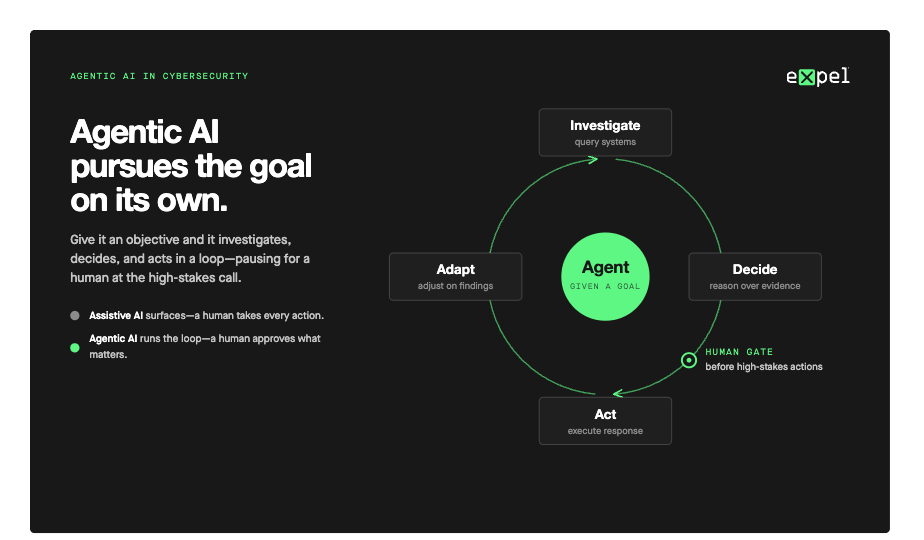
Agentic AI shifts this relationship. Rather than surfacing information for human decision-making, agentic systems are given a goal and pursue it by executing tasks to achieve the goal autonomously—investigate, gather additional context, make decisions, and take actions across multiple steps without waiting for human direction at each one.
The practical difference is significant. An assistive AI might surface a suspicious authentication alert and provide enrichment context. An agentic AI might receive the same alert, then autonomously query identity systems for account history, check endpoint telemetry for related process activity, cross-reference threat intelligence, determine the alert represents a genuine threat, and initiate an account suspension, all without human involvement.
Key characteristics of agentic AI systems
Goal-directed: Agentic AI systems are given objectives rather than explicit step-by-step instructions. They determine how to achieve the goal based on available information and tools.
Adaptive: Agentic systems adjust their approach based on what they discover. An agentic security AI investigating a potential compromise doesn’t follow a fixed script. It follows the evidence, asking new questions based on what each investigation step reveals.
Tool use: Agentic AI interacts with external systems by querying APIs, reading and writing data, executing actions to accomplish its goals. In security contexts, this might mean querying SIEM, running EDR commands, or triggering response actions.
Multi-step reasoning: Rather than making single decisions, agentic AI reasons through multi-step sequences—planning an investigation, executing steps, interpreting results, and adjusting course.
Multi-agent systems: Complex agentic AI deployments may involve multiple specialized agents working in coordination, where one agent handles threat intelligence lookups while another manages endpoint forensics and a third coordinates response actions.
How agentic AI differs from traditional AI methods
Traditional AI methods typically look for patterns and assess probabilistic confidence to detect and alert. Agentic AI can take this a step further to detect, investigate, decide, and act. This fundamentally can change the role AI plays in the security operations workflow.
The risk profile also differs. Traditional AI methods may generate alerts that humans must review before any action is taken, so the risk of an incorrect AI decision is validated by human reviews. Agentic AI takes action directly—incorrect decisions may execute before human review unless specific oversight mechanisms are in place.
Traditional AI detects threats and generates alerts for human review; agentic AI can investigate, decide, and act across multiple steps with minimal human direction. For a detailed comparison, see this page.
Agentic AI use cases in cybersecurity
Here are some ways that agentic AI is currently being used in cybersecurity:
Automated alert investigation: Agentic AI can autonomously gather the evidence needed to determine whether an alert represents a genuine threat by querying multiple systems, correlating findings, and producing a complete investigation summary without analyst involvement.
Adaptive incident response: Rather than following fixed response playbooks, agentic AI can adapt containment and remediation strategies based on what it discovers during investigation by adjusting scope as evidence of attacker activity expands.
Detection rule creation: Agentic AI can analyze threats and automatically identify missing coverage gaps in your detection rules based on threats, then use this information to propose new detections to add, or enhance/tune existing detections.
Vulnerability management: Agentic AI can autonomously prioritize vulnerabilities, determine remediation approaches, and in some cases execute patches or configuration changes by moving from discovery to remediation without human direction at each step.
Autonomous threat hunting: Agentic AI can proactively hunt for attacker activity by autonomously formulating and testing hypotheses.
Human oversight remains essential
The governance challenge of agentic AI in cybersecurity is significant. Systems that can take autonomous actions—suspending accounts, blocking network traffic, isolating endpoints—can cause significant operational disruption if they act incorrectly. A false positive that triggers account suspension mid-business process is a very different consequence than a false positive that generates an alert for a human to dismiss.
Effective agentic AI deployment requires clearly defined action boundaries (which actions can be taken autonomously and which require human approval), robust logging and auditability (every autonomous action should be recorded with reasoning), override mechanisms (humans must be able to quickly review and reverse autonomous actions), and graduated autonomy (starting with lower-risk autonomous actions and expanding scope as confidence in the system increases).
The most effective model isn’t maximum autonomy. It’s calibrated autonomy, where AI operates independently in well-defined scenarios and escalates to human judgment at appropriate decision points.
Agentic AI in MDR contexts
MDR providers are beginning to integrate agentic AI into their operations—using autonomous investigation agents to handle routine alert investigation, gather forensic evidence, and produce investigation summaries that analysts review rather than build from scratch. This allows MDR analyst teams to handle higher investigation volumes without proportional headcount growth.
The key distinction in responsible MDR agentic AI deployment is that autonomous agents accelerate and inform human decisions rather than replace them at high-stakes decision points. Agentic AI investigates; human analysts validate the threat and make decisions for how critical threats should be handled, such as authorizing response actions.
Expel’s take
Agentic AI is the most significant operational shift in security in years—not because it’s smarter than previous AI, but because it acts. An AI that can query an endpoint, pull identity context, check threat intelligence, and return a structured investigation summary has replaced a meaningful chunk of analyst work on routine cases. That’s what changes the economics of security operations, and it’s what’s behind our 13-minute mean time to respond (MTTR).
The part that requires real discipline is scope. Agentic AI that’s well-scoped—clear inputs, defined actions, logged outputs, human approval on consequential decisions—is powerful and safe to run at scale. Agentic AI without those guardrails is how you get fast, confident mistakes. We’re deliberate about where our agentic automation operates autonomously and where it stages a decision for human review. That boundary isn’t static; it moves as we build confidence in specific action types. But it always exists.
Frequently asked questions
What is agentic AI in cybersecurity?
Agentic AI in cybersecurity refers to autonomous AI systems that can independently plan, decide, and take multi-step actions to achieve security objectives. Unlike traditional AI that detects threats and alerts human analysts, agentic AI can investigate incidents, correlate evidence across tools, execute containment actions, and adapt its approach based on outcomes.
What are the top use cases for agentic AI in cybersecurity?
Top agentic AI use cases include autonomous alert triage and prioritization, automated investigation enrichment (correlating identity, endpoint, and cloud signals), adaptive threat response, vulnerability remediation prioritization, and proactive threat hunting support—all while keeping human analysts in control of high-impact decisions.
How does agentic AI differ from traditional security tools?
Traditional AI detects threats and generates alerts for human review. Agentic AI goes further—it autonomously investigates, correlates evidence, and executes containment actions with minimal human intervention. Both require human oversight but operate at fundamentally different levels of autonomy. For a detailed side-by-side comparison, see Q9.
What are the security risks of agentic AI?
Agentic AI introduces new security risks including prompt injection attacks that manipulate agent behavior, error propagation at machine speed, accountability gaps when agents act autonomously, and new attack surfaces through MCP and tool integrations. For the complete risk taxonomy, see Q18: Agentic AI Security Risks.
Is agentic AI replacing human security analysts?
No. The most effective agentic AI systems augment human analysts rather than replacing them—handling high-volume, routine investigation tasks while humans apply business context, judgment, and strategic decision-making.