

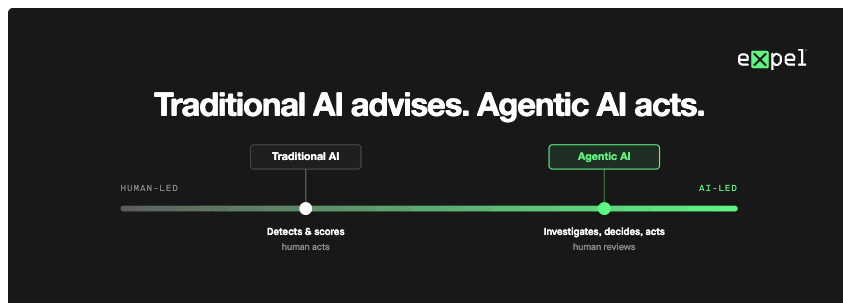
Traditional AI in cybersecurity detects threats and generates alerts for human review. Agentic AI goes further—it autonomously investigates, correlates evidence across tools, executes containment actions, and adapts its approach based on outcomes. These are not competing models but a spectrum of AI autonomy, each suited to different security operations contexts.”
Key takeaways
- Traditional AI in security recognizes patterns and scores risk; agentic AI takes action—it can query tools, execute investigation steps, and make decisions to accomplish a goal
- The gap between them isn’t just technical capability; it’s operational impact—agentic AI changes analyst roles, not just analyst workloads
- Human-in-the-loop and human-on-the-loop aren’t interchangeable governance models; which one you use should depend on the reversibility and stakes of the action, not convenience
- What’s production-ready today: investigation automation, enrichment, alert triage, and low-risk containment. What isn’t: fully autonomous response for high-stakes decisions
- The autonomy spectrum matters for vendor evaluation—”agentic AI” covers everything from guided investigation assistance to fully autonomous action, and those are very different things
What traditional AI does in security operations
In a security workflow, traditional AI use cases detect threats and generate alerts for human review. Agentic AI goes further: it autonomously plans what questions or facts it needs to gather, investigates, correlates evidence, executes containment actions, and adapts its approach based on what it discovers—all with minimal human intervention at each step. The distinction matters because it changes not just how fast security operations run, but who is accountable for the decisions being made.
Traditional AI in security—the kind most organizations are deploying today—operates as an intelligent assistant to human analysts, like a co-pilot. It looks for patterns and assesses probabilistic confidence to detect and alert, scores threats, and surfaces findings. But at every meaningful decision point, a human takes over.
A traditional AI system might analyze network traffic and flag a suspicious connection. It might score an authentication alert as high-risk based on behavioral patterns. It might enrich an endpoint alert with relevant threat intelligence. In every case, the AI’s output is an input to human decision-making, not a decision itself.
This is a deliberate design choice, not a capability limitation. Traditional AI in security is built to compress the time and effort required for human analysis, while keeping humans accountable for consequential actions.
What agentic AI adds
Agentic AI is designed to pursue goals rather than answer questions. Given an objective (like investigate this suspicious alert, contain this compromised account, hunt for evidence of lateral movement) an agentic system determines the sequence of steps needed, executes them across multiple tools and data sources, interprets the results, adjusts its approach based on what it finds, and produces an outcome.
The critical difference from traditional AI is autonomous action across multiple steps. Traditional AI generates one output (an alert, a score, an enrichment) and waits. Agentic AI generates a sequence of outputs, each building on the previous, without human direction at each step.
In a security context, an agentic investigation agent might: receive a suspicious authentication alert, query identity systems for account history, examine endpoint telemetry for related process activity, cross-reference threat intelligence for matching indicators, determine that the activity represents a genuine compromise, draft a detailed investigation summary, and initiate an account suspension, all without analyst involvement until the summary arrives for review.
The autonomy spectrum in security AI
Not all AI in security operates the same way. Rather than a binary between “human does everything” and “AI does everything,” security AI exists on a spectrum—and most organizations operate across multiple levels simultaneously.
Assisted AI. The AI processes data and surfaces findings; a human takes every consequential action. Example: an ML model scores an authentication alert as high-risk based on behavioral anomalies and routes it to an analyst queue for investigation.
Semi-autonomous AI. The AI investigates, enriches, and recommends—but a human approves before action is taken. Example: an agentic AI queries identity systems, pulls related endpoint telemetry, cross-references threat intelligence, and drafts a containment recommendation. The analyst reviews the completed investigation and approves or rejects the proposed response.
Autonomous AI. The AI acts independently on defined, high-confidence threat classes, with human audit review after the fact rather than approval before. Example: confirmed credential theft triggers automatic account suspension and session revocation—with full logging of the action and reasoning for post-hoc review.
Most mature security programs use all three levels, calibrated by threat type and confidence threshold. The governance mistake is applying the same autonomy level across the board—either leaving AI in assisted mode where autonomous action is clearly warranted, or deploying autonomous AI in scenarios where the confidence threshold hasn’t been earned.
| Dimension | Traditional AI | Agentic AI |
|---|---|---|
|
Autonomy |
Generates outputs for humans to act on | Takes sequences of actions to achieve defined goals; decision-making shifts from human to AI for routine scenarios |
|
Adaptability |
Applies trained models to incoming data based on learned patterns | Adjusts approach in real time based on what it discovers, following evidence rather than executing a fixed process |
|
Tool use |
Operates within a single analytical context | Actively uses external tools—querying APIs, reading and writing data across systems, triggering actions—to accomplish multi-step goals |
|
Scope |
Addresses individual decisions (is this alert malicious?) | Addresses complete workflows (investigate this alert end-to-end and produce a determination) |
|
Accountability |
Surfaces findings; humans are accountable for consequential decisions | Takes actions; accountability for those actions—and for the governance model that authorized them—becomes a more complex question |
Where agentic AI outperforms traditional AI
High-volume routine investigation: For alert types with predictable investigation patterns, agentic AI can execute the full workflow faster and more consistently than analyst-by-analyst manual investigation. Investigations that take an analyst 20 minutes can be completed autonomously in seconds.
Multi-step evidence gathering: Agentic AI can query multiple systems, correlate findings across data sources, and produce comprehensive investigation summaries without the context-switching overhead that slows human analysts doing the same work.
Speed-critical response: In scenarios where response time directly affects security outcomes (rapidly spreading ransomware, active account takeover, real-time data exfiltration) , agentic AI’s ability to act in seconds rather than minutes has direct operational value.
Scale without headcount: Agentic AI can run many investigations simultaneously, addressing scale challenges that would otherwise require proportional analyst headcount growth.
Where traditional AI remains the right choice
Novel threat scenarios: Agentic AI performs reliably within the scope of scenarios it was designed and trained for. Novel attack techniques, unusual environmental conditions, and edge cases that fall outside that scope are handled better by human analysts—with traditional AI providing support—than by agentic systems operating beyond their competence boundaries.
High-stakes decisions with limited reversibility: Actions that are difficult or impossible to reverse (deleting data, making architectural changes, issuing public communications) should retain human decision authority regardless of AI capability. This is where a human-led, AI-powered approach is critical, ensuring the AI surfaces the context while the analyst pulls the trigger.
Business context decisions: Whether a specific activity is malicious often depends on organizational context that agentic AI doesn’t have access to. A finance team processing large transactions during month-end close looks anomalous to an AI that doesn’t know the business calendar.
Regulatory and accountability requirements: Some industries and jurisdictions impose accountability requirements that agentic AI autonomous action complicates, particularly for decisions affecting individuals (account suspension, access revocation).
Human-in-the-loop vs. human-on-the-loop
As agentic AI takes on more active roles in security, the governance question shifts from “should AI act?” to “how much human oversight is required before it does?“
Human-in-the-loop means human approval is required before each consequential action. The AI investigates and recommends; nothing executes until a human confirms. Maximum control, full accountability, slower response. This is the right model for high-impact or hard-to-reverse actions—disabling a privileged account, isolating a production system—where the cost of a false positive justifies the latency.
Human-on-the-loop means the AI acts autonomously while humans monitor and can intervene. Actions happen at machine speed; humans audit in near-real time and retain override capability. Faster, but requires significantly higher trust in the AI’s accuracy and a governance model that defines what autonomous action is permitted. Appropriate for narrowly scoped, high-confidence, reversible actions—session revocation on confirmed credential theft, blocking a known-malicious IP—where delay has real cost and false positive risk is demonstrably low.
Getting this wrong cuts both ways. Human-in-the-loop applied too broadly creates bottlenecks that negate the speed benefit of agentic AI. Human-on-the-loop applied too broadly exposes the org to automated errors at scale before anyone catches them.
The practical guideline: default to human-in-the-loop and move toward human-on-the-loop only when an action type has demonstrated reliability, is scoped narrowly, is reversible, and has full audit logging in place. High-impact security actions should remain human-in-the-loop.
The governance implications of the shift
The shift from assistive to agentic AI isn’t just a capability change, it’s a governance change. When AI takes actions rather than making recommendations, the accountability framework for those actions requires explicit design.
Responsible agentic AI deployment requires defined action boundaries (what can the AI do autonomously, and what requires human approval?), complete auditability (every autonomous action logged with reasoning), override mechanisms (humans can quickly review and reverse AI actions), and graduated autonomy (start with low-risk, reversible actions; expand scope as reliability is demonstrated).
Organizations evaluating agentic AI security capabilities should ask vendors specifically about these governance mechanisms, not just what the AI can do autonomously, but what safeguards ensure it does so reliably and accountably.
AI in security operations: What’s production-ready today
Not all agentic AI security capabilities are at the same maturity level. Deploying the right capabilities at the right stage avoids both under-investment and premature automation of decisions that AI isn’t reliable enough to own.
Production-ready: investigation automation, enrichment, and alert triage. Autonomous evidence gathering, alert enrichment, behavioral correlation, and investigation summarization are mature and widely deployed. AI that ingests an alert, queries relevant systems, correlates signals, and hands an analyst a completed investigation summary—rather than a raw alert—is delivering real value in production environments today with well-understood reliability.
Emerging: autonomous response with human approval gates. Agentic AI that recommends and stages containment actions for human approval is moving into production at leading MDR providers and security platforms. The human-on-the-loop model for reversible, scoped response actions—session revocation, account suspension on confirmed credential theft—is viable where confidence thresholds are well-calibrated and audit logging is in place. Expect this to become standard practice over the next 1–2 years.
Aspirational: fully autonomous response for high-stakes decisions. AI that independently makes and executes high-impact, difficult-to-reverse response decisions—without human review at any point—remains premature given current model reliability. Hallucination risk, adversarial evasion, and the accountability gaps of fully autonomous action make this inappropriate for most organizations today, regardless of vendor claims to the contrary.
Expel’s take
Traditional AI told us something was wrong. Agentic AI goes and figures out what’s wrong. That’s the shift—and it’s meaningful. When agentic AI can pull endpoint telemetry, query identity context, check threat intel, and return a structured investigation summary, analysts spend their time on judgment rather than data collection. That’s what changes response times at scale.
But agentic AI requires a level of architectural discipline that traditional AI didn’t. When AI is only scoring alerts, a bad score costs you analyst time. When AI is taking actions—querying systems, isolating endpoints, suspending accounts—a bad decision has operational consequences. The governance model has to match the action type. At Expel, we’re deliberate about which agentic actions run autonomously, which stage for human approval, and how every action gets logged. That discipline is what makes agentic AI safe to run at the speed and volume security operations require.
Frequently asked questions
What is the main difference between agentic AI and traditional AI in cybersecurity?
Traditional AI detects threats and generates alerts for human review. Agentic AI is goal-directed—it can autonomously investigate threats, correlate evidence across multiple tools, execute containment actions, and adapt its approach based on outcomes. The key difference is autonomy: traditional AI alerts, agentic AI acts.
What are the autonomy levels of AI in security operations?
Security AI operates across a spectrum: Assisted AI (processes data, surfaces alerts for human review), Semi-autonomous AI (investigates, enriches, and recommends actions for human approval), and Autonomous AI (acts independently on defined classes of threats). Most production deployments today operate at the first two levels.
What is the difference between human-in-the-loop and human-on-the-loop AI?
Human-in-the-loop requires human approval before each AI action executes—maximum control, slower response. Human-on-the-loop allows AI to act autonomously while humans monitor and can intervene—faster response, requires higher trust and robust failure monitoring. High-impact security actions should remain human-in-the-loop.
Is agentic AI safe to deploy in security operations today?
Agentic AI can be deployed safely with proper governance: least-privilege access controls limiting agent capabilities, human approval gates for high-impact actions, output monitoring for anomalous behavior, audit logging of all AI actions, and regular red-team testing. Unsafe deployments skip these controls.
How do traditional AI and agentic AI complement each other in MDR?
In MDR services, traditional AI handles continuous high-volume detection and alert prioritization while agentic AI handles investigation enrichment and adaptive response—working together across the threat lifecycle with human analysts retaining decision authority for complex and high-impact actions.