
TL;DR
- Expel MDR coverage for Claude Chat is now generally available to all Expel MDR customers.
- Coverage is now in early access for Claude Code and Cowork. We pair session data with endpoint telemetry, so customers get two independent records of the same session.
- Our free Expel AI Risk Framework sorts AI security risk into 10 domains, so security leaders can see where AI risk exists and report business impact to the board.
When an AI agent logs work on an employee’s laptop, the hardest question to answer is if the employee meant for it to happen.
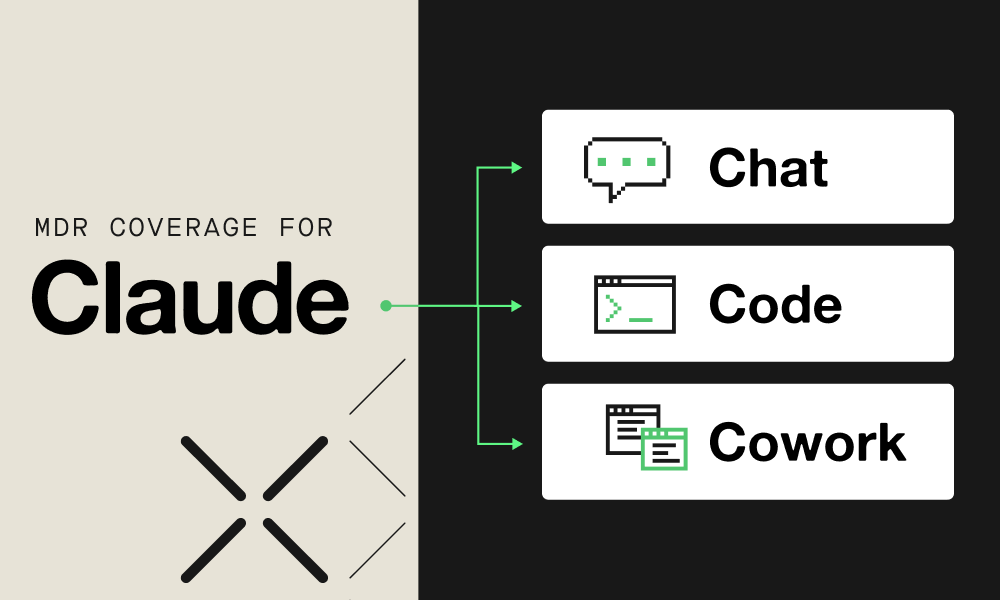
That question is why we built coverage for Anthropic’s Claude the way we did. Today, Claude Chat coverage is generally available to all Expel Managed Detection and Response (MDR) customers. Coverage for Claude Code and Claude Cowork is in early access.
It builds on our August launch of MDR coverage for the full AI attack surface, and it means we now monitor how customers use Claude and correlate that activity with their identity, SaaS, and endpoint signals.
AI adoption is outpacing the programs meant to secure it
Teams are adding AI to their workflows faster than security can keep up. In Boston Consulting Group’s (BCG) Cybersecurity Spending and AI Threat Trends for 2026 report, only 41% of surveyed cybersecurity leaders said they have formal AI governance policies. Only 23% have applied monitoring or logging to AI agents.
The tools also change faster than most internal teams can build expertise on them. Few organizations have the budget or headcount to stand up a dedicated AI security program, and AI risk touches so many teams that ownership is murky at best.
We cover AI the way we cover identity, SaaS, and endpoint: we investigate every alert representing risk for your org, and customers get clear answers they can act on without adding headcount.
Claude Chat is generally available
Chat coverage watches three things:
- Administrative activity
- User activity
- Prompt content
We look for data exfiltration through conversations, memory poisoning, credential exposure, and use of unsanctioned tools.
Ruxie, our AI SOC manager, checks each action against the user’s identity and endpoint activity. That tells our analysts whether an action came from the real user. The analysts make the call from there.
Claude Code and Cowork are early access right now
Agents run commands, touch files, and use whatever credentials the user has, so we pair Claude Code and Claude Cowork session data with endpoint telemetry. That gives customers two independent records of the same session, and then we compare them.
We run the same detections on both products, including:
- Suspicious file execution and upload
- Recursive credential search
- Reverse shell activity
Justin Bajko, Expel’s Chief Strategy Officer and co-founder, explains why the pairing matters: “When an AI agent runs on an employee’s laptop with their credentials, the hardest question in an investigation is whether the employee meant for it to happen. Answering it takes comparing the agent’s session record and the endpoint’s record side by side. Most organizations already have the endpoint half, and we connect the two so their security teams get an answer they can act on, based on the relevant context.”
A free framework for scoping AI risk
Monitoring is only half of the job—security leaders also need to see where AI risk sits in their organization. For that, we released the Expel AI Risk Framework, a free resource built by James Shank, our Director of Applied Threat Research. It sorts AI security risk into 10 domains, shows who needs to do what, and helps leaders report business impact to the board.
It’s structured to help security leaders identify, organize, and assign ownership of the risks your organization takes on when building with AI. AI risk management frameworks govern the process, but this framework is designed specifically to point to where risk surfaces in a real environment—yours.
The framework is free, and Claude coverage is available now.