

SOC modernization is the staged work of moving a security operations center from measuring alert throughput to measuring decision quality. It’s sequenced: fix telemetry quality and identity correlation first, automate context assembly second, and change what you measure last.
Key takeaways
- SOC modernization is a sequence, not a shopping list. Order matters more than tools.
- Fix telemetry quality and identity correlation first. AI triage is only as good as the data feeding it.
- Adding AI to poor data produces confident wrong answers faster.
- Tie your timeline to capability, not to calendar quarters.
- Modernizing doesn’t mean replacing your SIEM. That’s rarely the first move.
- Tuning is now a standing discipline, not a cleanup project.
Most SOCs don’t have a tooling problem. They have a sequencing problem. Teams buy AI first, then discover their telemetry is patchy and their identity data doesn’t line up across tools. This guide covers what to fix first, in what order, and how long it realistically takes. It’s one of several guides in our cybersecurity glossary. If you’re deciding how much AI to add, read AI SOC vs. autonomous SOC vs. AI-augmented SOC alongside this one.
What should you fix before adding AI to your SOC?
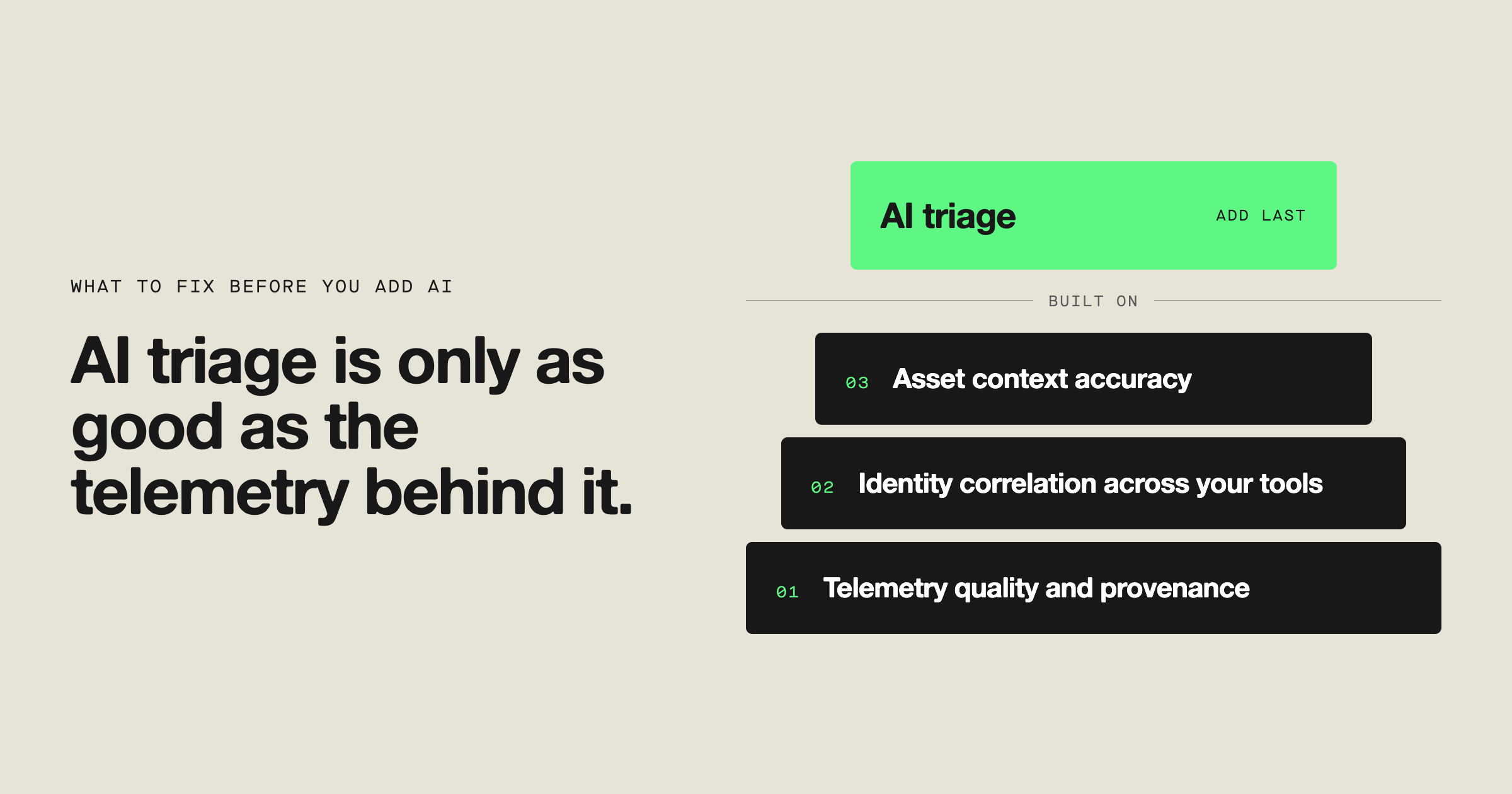
Three things, in this order:
- Telemetry quality and provenance. Know what data you collect, where it comes from, and whether it’s complete. Gaps here become blind spots later.
- Identity correlation across your tools. The same person shows up under different names in your EDR, email, and cloud logs. Tie them together.
- Asset context accuracy. Know which systems matter most and who owns them.
AI triage is only as good as the telemetry behind it. Skip these three and you’ll get confident answers built on weak foundations.
What does a realistic SOC modernization sequence look like?
Phase it by capability, not by quarter.
| Phase | What you do | You’re ready to move on when |
|---|---|---|
|
1. Fix the data |
Clean up telemetry quality and identity correlation | You can trace one user across every tool |
|
2. Automate context |
Assemble identity, asset, and prior decision context automatically | Analysts stop spending their time tab-switching |
|
3. Change the metrics |
Move from alerts closed to decision quality | The first two phases are real, not planned |
Metric changes come last because they need the first two phases to be true. Measuring decision quality on bad data just gives you a precise wrong answer.
How long does SOC modernization take?
Tie the timeline to capability, not the calendar. Telemetry and identity work typically runs a quarter or more, depending on how many tools you have. Context automation follows. Metric changes come last.
Anyone quoting you a fixed number of weeks without asking about your tool sprawl is guessing.
Does modernizing mean replacing your SIEM?
Not necessarily, and it’s usually not the first move. Customers consistently rank SIEM replacement below identity and governance work when asked where they’d spend. The more common problem is that the SIEM is carrying work it was never designed for.
What does detection drift mean for modernization?
Tuning used to be a cleanup project. Now it’s a standing discipline. Rules and models change, AI-generated detections widen coverage but add maintenance, and accuracy decays as attacker behavior shifts.
Budget for ongoing tuning, not a one-time build. If your plan ends at “go live,” it’s missing the part where detections go stale.
Best practices
Ready to modernize your SOC for the context era? Start here.
- Audit your telemetry before you buy anything. List every source, then mark what’s missing.
- Fix identity correlation first. It’s the hidden bottleneck in most investigations.
- Keep the SIEM unless it’s the actual problem. Replacing it rarely fixes sequencing.
- Define which decisions need a person before you automate anything.
- Budget tuning time every quarter, not once.
- Change your metrics last. Report on decision quality only after the data is trustworthy.
Expel’s take
We modernized our own SOC and run modernization inside customer environments, so the sequence above comes from doing it, not from a maturity framework. The pattern repeats: teams that fix telemetry and identity first get more from AI than teams that start with AI.
Our approach is human-led and AI-powered. AI handles the assembly work—enrichment, correlation, routine triage. Analysts make the calls that need judgment. That only works when the data underneath is sound.
Frequently asked questions
What is SOC modernization?
It’s the staged work of moving a SOC from measuring alert throughput to measuring decision quality. In practice, that means fixing telemetry quality and identity correlation, automating context assembly, and then changing the metrics—in that order.
What should I fix before adding AI to my SOC?
Three things, in order: telemetry quality and provenance, identity correlation across your tools, and asset context accuracy. AI triage is only as good as the telemetry feeding it, so adding AI to poor data produces confident wrong answers faster.
How long does SOC modernization take?
Tie the timeline to capability, not the calendar. Telemetry and identity work typically runs a quarter or more, depending on tool sprawl. Context automation follows. Metric changes come last because they need the first two to be real.
Does modernizing mean replacing the SIEM?
Not necessarily, and it’s usually not the first move. The more common problem is that the SIEM is carrying work it was never designed for.
What does detection drift mean for modernization?
Tuning is now a standing discipline, not a one-time project. Rules and models change, AI-generated detections add maintenance, and accuracy decays as attacker behavior shifts. Modernization has to budget for ongoing tuning.