

AI-powered security tools use machine learning and behavioral analytics to automate tasks like alert triage, threat detection, and anomaly identification across endpoints, networks, and cloud environments. They work alongside human analysts by reducing noise and surfacing the signals that matter most.
| Tool category | Primary AI capability | Key use case |
|---|---|---|
|
AI-enhanced SIEM |
Behavioral analytics and ML-based alert scoring on top of log correlation | Reducing false positives and surfacing anomalies that correlation rules miss |
|
EDR/XDR |
Behavioral detection across endpoint and multi-source telemetry | Catching novel malware, fileless attacks, and multi-stage threats that signatures don’t cover |
|
NDR |
Traffic baseline modeling and anomaly detection | Identifying lateral movement, C2 communication, and exfiltration over legitimate or encrypted protocols |
|
SOAR |
ML-powered alert routing, playbook recommendation, and workflow automation | Automating repetitive triage and response tasks without pre-programming every scenario |
|
IAM/ITDR |
User and entity behavior analytics (UEBA) | Detecting compromised credentials and insider threats through anomalous access patterns |
|
MDR services |
AI applied across the full detection and response lifecycle, trained on cross-customer threat data | Scaling 24×7 threat detection and response beyond what any single organization’s team or toolset can achieve alone |
Key takeaways
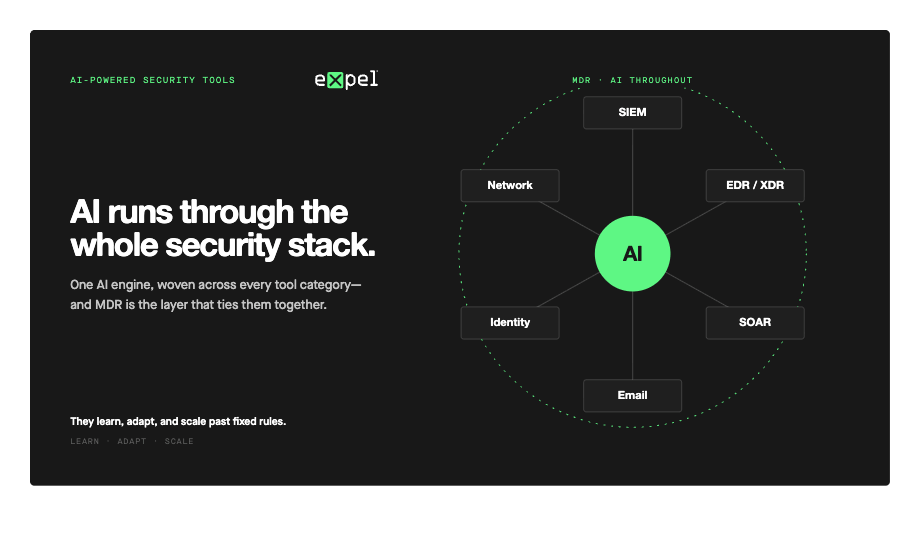
- “AI-powered” isn’t a single thing—it’s a capability applied across a wide range of tool categories: SIEM, EDR/XDR, SOAR, email security, identity analytics, NDR, and MDR services. What they share is the ability to learn from data rather than execute fixed rules.
- The more meaningful question isn’t “does this tool use AI?” but “what does the AI actually do, and how is its accuracy measured?” The term is applied to everything from genuinely sophisticated ML to basic automation with better marketing.
- AI doesn’t replace the tools already in your stack—it improves them. AI-enhanced SIEM still collects and correlates logs. AI-powered EDR still monitors endpoints. The AI adds behavioral detection, smarter prioritization, and pattern recognition on top of what those tools already do.
- MDR is where AI has the broadest impact because it’s applied across the entire detection and response lifecycle—not just one tool category—and because cross-customer scale means models get trained on threat data no single organization could generate on its own.
- Automation executes what you’ve already defined. AI handles what you haven’t anticipated. Most security tools combine both, which is why the two terms get conflated—but understanding the difference matters when you’re evaluating what a tool will actually catch.
AI-enhanced SIEM platforms
SIEM platforms have traditionally relied on correlation rules to detect threats. AI-enhanced SIEMs add machine learning layers that improve detection in several ways: behavioral analytics identify anomalies that rules miss, ML models reduce false positives by scoring alerts based on contextual risk, and AI-powered query assistance helps analysts investigate more efficiently.
Major SIEM platforms including Microsoft Sentinel, Google Security Operations, and Splunk have incorporated significant AI capabilities. The result is platforms that not only aggregate and correlate log data but actively learn from the environment to improve detection accuracy over time.
AI-powered EDR and XDR
Endpoint detection and response (EDR) platforms use AI to monitor endpoint behavior (process execution, file system changes, network connections, memory activity) and identify patterns indicative of malware, exploitation, or attacker post-compromise behavior. AI-powered EDR moves beyond signature matching to behavioral detection, catching novel malware and fileless attacks that signature-based tools miss.
Extended detection and response (XDR) extends this AI analysis across multiple data sources (endpoint, network, identity, cloud) correlating signals in a unified platform. AI-powered correlation across these sources enables detection of complex, multi-stage attacks that span multiple systems and appear innocuous in any single data source.
Security automation with AI (SOAR)
Security orchestration, automation, and response (SOAR) platforms automate security workflows including alert triage, data enrichment, containment actions, case documentation. AI enhances SOAR by making automation smarter: ML models can route alerts to the right analysts, recommend response playbooks based on similar past incidents, and identify which automated actions are appropriate for a given situation without requiring humans to define every scenario explicitly.
AI-powered SOAR reduces the manual work that consumes analyst time without requiring every possible scenario to be pre-programmed. The result is automation that handles more of the routine work while knowing when to escalate to human judgment.
AI-powered email security
Email remains one of the most common initial access vectors for attackers. AI-powered email security tools analyze message content, sender behavior, attachment characteristics, and link destinations to identify phishing, business email compromise (BEC), and malware delivery, including sophisticated attacks that evade traditional filter rules.
Natural language processing (NLP) models can recognize the linguistic patterns of social engineering attacks—urgency, authority impersonation, unusual requests—even in carefully crafted phishing emails that avoid traditional keyword triggers.
Identity and access management with behavioral analytics
User and entity behavior analytics (UEBA) applies AI to identity and access data to detect compromised accounts, insider threats, and privilege abuse. By establishing behavioral baselines for individual users such as typical login patterns, normal application access, expected data volumes, UEBA can flag anomalous behavior even when credentials are legitimate.
AI-powered IAM goes further, using ML to enforce adaptive access controls: requiring additional authentication when behavior deviates from baselines, flagging unusual privilege requests, and identifying access patterns associated with credential theft or insider threat activity.
Network detection and response with AI
AI-powered NDR analyzes network traffic to identify lateral movement, command-and-control communication, data exfiltration, and unusual protocol usage. ML models establish baselines of normal traffic patterns and flag deviations, which is particularly useful for detecting attacker activity that occurs over legitimate protocols or uses encrypted traffic to obscure malicious communication.
MDR services with AI throughout
MDR services represent the broadest application of AI security capabilities. AI is integrated throughout the detection, investigation, and response lifecycle rather than applied in a single tool category. MDR providers use AI to process incoming telemetry from multiple tool categories, triage and prioritize alerts, enrich findings with contextual intelligence, and automate routine investigation steps, all in support of human analysts who make final determinations and response decisions.
The AI advantage in MDR is compounded by cross-customer scale: ML models trained on threat data from many customer environments collectively recognize attack patterns that would be invisible from any single organization’s data.
For a full view of how AI is applied across security use cases, check out this page.
What a top AI-powered MDR solution includes
Not every MDR provider means the same thing when they say AI-powered. The ones worth considering share a few traits: AI applied across the full lifecycle rather than bolted onto one step, correlation across every telemetry source instead of tool-by-tool detection, transparency into what the AI decided and why, and human analysts making the final call on every finding that reaches you.
Ask for accuracy numbers, too. A provider that can tell you its false positive rate, mean time to respond, and how those figures are measured is describing something real. A provider that can only tell you its AI is advanced is describing a marketing position. The difference shows up in your queue.
How to choose an AI-powered cybersecurity solution
- Start with the gap, not the tool. Name the problem first—alerts nobody triages, blind spots in cloud or identity, no coverage after hours. Tools bought without a defined gap tend to add noise instead of removing it.
- Ask what the AI actually does. “AI-powered” describes everything from behavioral models trained on years of attack data to a scoring rule someone wrote last quarter. Ask which decisions the model makes, what it was trained on, and what happens when it’s wrong.
- Find out how accuracy gets measured. False positive rate, detection coverage against a framework like MITRE ATT&CK, time to detect. If a vendor can’t produce these, they aren’t measuring them.
- Check whether you can see the reasoning. When the tool flags something, your team needs to know why. Findings that can’t be explained can’t be acted on—or defended to an auditor.
- Look at how it fits what you already run. AI tools that work well alone often generate more noise together, because each one optimizes for its own detection logic. Ask how the tool correlates with the rest of your stack.
- Be honest about who operates it. Most AI security tooling needs tuning, and models drift. If nobody on your team owns that work, a managed service will get you further than another platform.
- Test it on your own data. Vendor demos run on curated environments. A trial against your real telemetry tells you what the tool catches in your environment, which is the only number that matters.
Expel’s take
The security market is full of tools with “AI-powered” in the name. Some of that is genuine capability; a lot of it’s positioning. The useful question isn’t whether a tool uses AI—it’s what the AI actually does, how it’s validated, and what happens when it’s wrong.
At Expel, we work across 160+ coverage areas, which means we see how AI performs across a wide range of tools and environments. The pattern we see consistently: AI-powered tools that work well in isolation often create more noise when integrated together, because each tool optimizes for its own detection logic without cross-source correlation. That’s the gap MDR fills—not just running AI tools, but connecting signal across them so findings mean something by the time an analyst sees them.
The other thing worth saying: no AI-powered tool replaces the need for someone who understands what the output means. Tools surface findings; humans decide what to do about them. That division of labor isn’t a limitation of current AI—it’s the right design.
Frequently asked questions
What are the main categories of AI security tools?
AI security tools fall into five main categories: AI-enhanced SIEM (log correlation and detection), EDR/XDR with behavioral analysis, NDR with anomaly detection, SOAR with ML-driven automation, and MDR services that layer AI across all categories.
How do I evaluate AI claims in security tools?
Ask what specific decisions the AI makes, what data trained it, how accuracy is measured, and whether you can see the reasoning behind a finding. Vendors who can answer those four questions with numbers are describing real capability. See the “How to choose an AI-powered cybersecurity solution” section for the full evaluation checklist.
What is AI washing in cybersecurity?
AI washing is when vendors overstate AI capabilities in their security products, claiming ‘AI-powered’ features that rely on simple rule-based logic or basic statistics. Asking specific technical questions about model architecture and training data helps identify genuine AI implementation.
How do AI security tools reduce alert fatigue?
AI security tools reduce alert fatigue by correlating events across data sources, suppressing known-benign alerts, prioritizing high-confidence threats, and routing alerts to appropriate analysts—reducing the volume analysts must manually review.
What is the difference between AI-powered EDR and traditional endpoint security?
AI-powered EDR establishes behavioral baselines for each endpoint and detects deviations, while traditional endpoint security relies on signature databases of known threats. AI-powered EDR better detects novel and file-less attacks.
What AI detection and response tools are out there?
The tools built specifically to detect and respond to AI-related threats fall under a category called AI detection and response (AIDR). Rather than rank individual vendors here, see our full breakdown of what AIDR covers and how it fits alongside the AI-powered security tools.