

AI in cybersecurity is used to automate threat detection, analyze large volumes of telemetry at speed, and identify patterns of behavior that would be impossible for humans to spot manually. From anomaly detection to alert triage, AI is becoming a core part of how modern security teams operate.
Key takeaways
- AI is being applied across the full security lifecycle—from threat detection and alert triage to vulnerability management, fraud detection, and identity threat monitoring
- The highest-value AI use cases in security operations are the ones that reduce analyst workload on repeatable, high-volume tasks: triage, enrichment, and routine investigation steps
- AI-powered automation delivers better outcomes than rule-based automation alone because it adapts to new patterns rather than matching against static signatures
- The use cases where AI falls short—novel threat hunting, complex incident judgment, high-stakes response decisions—are exactly where human analysts remain essential
- Organizations that get the most from AI in security don’t bolt it onto existing workflows; they redesign operations around what AI handles well and what it doesn’t
AI can be applied across virtually every area of cybersecurity, from threat detection and automated response to phishing prevention, vulnerability prioritization, and security operations efficiency. The practical question isn’t whether AI has a role in your security program, but which applications deliver the most meaningful security improvement for your specific environment and team.
10 ways AI is used in cybersecurity
- Threat detection and behavioral analytics. ML models analyze network traffic, endpoint activity, authentication events, and application logs to identify attack patterns and behavioral anomalies—including novel threats that no existing signature would catch.
- Automated incident response. When AI detects a threat, automated response can contain it in seconds: disabling a compromised account, isolating an endpoint, or blocking malicious traffic—before an analyst has even opened the alert.
- Phishing detection and email security. Natural language processing models recognize social engineering patterns in message content, while ML analyzes sender behavior and message structure to catch sophisticated phishing campaigns that bypass traditional filter rules.
- Vulnerability management and prioritization. AI scores vulnerabilities based on real-world exploitability, asset criticality, and attacker interest—not just static severity scores—so remediation effort goes where it actually reduces risk.
- Identity threat detection and insider risk. By establishing behavioral baselines for individual users, AI-powered UEBA flags anomalous access patterns that indicate compromised credentials or insider threats, even when the attacker is using legitimate access.
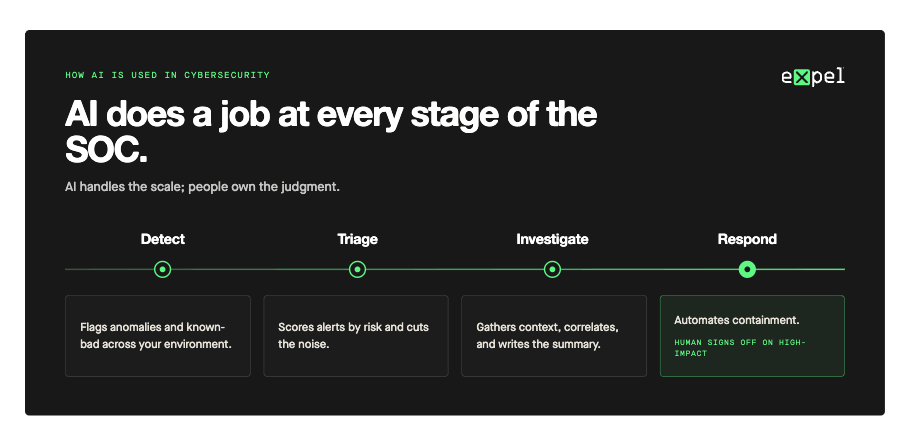
- Security operations automation. AI automates alert triage, data enrichment, case documentation, and reporting—reducing the manual overhead that consumes analyst time and allowing smaller teams to handle higher investigation volumes.
- Threat intelligence processing. AI ingests and correlates threat intelligence from multiple sources, extracts relevant indicators, and surfaces what’s actually actionable for your environment—rather than burying teams in raw feeds.
- Cloud security monitoring. Cloud environments generate security-relevant events at a scale and velocity that makes static rule-based detection unworkable. AI continuously monitors API calls, configuration changes, and identity actions across dynamic cloud infrastructure.
- Security automation. AI-powered automation reduces manual workload, speeds detection and response, eliminates human error in repetitive tasks, and enables consistent 24×7 monitoring at scale—freeing analysts to focus on complex work that requires human judgment.
- MDR services. MDR providers use AI across the full detection and response lifecycle—handling alert triage at scale, automating investigation steps, and enabling 24×7 coverage that would be impossible to staff without it.
Threat detection and behavioral analytics
The most widely deployed AI application in cybersecurity is threat detection. ML models analyze security telemetry (network traffic, endpoint activity, authentication events, application logs) to identify attack patterns and behavioral anomalies. AI threat detection finds both known threats (through pattern matching on historical attack data) and novel threats (through behavioral anomaly detection that doesn’t require advanced knowledge of the specific technique).
Automated incident response
AI-powered response automation reduces the time between threat detection and containment. When an AI system detects a compromised account, automated response can immediately disable the account, revoke active sessions, and notify relevant stakeholders—all within seconds of detection rather than minutes or hours of analyst review.
Effective automated response operates within clearly defined boundaries: routine containment actions (account suspension, endpoint isolation, blocking specific network traffic) can often be automated safely. High-impact or irreversible actions should retain human approval requirements.
Phishing detection and email security
AI has significantly improved email security by enabling detection of sophisticated phishing campaigns that evade traditional filter rules. Natural language processing models recognize social engineering patterns—urgency, authority impersonation, unusual requests—in message content. ML models analyze sender reputation, message structure, and historical communication patterns to flag anomalous email behavior. AI-powered link analysis evaluates destination URLs dynamically rather than matching against static blocklists.
Vulnerability management and prioritization
Security teams face the impossible task of remediating more vulnerabilities than they can realistically address. AI helps by prioritizing vulnerabilities based on exploitability, asset criticality, attacker interest, and environmental context, focusing remediation effort where it matters most rather than working through a flat list by severity score.
AI vulnerability prioritization considers factors that static CVSS scores don’t: whether a vulnerability is being actively exploited in the wild, whether the affected system is exposed and critical to your specific environment, and what attackers with access to that system could realistically accomplish.
Identity threat detection and insider risk
AI-powered user and entity behavior analytics (UEBA) applies machine learning to identity and access data to detect compromised credentials, privilege abuse, and insider threats. By establishing behavioral baselines for individual users, UEBA can identify anomalous access patterns that indicate account compromise even when the attacker is using legitimate credentials.
Insider threat detection is particularly valuable because traditional perimeter-based detection misses threats that originate inside the network with legitimate access.
Security operations automation
Beyond detection, AI drives efficiency across security operations: automating alert triage and routing, enriching alerts with contextual information from multiple sources, generating investigation summaries, documenting cases, and producing reports. These automation applications reduce the manual overhead that consumes analyst time and contributes to burnout, allowing security teams to handle higher investigation volumes without proportional headcount growth.
Threat intelligence processing
Security teams receive more threat intelligence than they can manually process and operationalize. AI systems ingest intelligence from multiple sources, extract relevant indicators and TTPs, assess relevance to the specific environment, and surface actionable intelligence in context. They connect incoming intelligence to current activity in the environment rather than treating it as an abstract feed.
Cloud security monitoring
Cloud environments generate enormous volumes of security-relevant events—API calls, configuration changes, resource access, identity actions—across complex, dynamic infrastructure. AI is particularly well-suited to cloud security monitoring because of the scale and velocity of cloud telemetry, and because cloud environments change rapidly in ways that make static rule-based detection quickly outdated.
Why use automation in cybersecurity?
The volume of security events modern environments generate has outpaced what human teams can manually review. A mid-size enterprise can produce billions of security events daily. Without automation, analysts spend the majority of their time on repetitive triage and enrichment tasks—not on the complex investigation work that actually requires human judgment.
Automation addresses this in several ways. It reduces manual workload by handling routine tasks like alert triage, indicator lookups, case documentation, and data enrichment without analyst involvement. It speeds detection and response by executing containment actions in seconds rather than waiting for a human to review an alert queue. It eliminates human error in repetitive, high-volume tasks where fatigue and inconsistency create risk. And it enables 24×7 monitoring at scale—consistent coverage across every hour of the day, not just when an analyst is actively watching.
The result is that analysts can focus on the work that actually requires a human: complex investigations, ambiguous situations, novel attacker behavior, and decisions with real organizational consequences.
AI-powered automation raises the ceiling further. Rule-based automation executes predefined workflows reliably but only handles what you’ve already anticipated. AI-powered automation adapts—it can investigate alerts it’s never seen before, adjust its approach based on what the evidence shows, and improve accuracy over time through analyst feedback. For security operations that need to keep pace with attackers who don’t follow scripts, that adaptability matters.
MDR applications of AI
MDR services represent the most comprehensive application of AI across the security operations lifecycle. AI in MDR handles alert triage at scale, enriches findings with cross-customer threat intelligence, automates investigation steps, and supports 24×7 coverage that would be impossible to staff manually. MDR is how many organizations access sophisticated AI security capabilities without building and maintaining them internally.
Expel’s take
The list of ways AI can be used in cybersecurity keeps growing, but more use cases doesn’t automatically mean better security. The question is whether AI is being applied where it actually changes outcomes. Automating alert triage on a queue that was already manageable doesn’t move the needle. Automating enrichment and investigation on the cases that used to take analysts 45 minutes does.
At Expel, we’ve focused AI where the volume and repetition are highest: ingesting telemetry across 160+ coverage areas, correlating signals, and building investigation context before a human touches a case. That’s what compresses detection and response times, rather than just adding AI labels to existing steps.
The other thing we’ve learned: AI use cases in security have a maintenance burden that’s easy to underestimate. Models drift, attacker behavior evolves, and detections that worked last quarter may not work next quarter. The organizations that treat AI as a set-it-and-forget-it capability are the ones who discover the gap when something gets through.
Frequently asked questions
What are the most common uses of AI in cybersecurity?
The most common uses include threat detection through behavioral analysis, automated alert triage to reduce analyst workload, phishing detection in email security, user behavior analytics for insider threats, vulnerability prioritization, and security operations automation across SIEM and SOAR platforms.
Why use automation in cybersecurity?
Automation in cybersecurity reduces manual workload, speeds detection and response, eliminates human error in repetitive tasks, enables 24×7 monitoring at scale, and frees security analysts to focus on complex investigations that require judgment. AI-powered automation delivers better outcomes than rule-based automation alone.
How is AI used in incident response?
AI accelerates incident response by automatically gathering enrichment data, correlating signals across environments, recommending containment actions, and generating incident reports. Human analysts retain decision authority for high-impact response actions.
Can AI help with vulnerability management?
AI improves vulnerability management by prioritizing CVEs based on exploitability, asset criticality, and threat intelligence—reducing the volume of vulnerabilities requiring immediate attention and helping teams focus patching efforts where risk is highest.
How does AI support 24×7 security monitoring?
AI systems operate continuously without fatigue, processing telemetry from all environments around the clock and escalating high-confidence threats for human review. This enables MDR providers to deliver 24×7 coverage that scales with customer environments.