

Agentic SOC is a type of security operations center where AI agents autonomously investigate threats, correlate evidence across security tools, and execute containment actions, while human analysts govern the system, approve high-impact decisions, and handle novel threats that require judgment.
Key takeaways
- An agentic SOC goes beyond AI-augmented alerting—agents chain investigative steps and act without waiting for human direction at each stage.
- Four architecture patterns exist today: single-agent, orchestrator, peer-to-peer mesh, and hierarchical.
- Across the threat lifecycle, agents own detection and most investigation, while humans govern high-impact response and novel judgment calls.
- A governance layer—like Expel’s AI Trust vs. Impact Matrix—defines which decisions agents can own outright and which need human sign-off.
- The main risks are prompt injection, excessive agent privilege, and MCP supply-chain exposure—not autonomy itself.
- Most organizations get agentic SOC capability through an MDR provider, rather than building it in-house.
For the foundational AI-augmented SOC definition, see how AI and automation improve SOC operations. For the build-vs-buy question, see agentic MDR vs. agentic AI SOC platform.
This page defines the agentic SOC itself: what makes it different from AI-augmented operations, how the architecture and governance work, and what to ask a vendor claiming to sell one. Interest in the term has grown steadily as security teams move past basic AI alerting toward systems that can reason and act with less hand-holding—and the label gets used loosely enough that a clear definition is overdue.
What does “agentic” add that an AI-augmented SOC doesn’t?
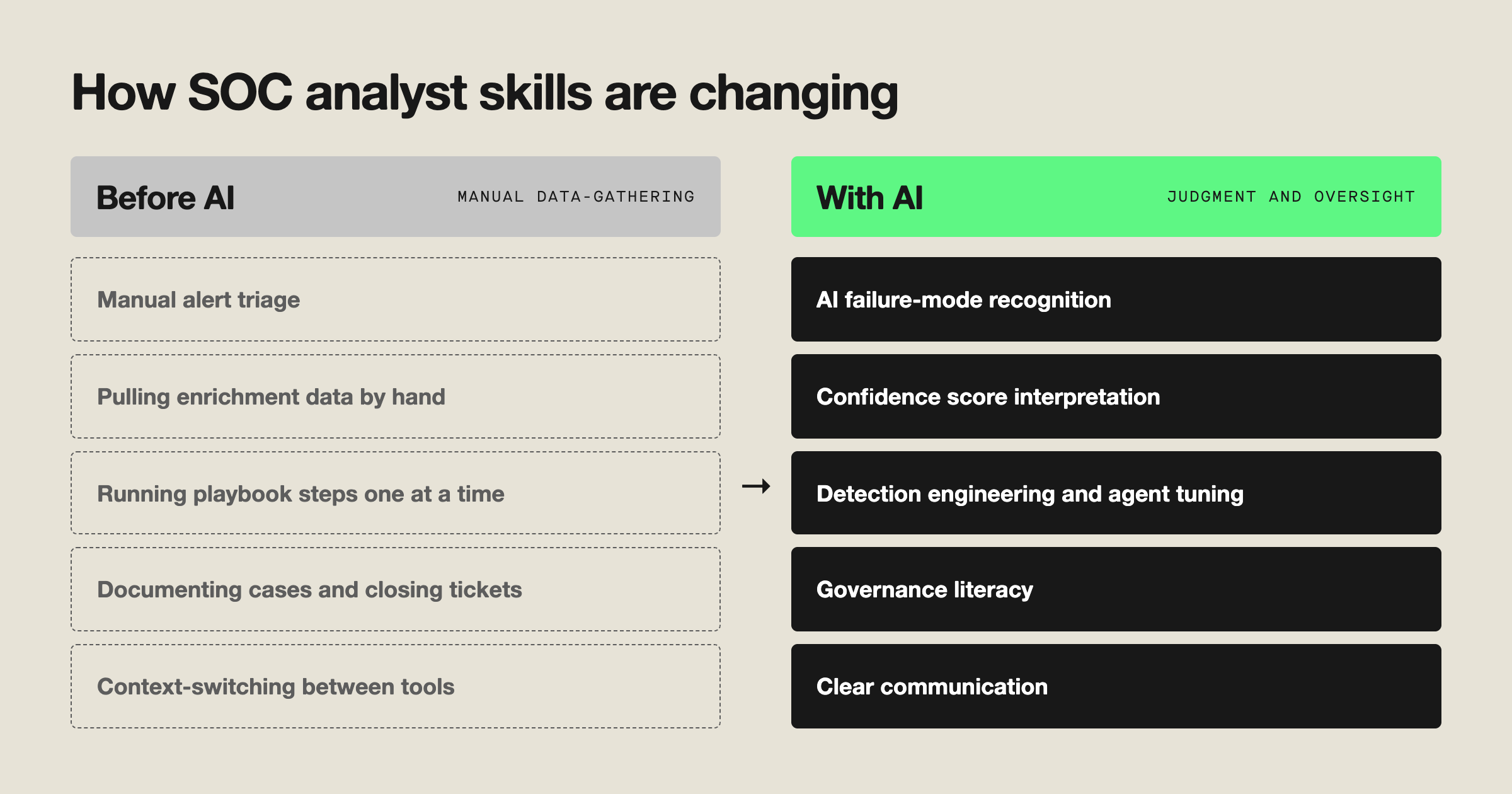
An AI-augmented SOC uses AI to support people—it enriches alerts, surfaces context, and recommends a next step, but a human decides and acts. An agentic SOC changes who’s driving. AI agents reason across multiple steps in sequence, to complete actions like pulling evidence from one tool, forming a hypothesis, checking it against another data source, and deciding what to do next—all without a human re-approving each step along the way.
The practical difference shows up in speed and scope, not just automation depth. An AI-augmented system might flag an alert as “likely malicious, recommend isolation.” An agentic system investigates why it’s likely malicious, checks whether the same indicators appear elsewhere in the environment, and—within guardrails a human has already set—isolates the host itself.
Agentic, in practice, is a spectrum. Most production deployments let agents own more of the routine, high-confidence path autonomously, while escalating anything novel, ambiguous, or high-impact to a human. The organizations getting this right are deliberate about exactly where the human stays in the loop, which is really a governance question as much as a technical one (more on that below).
What are the different agentic SOC architecture types?
Agentic SOC deployments generally follow one of four patterns:
- Single-agent: One agent handles detection, investigation, and response recommendations end to end. Simplest to reason about; can become a bottleneck as scope grows.
- Orchestrator: A lead agent delegates specific tasks (enrichment, correlation, containment) to specialized sub-agents and assembles their output. Common in larger environments with varied tooling.
- Peer-to-peer mesh: Agents communicate directly with each other rather than through a central coordinator, each responsible for a domain (endpoint, identity, cloud) and sharing findings laterally.
- Hierarchical: Layered agents, where lower tiers handle high-volume triage and escalate only what clears a confidence threshold to a senior agent (or a human) for deeper reasoning.
None of these is universally correct—the right pattern depends on how many tools an environment has to correlate across, how much volume the SOC handles, and how centralized the organization wants decision authority to be. A hierarchical or orchestrator pattern tends to suit larger, tool-sprawling environments better than a single agent trying to hold all context itself.
What do AI agents actually do across the threat lifecycle?
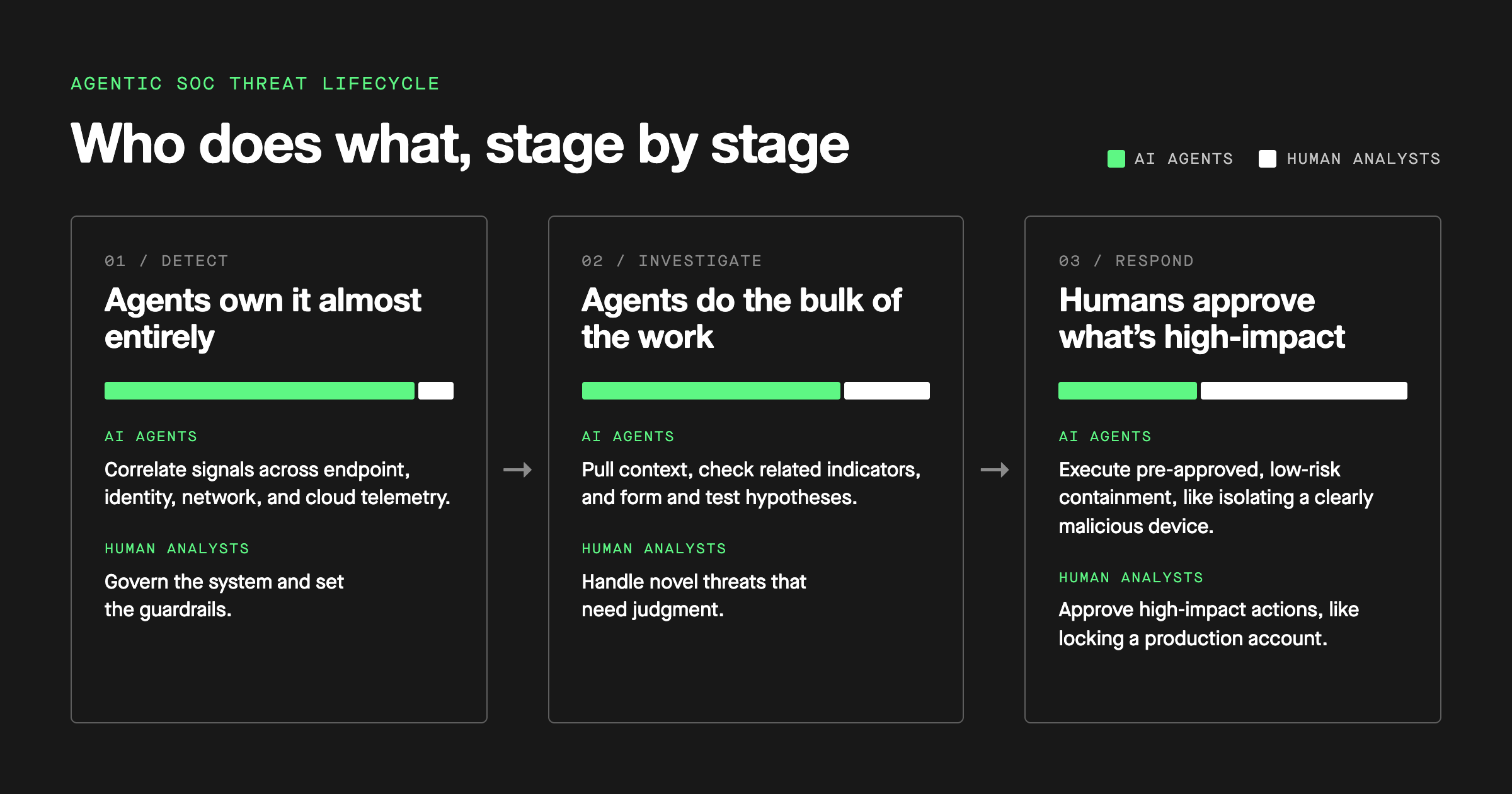
Break the SOC workflow into detect, investigate, and respond, and the AI-vs-human split looks different at each stage.
Detect: Agents own this almost entirely—correlating signals across endpoint, identity, network, and cloud telemetry faster and more consistently than manual triage.
Investigate: Agents do the bulk of the work here too: pulling context, checking related indicators, forming and testing hypotheses about what happened. This is where “agentic” earns its name—multi-step reasoning without a human re-prompting at each turn.
Respond: This is where the human role concentrates. Agents can execute pre-approved, low-risk containment (isolating a device with clear malicious indicators, for example) autonomously. Higher-impact actions—locking a production account, taking down a customer-facing system—route to a human for approval, because the cost of a wrong autonomous call is highest here.
The pattern across all three stages is that autonomy scales with confidence and reversibility. Agents own more where the evidence is clear and the action is easy to undo; humans stay in the loop where either of those isn’t true.
How does governance work in an agentic SOC?
Governance is what separates a production-ready agentic SOC from a risky one. The central question to answer for every agent action is: should this decision be made without a human checking first?
Expel’s AI Trust vs. Impact Matrix is a published framework for answering that question systematically: it maps SOC decisions against two axes—how much the system can be trusted to get the decision right, and how much damage a wrong decision could cause—to determine which actions agents can own autonomously and which require human approval before execution.
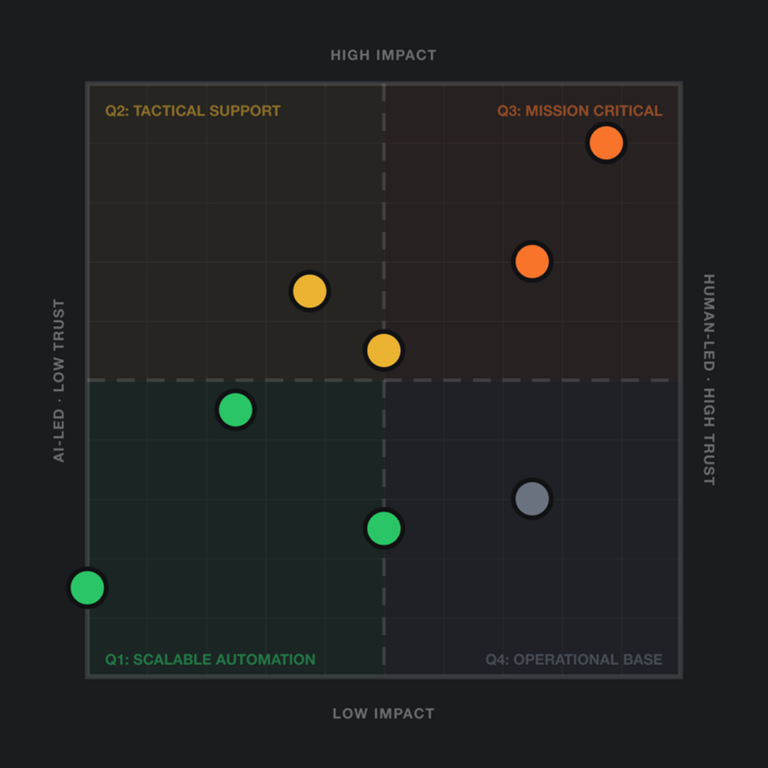
In practice, a governance layer like this needs to answer four things before an agent gets deployed: what specific actions can it take unsupervised, what triggers a human approval gate, how is every agent decision logged for audit, and who’s accountable when something goes wrong. Skipping any of the four is how “agentic” deployments end up either too cautious to deliver value or too permissive to be safe.
What are the security risks of an agentic SOC?
Autonomy that helps a SOC move faster also expands what can go wrong faster. The main risks are prompt injection (malicious content in processed data redirecting agent behavior), excessive privilege (agents with broader system access than their task requires), MCP supply-chain vulnerabilities from third-party tool integrations, and error propagation at machine speed before a human notices. For the full risk taxonomy and mitigations, see what are the security risks of agentic AI.
Best practices: What to ask any agentic SOC vendor
Before adopting an agentic SOC—whether built in-house or bought as a service—ask the vendor:
- Which specific decisions does the agent make autonomously, and which always route to a human?
- What does the audit trail look like for an agent’s decision, end to end?
- How is the agent tested against prompt injection and adversarial inputs before and after deployment?
- What happens when the agent encounters a scenario outside its training or guardrails?
- Can you see a real production example of the agent handling an off-script incident, not just a scripted demo?
A vendor that can’t answer the second and fourth questions concretely is probably describing an AI-augmented tool with agentic marketing, not the real thing.
Expel’s take
Ruxie, Expel’s AI SOC manager, pairs autonomous investigation with mandatory human sign-off on anything that carries real consequence. She reasons across the full threat lifecycle, but every action she takes runs against the same trust-vs.-impact governance model described above: low-impact, high-confidence actions execute automatically, and anything with real consequence routes to a human analyst for approval. That distinction between agentic and autonomous is the one that matters most for anyone running an agentic SOC in production, not just piloting one.
Frequently asked questions
What is an agentic SOC?
An agentic SOC is a security operations center where AI agents autonomously investigate threats, correlate evidence across security tools, and execute containment actions, while human analysts govern the system, approve high-impact response decisions, and handle novel threats requiring judgment. Unlike an AI-augmented SOC, agentic agents act across multi-step workflows without waiting for human direction at each stage.
What is the difference between an agentic SOC and an AI-augmented SOC?
An AI-augmented SOC integrates AI to support analyst workflows—detecting threats, enriching alerts, and recommending actions for human review. An agentic SOC goes further: AI agents autonomously chain investigative steps, decide on containment, and execute responses within defined guardrails. The distinction is autonomous multi-step reasoning versus AI-assisted human decision-making at each step.
Is an agentic SOC safe to deploy today?
Yes, with proper governance. Safe agentic SOC deployment requires least-privilege access controls limiting what agents can do, human approval gates for high-impact response actions, audit logging of every agent decision, prompt injection defenses for agent workflows, and regular red-team testing of agent behavior. Fully autonomous agentic operations—without any human oversight—remain premature for production security environments in 2026.
What are the security risks of an agentic SOC?
Key risks include prompt injection attacks that redirect agent behavior via malicious content in processed data, excessive privilege where agents have broader system access than needed, MCP supply chain vulnerabilities from third-party tool integrations, and error propagation at machine speed before human review. For the complete agentic AI security risk taxonomy, see our dedicated page on agentic AI security risks.
How does MDR deliver agentic SOC capabilities?
Most organizations get agentic SOC capability through a managed detection and response (MDR) provider rather than building and governing agents in-house. The provider operates the agents, owns the governance framework, and carries accountability for agent decisions—while the customer still approves the policies that define what the agent can and can’t do. See agentic MDR vs. agentic AI SOC platform for the full build-vs-buy comparison.