

Security orchestration, automation, and response (SOAR) executes predefined playbooks—deterministic, if-then logic that runs the same steps every time a condition is met—which is fundamentally different from how an agentic SOC reasons through an incident.
Key takeaways
- SOAR automates high-volume, predictable workflows that run the same way every time.
- An agentic SOC handles the unexpected by reasoning contextually and adapting mid-investigation when an incident doesn’t match any existing playbook.
- The core difference is contextual reasoning versus deterministic execution, not smarter automation.
- Most mature security operations use both—SOAR for reliable execution, agentic AI for investigation and judgment.
- Moving from SOAR-only to agentic capability is a maturity step, not a rip-and-replace decision.
For the full definition of what an agentic SOC is—architecture, governance, and risk—see what is an agentic SOC.
This page focuses specifically on how it compares to SOAR, the automation approach most security teams already know. If you’ve run SOAR for years, and are wondering whether agentic is just a rebrand of the same thing, the difference shows up in exactly the incidents your playbooks were never written for.
What does SOAR do well?
SOAR earns its place in a SOC by being predictable. Give it a clearly defined trigger—a phishing report, a failed-login threshold, a known malware hash—and it runs the same sequence of steps every time: enrich, notify, contain, and document. For high-volume, well-understood incident types, that consistency is exactly what you want. It doesn’t get tired, doesn’t skip a step, and doesn’t need a human to re-approve a playbook it’s run a thousand times before.
This is where most SOCs still get the most value from automation, and it’s not going away. Routine phishing triage, account lockout response, automated ticket creation—SOAR handles these faster and more reliably than a human, and faster than an AI agent reasoning from scratch would need to.
Where does SOAR break down?
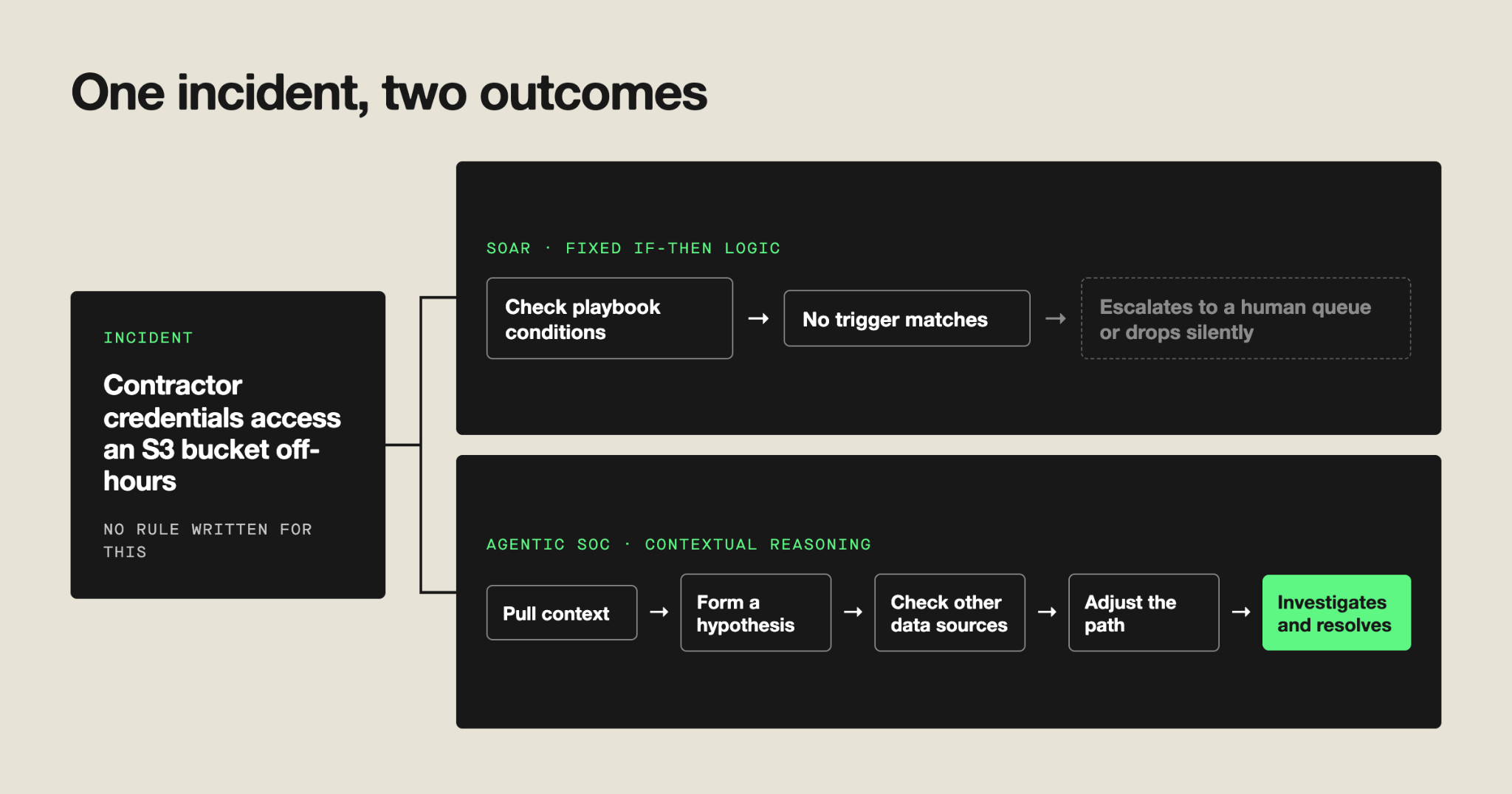
The moment an incident doesn’t match a predefined trigger, SOAR has nothing to offer. It can’t reason about a scenario nobody scripted for. A contractor’s credentials accessing an off-hours S3 bucket, with no rule written for that specific combination of account type, time, and resource, doesn’t match a playbook condition—so SOAR either escalates it to a human queue or, worse, drops it silently because nothing fired.
This is the structural limit of if-then automation—it’s only as good as the scenarios someone anticipated in advance. Novel attack patterns, contextual judgment calls, and incidents that span multiple systems in ways a rule-writer didn’t foresee all fall outside what SOAR can act on. It doesn’t fail loudly—it just doesn’t engage.
What does agentic AI add that SOAR can’t?
An agentic SOC’s core advantage is that it doesn’t need the scenario to be anticipated in advance. It reasons by pulling context, forming a hypothesis about what’s happening, checking that hypothesis against other data sources, and adjusting its investigation path based on what it finds. The same off-script contractor-credentials scenario that SOAR drops, an agent can investigate on its own, reasoning from the evidence in front of it rather than matching against a fixed rule.
That contextual reasoning is also what lets agentic systems handle edge cases requiring business context—a compromised executive account during a sensitive period, for instance—that no playbook could realistically encode in advance.
| SOAR | Agentic SOC | |
|---|---|---|
|
Trigger type |
Predefined rule or condition | Any anomaly or signal worth investigating |
|
Reasoning |
None—executes fixed logic | Multi-step, contextual reasoning |
|
Off-script handling |
Breaks on unanticipated scenarios | Adjusts investigation path as it learns |
|
Human role |
Sets rules up front, rarely intervenes | Approves high-impact actions, handles true novelty |
|
Best use case |
High-volume, predictable workflows | Off-script, ambiguous, or high-context incidents |
Best practices: When should you use SOAR vs. move to agentic?
Keep SOAR for anything high-volume and genuinely predictable—it’s still the fastest, cheapest way to handle routine, well-understood incident types. Move toward agentic capability where your incident volume includes a meaningful share of off-script cases that SOAR either escalates constantly or silently drops.
Don’t treat this as an either-or migration. Most teams add agentic reasoning on top of an existing SOAR investment, rather than replacing it. Track how often your SOAR playbooks fail to match, because a high miss rate is the clearest signal that contextual reasoning would add value.
Expel’s take
Ruxie, Expel’s AI SOC manager, and Expel Workbench™, our automation platform, split this into two layers. Ruxie handles investigation by reasoning over evidence, forming hypotheses, and deciding what needs to happen next. Workbench handles execution by triggering the containment action Ruxie decides on, documenting the case, and routing escalations. She decides; the automation executes reliably.
That split is deliberate. Asking one system to both reason contextually and execute with perfect reliability every time is asking for trouble in both directions. Keeping investigation and execution as separate, purpose-built layers is what lets Ruxie handle the contractor-credentials scenario above without needing SOAR to somehow anticipate it.
Frequently asked questions
What is the difference between an agentic SOC and SOAR?
Security orchestration, automation and response (SOAR) executes predefined playbooks—if-then logic that runs the same steps each time conditions are met. An agentic SOC uses AI agents that interpret context, reason across data sources, and adapt mid-investigation when incidents go off-script. SOAR automates the expected; agentic AI handles the unexpected. Most mature deployments use both rather than choosing between them.
Can an agentic SOC replace SOAR?
Not directly—they solve different problems. SOAR excels at high-volume, predictable workflows (routine phishing triage, account lockout response, automated ticketing) where speed and consistency matter most. Agentic AI adds value for complex, contextual investigations where rigid playbooks break down. Most mature deployments use SOAR for deterministic execution and agentic AI for contextual investigation, with the agent deciding what the SOAR should execute.
What does an agentic SOC do that SOAR cannot?
An agentic SOC can reason about off-script incidents with no matching playbook, correlate signals across multiple tool outputs to form novel hypotheses, adjust its investigation path based on intermediate findings, and handle edge cases—like a compromised executive account during a critical business period—that require contextual business judgment no SOAR playbook can encode. Ruxie, Expel’s AI SOC manager, handles exactly these scenarios in production.
How do SOAR and agentic AI work together?
In an effective deployment, SOAR handles execution (triggering containment actions, documenting cases, routing escalations) while agentic AI handles investigation (reasoning over evidence, forming hypotheses, enriching context). The agent decides what action to take; SOAR executes it. This is how Expel’s Ruxie AI SOC manager works alongside Workbench automation—investigation intelligence from agentic AI, reliable execution from the automation layer.
Is agentic AI more secure than SOAR for high-risk response actions?
Neither is inherently more secure because the risk profile differs. SOAR’s risk is rigidity: it can execute the wrong action reliably if the playbook logic is flawed. An agentic system’s risk is that reasoning can be manipulated (through prompt injection, for example) or wrong. The safer approach for high-risk actions is layered: agentic reasoning to decide, human approval before execution, and SOAR to carry out only what’s been explicitly approved.