

Threat hunting is the proactive, hypothesis-driven search for threats that have evaded existing detections. Incident response (IR) is the reactive process that begins once a threat is confirmed. Hunting often finds the incidents that IR then handles.
Key takeaways
- Threat hunting looks for what your defenses missed. Incident response manages what’s already been found.
- Hunting starts with a hypothesis, not an alert. That’s the defining difference—there’s no trigger.
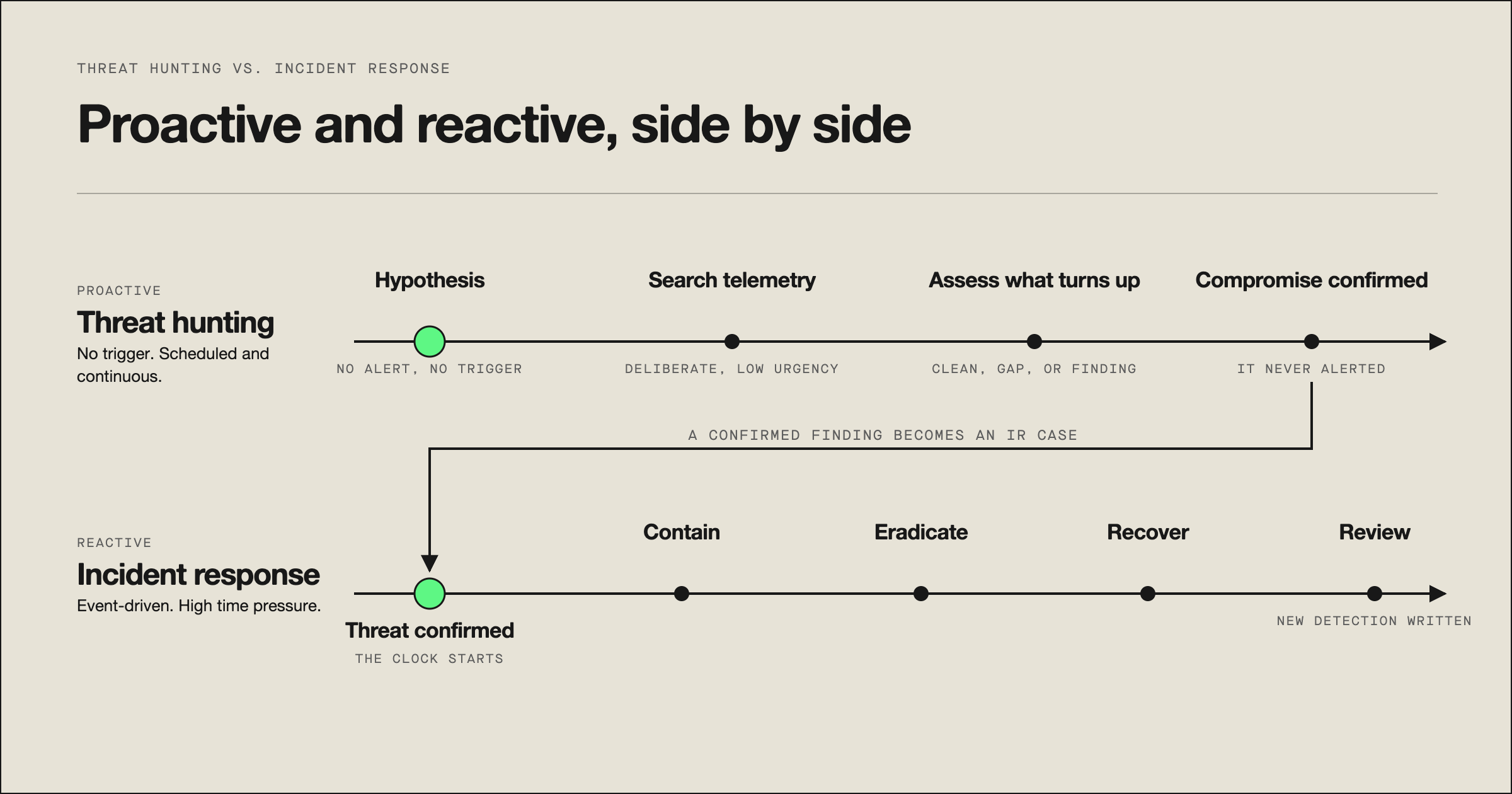
- The two are sequential and complementary, not competing. A confirmed hunt finding becomes an IR case.
- Most organizations need both, but they don’t need two separate teams. In managed models the same analysts do both, using the same telemetry.
- Dwell time is the number that connects them. Hunting shrinks it. IR is what happens once the clock stops.
Security teams get asked to choose between these two disciplines fairly often, usually during budget season, and it’s a false choice. Incident response is non-negotiable—every organization needs a defined way to handle a confirmed compromise, and that’s covered in more depth on our incident response page. Threat hunting is what closes the gap between “an attacker is in our environment” and “an alert has fired,” which for a patient or skilled intruder can be weeks. One is your response capability. The other determines how long an attacker gets to operate before you need it.
What triggers threat hunting?
Nothing does, and that’s the point. Hunting is scheduled or hypothesis-driven, which means it runs whether or not anything looks wrong.
Typical hunt starting points include:
- A threat intelligence report. A new technique gets published, and hunters go looking for it across the environment.
- A hypothesis about attacker behavior. “If someone were abusing service accounts for lateral movement here, what would that look like in the logs?”
- A detection gap. The team knows a particular technique wouldn’t alert, so they look for it manually.
- An anomaly that isn’t an alert. Unusual authentication patterns, a process running from an odd path, outbound traffic to a new destination.
- A schedule. Many mature programs simply run hunts on a cadence, rotating through techniques and asset classes.
A hunt has three possible outcomes: it finds nothing and increases confidence, it finds a detection gap and produces a new rule, or it finds a real compromise. That third outcome is where incident response begins. The full workflow is covered in our threat hunting process page.
What triggers incident response?
Incident response starts when a threat is confirmed, and confirmation can arrive from several directions:
- A detection fires and an analyst validates it as a true positive
- A threat hunt turns up malicious activity that never alerted
- An employee reports a phishing email they clicked
- A third party notifies you—a customer, a partner, a payment processor, or law enforcement
- An extortion note appears, which is its own category of notification
Whatever the source, the response is the same framework: scope it, contain it, eradicate the foothold, recover the systems, and review what happened. The trigger changes the starting information, not the process.
How are threat hunting and incident response different?
| Threat hunting | Incident response | |
|---|---|---|
|
Posture |
Proactive | Reactive |
|
Starting point |
A hypothesis | A confirmed threat |
|
Question it answers |
What did we miss? | What do we do now? |
|
Cadence |
Scheduled and continuous | Event-driven |
|
Success looks like |
A finding, a new detection, or verified confidence | Contained, eradicated, recovered |
|
Primary output |
Improved detection coverage | A resolved incident and an after-action report |
|
Time pressure |
Low—hunts are deliberate | High—minutes later |
How do threat hunting findings become incident response cases?
The handoff is the most operationally interesting part of the relationship, and it’s where a lot of programs get sloppy.
A hunter working a hypothesis finds something that shouldn’t be there—a scheduled task on three servers pointing at an unfamiliar binary, for example. At that moment, the work changes character completely. Hunting is deliberate and low-urgency, and incident response is time-critical. The hunter has to stop investigating breadth and hand off, or formally switch modes.
A clean handoff carries four things: the confirmed indicators, the scope established so far, the hypothesis that led there, and critically, what hasn’t been checked yet. That last item is what prevents the response team from assuming the hunt was exhaustive when it was scoped to one hypothesis.
What happens next is standard incident response inside a security operations center (SOC)—containment, eradication, recovery. But the case starts with something an alert-driven process would never have produced, which is the entire argument for running hunts in the first place.
The loop closes at the post-incident review. Every hunt-originated incident is evidence of a detection gap by definition, since automation didn’t catch it. The finding should produce a new detection so the same technique alerts next time instead of waiting for the next hunt.
Do you need both threat hunting and incident response?
Incident response, yes, unconditionally. Even a three-person IT team needs a documented answer to “ransomware just hit, who does what.” There’s no organization size where improvising a response is the better plan.
Threat hunting is where it depends—not on whether it’s valuable, but on how you get it. Hunting needs three things: telemetry with enough retention and depth to search, someone with the skill to form good hypotheses about attacker behavior, and uninterrupted time. That third requirement is what kills in-house hunting programs. An analyst who owns the alert queue will always be pulled off a hunt, so hunts get scheduled and then don’t happen.
It’s why hunting is one of the clearest cases for a managed model. A managed detection and response (MDR) provider runs hunts across many environments at once, so a technique found at one organization becomes a hunt hypothesis everywhere. That cross-environment view is genuinely difficult to replicate with a single organization’s telemetry, no matter how good the analyst is.
Best practices for running both
- Write hunt hypotheses down before you start, and record the outcome even when you find nothing. Negative results are coverage evidence.
- Define the hunt-to-IR handoff in your incident response plan, including who declares an incident and what information transfers.
- Scope hunts narrowly. “Look for anything weird” isn’t a hypothesis and doesn’t produce a repeatable result.
- Turn every hunt finding into a detection. A hunt that finds the same thing twice is a detection you failed to write.
- Don’t staff hunting from the alert queue unless you protect the time. It won’t survive contact with a busy week.
- Track dwell time on hunt-originated incidents separately. It’s the clearest measure of what your detections are missing.
- Map hunts to a framework like MITRE ATT&CK so coverage gaps are visible rather than anecdotal.
Expel’s take
At Expel, hunting and response aren’t separate teams handing tickets across a wall. The same analysts do both, in Expel Workbench™, against the same telemetry—which matters more than it sounds, because the handoff friction between a hunt team and an IR team is where dwell time quietly accumulates.
Our hunts are hypothesis-driven and informed by what we see across every environment we cover, which is the structural advantage of the managed model. A technique that surfaces in one customer’s environment becomes a hunt hypothesis for all of them, usually within days. When a hunt confirms something malicious, it enters the same 24×7 response workflow as any detection-originated incident, with the same pre-authorized containment actions.
Ruxie™, our AI SOC manager, handles the enrichment and context-assembly work on both sides—pulling the surrounding activity together so an analyst starts a hunt or an investigation with a picture rather than a log line. Human-led, AI-powered. The analyst forms the hypothesis and makes the call.
Every hunt finding also feeds detection engineering, because a threat we had to hunt for is a threat that should have alerted; that’s the part that compounds.
Frequently asked questions
What is the difference between threat hunting and incident response?
Threat hunting is a proactive search for hidden threats that haven’t triggered an alert. Incident response is the reactive process that starts once a threat is confirmed. Hunting looks for what defenses missed. IR manages and resolves what’s already been found.
Can threat hunting trigger an incident response?
Yes. When a hunter confirms malicious activity that wasn’t previously detected, that finding is handed off to the incident response process for containment, eradication, and recovery. Threat hunting frequently surfaces the incidents that formal IR then handles.
Does a company need both threat hunting and incident response?
Most mature security programs need both. Incident response handles confirmed threats and is essential even for small teams. Threat hunting adds proactive coverage for attackers who evade automated detection. Organizations without dedicated staff usually get both through an MDR provider.
Is threat hunting part of incident response?
No. They’re distinct disciplines that intersect. Threat hunting is proactive and hypothesis-driven, searching for undetected compromise. Incident response is reactive and begins after a threat is confirmed, whether from an alert, a report, or a hunt.
Do the same people perform threat hunting and incident response?
Often yes, especially in managed models—the same SOC analysts who monitor alerts and execute incident response also conduct scheduled hunts using the same telemetry and tooling. Larger enterprises may run separate teams but still hand findings off to IR.