

The term AI SOC has emerged alongside—and is sometimes used interchangeably with—AI-augmented SOC. If you’re looking for the foundational definition of the operating model, start here. This page focuses on what AI SOC specifically signals now: the shift toward agentic AI capabilities and what vendors actually mean when they use the term.
Key takeaways
- An AI SOC uses AI as the operational foundation for security operations, not just as a tool layer on top
- AI handles detection, triage, investigation automation, and routine response; humans handle judgment, complex cases, and oversight
- The term reflects the evolution from “SOC that uses AI tools” to “SOC whose operations are driven by AI capabilities”
- Agentic AI powers autonomous multi-step investigation and response agents, and is what distinguishes emerging AI SOC capabilities from earlier AI-augmented models
- The most effective AI SOCs maintain strong human oversight; “autonomous SOC” is a marketing claim, not a production reality
AI SOC: what the term means and where it came from
The term “AI SOC” has emerged to describe a more advanced integration of AI in the SecOps process than earlier “AI-augmented SOC” language captured. Where AI-augmented implies AI tools added to existing SOC workflows, AI SOC implies AI as the operational foundation—workflows designed to use AI capabilities to process, investigate, and dispose of alerts with little human involvement rather than retrofit AI into traditional analyst-centric processes.
| Term | What it means in an AI SOC context |
|---|---|
|
AI agent |
An autonomous AI system that pursues a defined goal through multi-step action (e.g., an investigation agent that gathers evidence, correlates findings, and produces a determination) |
|
Agentic AI |
AI systems capable of planning, executing, and adapting to accomplish a goal, typically defined by multi-step autonomous operation (the capability that distinguishes advanced AI SOC models from earlier AI-augmented approaches) |
|
Multi-agent system |
Multiple specialized AI agents working in coordination) (e.g., an intelligence agent, an investigation agent, and a response agent operating together on a confirmed threat) |
|
GenAI in SOC |
Generative AI uses large language models (LLMs) to create human-like content, such as synthesizing vast amounts of data to write investigation summaries, new detection content, or enable natural language queries of security data |
|
Human approval gate |
A defined checkpoint where human review and authorization is required before an AI system proceeds with a specific action |
|
Graduated autonomy |
The principle that AI authority expands incrementally as reliability is demonstrated, not granted broadly based on general capability claims |
Human-in-the-loop vs. human-on-the-loop
Both are legitimate implementations of an AI SOC, not competing philosophies. Human-in-the-loop means AI pauses and waits for a person to review and approve an action before it happens. It’s used for high-stakes or ambiguous decisions. Human-on-the-loop means AI acts autonomously within defined guardrails while a person monitors in real time and can intervene or override if needed. It’s used for high-confidence, lower-risk actions. Most mature AI SOCs use both, matching the oversight model to the risk of the action.
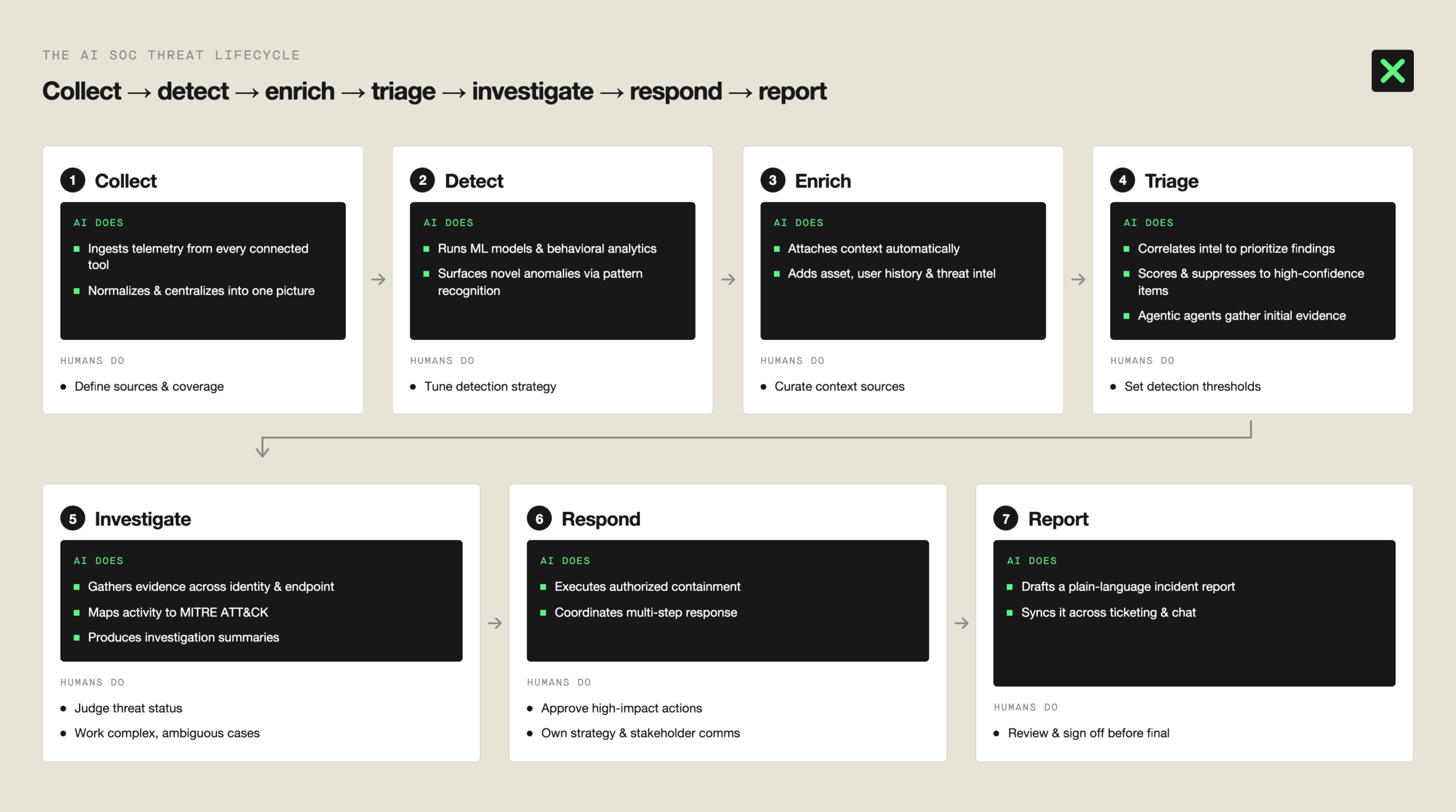
The AI SOC threat lifecycle
The stages mirror Expel’s own detection and response lifecycle: collect, detect, enrich, triage, investigate, respond, report, and evolve. What’s different in an AI SOC is how AI executes each stage, not the stages themselves.
Collect: AI-powered ingestion pulls telemetry from every connected tool, normalizes it, and centralizes it into one picture of the environment before detection even runs.
Detect: ML-powered detection models and behavioral analytics identify novel threats through pattern recognition, not just static rule matching, surfacing anomalies across the environment for triage.
Enrich: AI attaches context automatically—live telemetry, asset data, user history, prior decisions, and outside threat intelligence—so alerts reach analysts already assembled instead of requiring manual lookups.
Triage: AI ingests security telemetry from across the environment and correlates threat intelligence to prioritize what detection surfaces. Alert scoring and suppression reduce the finding set to high-confidence, high-priority items. Agentic triage agents handle initial evidence gathering and context assembly automatically.
Investigate: For triaged findings, AI investigation agents execute evidence-gathering workflows—querying identity systems, examining endpoint telemetry, correlating threat intelligence, mapping activity to MITRE ATT&CK techniques—and produce investigation summaries. Human analysts evaluate AI-produced summaries, exercise judgment on threat status, and investigate complex or ambiguous cases that require human expertise.
Respond: For confirmed threats, AI systems execute authorized containment actions (account suspension, endpoint isolation, network blocking, etc.) with human approval gates on high-impact actions. Agentic response agents coordinate multi-step containment workflows. Humans make strategic response decisions, manage stakeholder communication, and oversee remediation.
Report: AI turns what happened into a plain-language incident report and keeps it in sync across ticketing and chat tools. Humans review and sign off before it’s final.
Evolve: Analyst decisions and hunt findings feed back into the model, sharpening detections and closing coverage gaps for the next alert.
How an AI SOC differs from an AI-augmented SOC
An AI-augmented SOC integrates AI tools into existing analyst workflows to handle data volume and routine analysis. An AI SOC takes that further—the entire operational model is structured around AI capabilities from the ground up, with agentic AI handling significant portions of the investigation lifecycle and humans applied at the high-judgment decision points rather than every step. You can find details on the full operating models here.
MDR as AI SOC delivered as a service
Most organizations cannot build an AI SOC independently. The AI infrastructure, ML model development, cross-customer intelligence, and specialized talent required represent investments that individual organizations can’t justify at the scale needed for effectiveness.
MDR providers have built AI SOC capabilities at scale and deliver them as a service. The AI infrastructure, agentic investigation capabilities, cross-customer intelligence, and analyst expertise that define a mature AI SOC are available through MDR without internal development. For organizations evaluating how to access AI SOC capabilities, MDR is typically the fastest path to meaningful security outcomes.
The Expel take
At Expel, we’ve been building toward the AI SOC model since before the term existed. Our AI SOC manager, Ruxie™, has been around since we first started ten years ago, and leverages AI in multiple ways – deterministic workflows, ML, LLMs, and agentic workflows – to enhance our MDR service offering. Ruxie assists with triage, automated enrichment, investigation, and reporting across every customer environment we protect, while our analysts focus on the complex, judgment-intensive work that determines whether an incident becomes a breach. The result: a 14-minute MTTR on fully automated high and critical incidents. That’s not a demo—it’s what an AI SOC with real human-led oversight looks like in production.
Frequently asked questions
What is an AI SOC?
An AI SOC is a security operations center that deeply integrates artificial intelligence—including ML, behavioral analytics, and increasingly agentic AI—across threat detection, investigation, and response. Unlike traditional SOCs that rely primarily on human analyst review, an AI SOC uses AI to handle high-volume data processing, automated enrichment, and adaptive threat response while keeping human analysts in control of critical decisions.
What’s the difference between an AI SOC and an AI-augmented SOC?
AI-augmented SOC is the established term emphasizing human-AI collaboration as the core operational philosophy. AI SOC is a newer industry term that often implies more advanced AI integration—particularly agentic AI capabilities—and is increasingly used by vendors to describe next-generation operations centers using AI-native SecOps platforms.
What does an AI SOC analyst do?
An AI SOC analyst works within an AI-powered environment, reviewing AI-prioritized alerts, investigating flagged threats with AI-generated context, making response decisions, and providing feedback to improve AI model accuracy. The role requires both traditional security expertise and the ability to effectively direct, validate, and govern AI systems.
What is an agentic SOC?
An agentic SOC uses agentic AI—autonomous AI systems capable of multi-step reasoning and action—to investigate threats, correlate evidence, and execute response actions. In practice, agentic SOC capabilities are deployed alongside human oversight rather than in place of it. For the definition of agentic AI specifically, see Q4.
Can a small security team access AI SOC capabilities?
Yes. AI SOC platforms market themselves as always-on, AI threat analysts that replace the need to build a large, analyst-driven traditional SOC structure. These tools are designed to enable smaller teams to scale their detection, investigation, and response capabilities. However, while AI SOC platforms can replace some aspects of the analyst day-to-day role with AI, these tools do not fully create an autonomous SOC. Many smaller teams are still opting to partner with an MDR provider that deliver AI SOC capabilities as part of their services so they can access sophisticated AI-powered threat detection, investigation automation, and expert analyst oversight without building and maintaining AI infrastructure in-house.