

Table of Contents
Can MDR work with my existing SIEM?
Yes, MDR can absolutely work with your existing SIEM—and the integration between the two often delivers better security outcomes than either solution could achieve alone. Most modern managed detection and response (MDR) providers are built around a “bring-your-own-tech” philosophy, which means they’re designed to integrate seamlessly with the security information and event management (SIEM) tools you already have in place. Rather than forcing you into costly replacements or complete tech stack overhauls, MDR services act as complementary services to enhance your SIEM’s capabilities while maximizing your existing investment.
If you’re wondering whether you’ll need to rip and replace your security infrastructure to benefit from MDR, the short answer is: probably not. MDR providers connect to your SIEM through various integration methods—most commonly via API connectivity—to pull in alerts, enrich them with context, and help your team focus on real threats instead of wading through endless false positives. This approach means you get the centralized log aggregation and correlation rules you’ve built in your SIEM, plus the expert human analysis and rapid response capabilities of an MDR service.
Do I need to replace my security tools for MDR?
No, you don’t need to replace your security tools to implement MDR. In fact, one of the biggest advantages of working with a quality MDR provider is that they’re designed to work with your existing security stack, not against it.
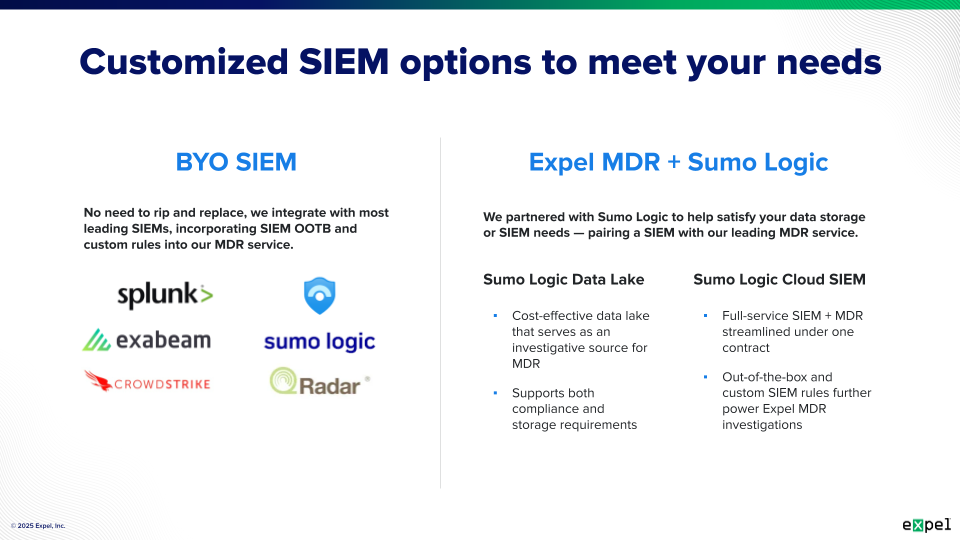
MDR providers like Expel connect to your current technology through remote API connections rather than requiring agents or forcing tool swaps. This API-first approach means setup happens in hours or days instead of weeks, and you maintain the tools already in your environment and strategy. Whether you’re running Sumo Logic, CrowdStrike Falcon LogScale, Palo Alto Networks Cortex XSIAM, Google Security Operations, or another leading SIEM platform, a good MDR service will meet you where you are.
The real value comes from how MDR enhances what you already have. Your SIEM continues to serve as the centralized repository for security data sources across your environment. Meanwhile, the MDR service analyzes those SIEM alerts, filters out the noise, prioritizes genuine threats, and provides the human expertise needed to respond effectively. It’s not about replacement—it’s about augmentation.
Think of it this way: your SIEM provides the eyes and ears across your infrastructure, collecting and correlating logs from dozens or even hundreds of sources. Your MDR provider brings the security analysts, threat intelligence, and rapid response capabilities that turn all data into actionable security outcomes. Together, they create a security operations capability that’s extremely difficult and expensive to build and maintain in-house.
What other tools does MDR integrate with?
Beyond SIEM platforms, MDR services typically integrate with a wide range of security tools across your entire attack surface. The goal is comprehensive visibility, so modern MDR providers support integrations with endpoint detection and response (EDR) tools, cloud security platforms, email security gateways, identity and access management systems, network security tools, and SaaS applications.
Expel MDR, for example, maintains a broad library of integrations spanning the security stack. These include endpoint tools like Microsoft Defender for Endpoint and CrowdStrike, cloud platforms like AWS and Azure, identity solutions like Okta and Azure Active Directory, network security tools, and dozens of other security products. The integration portfolio is constantly expanding as new technologies emerge and customer needs evolve.
What makes these integrations powerful is the variety of integration methods used to connect them. While direct API connectivity is the preferred method for its speed, stability, and bidirectional capabilities, MDR providers also use webhooks, SIEM connections, and collectors depending on what works best for each specific tool. This flexibility ensures you’re not locked into a specific configuration or forced to abandon tool compatibility when your needs change.
The real magic happens when all these data sources come together. Your MDR provider can correlate activity across endpoints, cloud environments, network traffic, user identities, and email—providing a complete picture of potential threats. A suspicious login detected in your identity management system can be immediately cross-referenced with endpoint activity, cloud resource access, and network connections to determine whether it’s a false alarm or the beginning of a coordinated attack.
How does MDR use my SIEM data?
MDR providers use your SIEM data in several strategic ways far beyond simple alert monitoring. At the most fundamental level, an MDR service connects to your SIEM to ingest the alerts it generates based on your correlation rules and detection logic. But that’s just the starting point.
Once connected, the MDR service analyzes those SIEM alerts through multiple lenses. Security analysts apply threat intelligence, behavioral analytics, and their own detection rules engine to determine which alerts represent genuine threats versus false positives or low-priority events. This dramatically reduces alert fatigue—instead of your team wading through hundreds of SIEM alerts daily, the MDR service surfaces only those requiring action.
But the value extends beyond alert triage. Your SIEM contains a wealth of historical log data from across your environment. MDR analysts leverage this data for investigative context when responding to incidents. If a suspicious endpoint activity is detected, analysts can query your SIEM to understand what else a user or system has been doing, check for similar patterns across other systems, and piece together the full scope of a potential incident. This investigative access transforms your SIEM from an alerting tool into a powerful forensics resource.
MDR services also help improve your SIEM itself. Premium MDR offerings often include guidance on SIEM rules with tuning suggestions, helping you refine correlation rules to reduce false positives and improve detection accuracy. Some providers offer custom detection logic tailored to your specific environment alongside out-of-the-box rules. This means your SIEM actually becomes more effective over time through the partnership, rather than becoming just another source of overwhelming, unactionable alerts.
The context enrichment MDR provides is particularly valuable. When your SIEM generates an alert, it typically includes technical details—IP addresses, usernames, timestamps. MDR analysts enrich this with additional context: Is this IP address associated with known threat actors? Has this user exhibited suspicious behavior before? Are there ongoing campaigns targeting your industry matching this pattern? This enrichment transforms raw alerts into actionable intelligence.
What if I don’t have a SIEM?
Not having a SIEM doesn’t disqualify you from benefiting from MDR services—in fact, many organizations successfully run MDR without a traditional SIEM in place. The question isn’t whether you can use MDR without a SIEM, but whether you actually need a SIEM at all for your security objectives.
If you have limited log sources and no regulatory requirements demanding centralized log management, you may not need to invest in a SIEM at all. MDR services can connect directly to your individual security tools—endpoints, cloud platforms, network devices, email security—and correlate activity across them within the MDR platform itself. Many modern MDR solutions include their own detection and correlation engines providing similar functionality to what a SIEM offers, without the overhead of managing a separate system.
For organizations needing data retention for compliance but don’t want the complexity or cost of a full SIEM deployment, there are alternative options. Some MDR providers now offer data lake solutions with long-term storage of security logs at a lower cost than traditional SIEM platforms. Expel’s partnership with Sumo Logic, for example, enables customers to store high-volume security logs affordably while maintaining compliance with regulatory requirements—all without needing a full SIEM with expensive licensing and operational overhead.
If you’re considering a SIEM for the first time, an MDR provider can actually help you on that journey. Many organizations find it beneficial to start with MDR first, which handles the immediate detection and response needs while your team focuses on strategic SIEM management and optimization. The MDR service can provide guidance on what log sources are most valuable, what correlation rules make sense for your environment, and how to tune the SIEM for best results. This approach lets you build your SIEM capabilities deliberately rather than being overwhelmed by alert volume from day one.
The key is understanding what you’re trying to achieve. If your goal is effective threat detection and rapid response, MDR can deliver that with or without a SIEM. If you also need centralized logging, detailed forensics capabilities, or long-term data retention, then a SIEM—or a data lake alternative—may make sense as part of your overall security stack.
Can MDR work with any SIEM vendor?
While most reputable MDR providers support a wide range of SIEM platforms, the level and quality of integration can vary significantly between vendors. The best MDR services offer broad compatibility across both legacy and modern SIEM platforms, but you’ll want to understand what “integration” really means for your specific SIEM.
Leading MDR providers typically offer multiple tiers of SIEM support. Basic integration might involve pulling alerts from your SIEM via API or log forwarding and using those alerts within the MDR platform. More advanced integration includes bidirectional API connections allowing the MDR service not only to consume SIEM data but also to push enriched alerts, investigation findings, and remediation actions back into your SIEM. Premium SIEM coverage often includes custom detection rules tailored to your environment, out-of-the-box detection logic optimized for the specific SIEM platform, and ongoing tuning guidance from the MDR team.
Expel MDR, for instance, provides integration support for numerous SIEM vendors including Sumo Logic Cloud SIEM, CrowdStrike Falcon LogScale, Google Security Operations, Palo Alto Networks Cortex XSIAM, Microsoft Sentinel, and others. The company continuously expands its SIEM coverage as the market evolves and customer needs change. Some integrations receive “premium” or “advanced” support with additional features like custom rule creation and detailed tuning recommendations.
However, tool compatibility extends beyond just technical integration. You also want to consider how the MDR provider’s detection strategy aligns with your SIEM’s capabilities. Some SIEMs are better at certain types of detection than others. A good MDR provider will understand these nuances and design their integration to leverage your SIEM’s strengths while compensating for any limitations with their own detection capabilities.
It’s worth noting the SIEM landscape is evolving rapidly. Cloud-native SIEMs, security data lakes, and next-generation platforms with AI-driven analytics are changing how organizations approach centralized logging and correlation. The best MDR providers stay current with these changes, adding support for emerging platforms while maintaining compatibility with legacy systems many organizations still rely on.
Before committing to an MDR provider, verify they support your specific SIEM version and deployment model (cloud versus on-premises). Ask about the integration methods they use, what level of support they provide, and whether they have documented success with customers running similar environments. Request references from organizations using the same SIEM platform you have.
Getting the most from MDR and SIEM together
The partnership between MDR and SIEM represents one of the most effective approaches to modern security operations. Your SIEM provides the comprehensive visibility and centralized logging that comes from aggregating data across your entire environment. Your MDR service provides the security expertise, rapid response capabilities, and continuous monitoring that turns that visibility into actual security outcomes.
When properly integrated, these complementary services create a security operations capability that far exceeds what most organizations could build and maintain in-house. Your SIEM alerts become more accurate through expert tuning guidance. Your incident response becomes faster through automated enrichment and prioritization. And your security team gains back valuable time to focus on strategic initiatives rather than drowning in alert queues.
The key is choosing an MDR provider that truly embraces integration rather than viewing your existing tools as obstacles. Look for providers who demonstrate flexibility across multiple integration methods, maintain broad compatibility with leading SIEM platforms, and show a track record of enhancing customer SIEM investments rather than competing with them.
Whether you have an enterprise SIEM that’s been tuned over years, a cloud-native platform you just deployed, or no SIEM at all, the right MDR partnership will meet you where you are and help you build the security operations capability your organization needs. The goal isn’t to replace what’s working—it’s to make everything work better together.