

Cybersecurity simulation training is structured practice in which a security team rehearses responding to realistic cyberattacks. It spans discussion-based tabletop exercises, technical threat emulation, and full live-fire drills, and it targets the security team itself rather than general employee awareness.
Key takeaways
- Simulation training is for your security team. Security awareness training is for everyone else. They’re different budgets, different audiences, and different outcomes.
- There are four levels: tabletop, threat emulation, red team engagement, and live-fire. Most teams have only done the third one.
- A practical annual cadence is two tabletop exercises, four threat emulation exercises, and one red team engagement.
- The measure of whether it’s working is what changes afterward—plan revisions shipped, decision latency, time to escalate. Not exercises completed.
- The entry point costs two hours and no money.
Plans that have never been used fail in predictable ways. An analyst who has read the escalation procedure and an analyst who has run it at 2am on a Saturday are not the same analyst, and the difference only shows up when it matters. Simulation training is the deliberate practice that closes that gap—not a single exercise booked once a year and reported to the board, but a cadence that keeps the team’s reflexes current as the environment, the tooling, and the roster all change underneath them.
Security team training is not security awareness training
This distinction gets collapsed constantly, including by most of the content ranking for this term, and the collapse is expensive.
Security awareness training teaches every employee to recognize a phishing email, handle data properly, and report something that looks wrong. The audience is the whole company. Success looks like a lower click rate.
Security simulation training tests whether the security team and its incident response plan hold up during an actual incident. The audience is a handful of people. Success looks like a faster, cleaner response to something that already got through.
Both matter. They protect against different failures and they should be budgeted separately. When they share a line item, the awareness program almost always wins, because it has a bigger headcount and a simpler metric—and the team that would actually be responding to a breach never gets to practice.
The four levels of simulation training
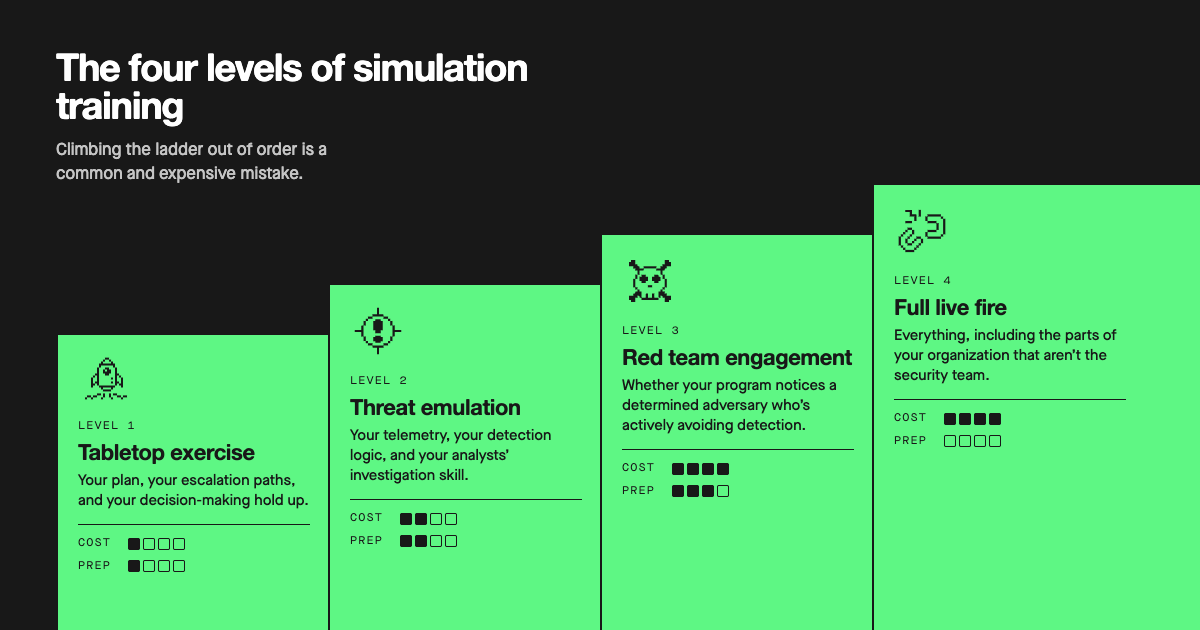
Think of these as a ladder. You can locate your team on it in about 30 seconds.
- Tabletop and discussion-based exercises. The team talks through a scenario in real time.
- Cost: Near zero.
- Prep: A few hours.
- Disruption: Two hours of calendar time.
- What it proves: Your plan, your escalation paths, and your decision-making hold up.
Full detail on the incident response tabletop exercise.
- Threat emulation. You reproduce a specific adversary’s techniques in a lab or scoped production environment and watch whether detections fire.
- Cost: Low to moderate—mostly engineering time.
- Prep: Days to weeks for the first one, much less afterward.
- Disruption: Minimal, if scoped properly.
- What it proves: Your telemetry, your detection logic, and your analysts’ investigation skill.
See threat emulation.
- Red team engagement. An offensive team attempts to achieve an objective without being caught, usually with only a couple of people inside the organization aware.
- Cost: High.
- Prep: Weeks.
- Disruption: Moderate and unpredictable.
- What it proves: Whether your program notices a determined adversary who’s actively avoiding detection.
Prep matters enormously here—see six things to do before you bring in a red team.
- Full live-fire. Nobody is told it’s a drill, and leadership, legal, and communications respond as though it’s real.
- Cost: High.
- Disruption: Real.
- What it proves: Everything, including the parts of your organization that aren’t the security team.
Few organizations need this, and fewer are ready for it.
Climbing the ladder out of order is a common and expensive mistake. A red team engagement is a costly way to discover that your incident response plan has never been read.
How to build a simulation training program
A program is four decisions, not a calendar invite.
- Set a cadence and defend it. A workable annual baseline for most teams: two tabletop exercises, four threat emulation exercises, one red team engagement. Scale down for a small team—two tabletops and two emulation exercises is a real program. Add an extra session after any major change to your environment, your tooling, or your on-call structure, because those are exactly the changes that quietly invalidate a plan.
- Name an owner. One person schedules, preps, and chases the follow-ups. Without a name against it, the cadence survives about two quarters. This doesn’t have to be a senior person, and it’s a genuinely good development assignment.
- Budget the two halves separately. Tabletop exercises need calendar time and nothing else. Emulation needs engineering hours and possibly lab infrastructure. Red teaming needs real money. Teams that lump these into one number tend to lose the cheap, high-value end of the ladder when budgets tighten.
- Close the loop into the plan. Every exercise produces a gap log, and every gap log has to land somewhere that outlives the session—usually the incident response plan, sometimes the runbooks, sometimes the org chart. An exercise whose findings never reach a document anyone reads is a training simulation of doing training.
Where to start if you have no budget
Level one costs nothing but calendar time, which means the barrier is never money. It’s permission and attention. Three moves get you from zero to a program without a purchase order.
- Attach the first exercise to something already on the calendar. A quarterly planning day, an on-call handover, the week after an audit. A session that needs its own two-hour invite from scratch gets rescheduled twice and then quietly dropped.
- Do it badly the first time, on purpose. A rough exercise that produces three real gaps beats a polished one that never gets scheduled. The prep gets faster and better from the second run, and the findings from the first run are what buy you the second.
- Report the gaps upward, not the exercise. “We ran a tabletop” is an activity update nobody funds. “We found that nobody can authorize host isolation outside business hours” is a decision somebody has to make, and it’s how a one-off turns into a standing line in the plan.
Our free Oh Noes! incident response tabletop exercise supplies the scenarios and role sheets so the first session needs no prep budget.
Expel’s take
Expel Managed Detection and Response (MDR) covers detection and response 24×7, which changes what your team needs to practice—but it doesn’t remove the need to practice.
What it changes is the mix. When a partner covers triage and the first stretch of investigation around the clock, your team spends less time practicing “did we see it” and more time practicing the things that stay in-house permanently: who has authority, who gets told, what gets shut off and by whom. Teams that keep running level-one exercises after onboarding an MDR provider tend to be the ones who’ve noticed that distinction. Teams that stop tend to assume coverage and readiness are the same purchase.
The cadence matters more than the sophistication. A team running two honest tabletop exercises a year and acting on the findings is in better shape than a team that bought a red team engagement, filed the report, and changed nothing. Our own 14-minute mean time to remediate on fully automated high and critical incidents is a number built from repetition, not from a single good quarter, and the same logic applies on your side of the line.
Ruxie carries the repetitive investigative work—enrichment, correlation, the legwork that used to eat the first stretch of every investigation. It’s AI in the human loop, deliberately. The judgment calls that simulation training exists to sharpen are exactly the ones we think a person should keep making.
Frequently asked questions
What is cybersecurity simulation training?
Cybersecurity simulation training is structured practice where a security team rehearses responding to realistic cyberattacks. It includes tabletop exercises, threat emulation, red team engagements, and live-fire drills, and it’s aimed at the security team rather than general staff.
How is simulation training different from security awareness training?
Security awareness training teaches all employees to spot threats like phishing. Simulation training tests whether the security team and its incident response plan hold up during an actual incident. They serve different audiences and should be budgeted separately.
Why is simulation training important for a security team?
Plans that have never been used tend to fail in predictable ways: unclear ownership, missing escalation paths, and slow decisions. Simulation training surfaces those failures at a time when nothing is actually burning and the fix is cheap.
How often should a security team run simulation training?
A practical baseline is a tabletop exercise twice a year, a threat emulation exercise quarterly, and a red team engagement annually. Adjust down if the team is small, and add a session after any major tooling or org change.
How do you start simulation training with no budget?
Start with a discussion-based tabletop exercise. It needs one facilitator, two hours, and a scenario—no tooling and no vendor. Free kits like Oh Noes! include the scenarios and role sheets, so the only real cost is calendar time.