

An incident response tabletop exercise is a facilitated, discussion-based drill in which a security team works through a simulated attack scenario to test its incident response plan. Nothing in production is touched. The output is a list of gaps in process, ownership, and communication.
Key takeaways
- A tabletop exercise is a conversation, not a technical test. Nobody touches production.
- Two hours is the standard block: roughly 15 minutes of setup, 75 minutes of play, 20 minutes of debrief.
- Four people is a workable minimum. An incident master, a security analyst, someone from IT, and someone who can speak for leadership.
- The exercise tests the plan, not the tooling. Most of what it finds is ownership and escalation, not detection.
- The deliverable is a written gap log with names and dates on it. An exercise that doesn’t produce one didn’t happen.
An incident response plan is a document that describes what a team will do under conditions it has never experienced. That’s a hard thing to get right on the first draft, and most plans are never stress-tested before the day they’re needed. A tabletop exercise is the cheapest available way to find out whether yours holds. You put the team in a room, run a realistic attack at them in stages, and watch where the conversation stalls. Every stall is a gap you now know about while fixing it is still free.
Why teams run tabletop exercises
Technical testing tells you whether your controls fire. A tabletop exercise tells you what happens in the 20 minutes after they do, and that’s a different failure surface entirely.
Four things come up repeatedly:
- Unclear ownership. The plan names a role. In the room, three people think someone else has it, or the named person doesn’t have the authority the role implies.
- Missing escalation paths. The team knows an incident is serious. Nobody is sure who to wake up at 2am, or whether this clears the bar for waking anyone.
- Legal and communications lag. Security works the incident alone for an hour. Legal arrives to discover a notification clock started before anyone called them.
- Decision paralysis. Someone has to choose between containing the incident and preserving evidence, or between pulling a production system offline and letting an intrusion continue. Without a pre-agreed principle, the conversation loops.
None of these are tooling problems, which is why no amount of tooling finds them. The thing being tested is your incident response plan—if the exercise exposes a plan that’s thinner than expected, that’s the page to start from.
| Tabletop exercise | Technical simulation | Live fire drill | |
|---|---|---|---|
|
What happens |
The team talks through a scenario | Attacker behavior is executed in a lab or scoped production | A full unannounced incident runs against the live environment |
|
Production impact |
None | Minimal to contained | Real |
|
What it proves |
The plans and the decisions work | Detections fire and analysts can work them | The whole program holds under pressure |
The deeper comparison—including how these relate to penetration testing and red teaming—lives on breach and attack simulation.
Who takes part and what each role does
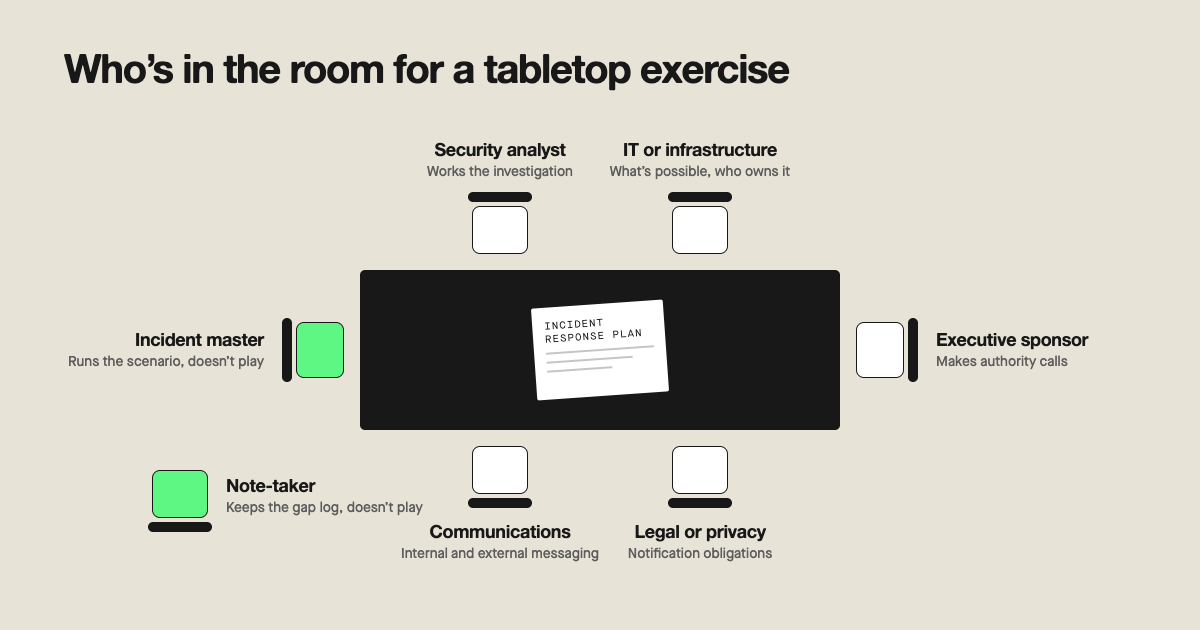
This is about who’s in the room during the exercise, not your full incident response org chart.
| Role in the room | Responsibility during the session |
|---|---|
|
Incident master |
Runs the scenario, releases injects on the clock, stays neutral. Preps in advance. |
|
Note-taker |
Captures the gap log; doesn’t play. This role is skipped constantly, which is a mistake. |
|
Security analyst |
Works the technical investigation out loud—which queries, which logs, and for how long. |
|
IT or infrastructure |
Answers what’s possible, who owns it, and how long changes actually take. |
|
Communications |
Handles internal and external messaging decisions. |
|
Legal or privacy |
Flags notification obligations and contractual triggers. |
|
Executive sponsor |
Makes authority calls and experiences the cost of incomplete information. |
Full team structure, sizing, and the RACI matrix for incidents outside the exercise room are covered on the incident response team page.
What a two-hour tabletop exercise looks like
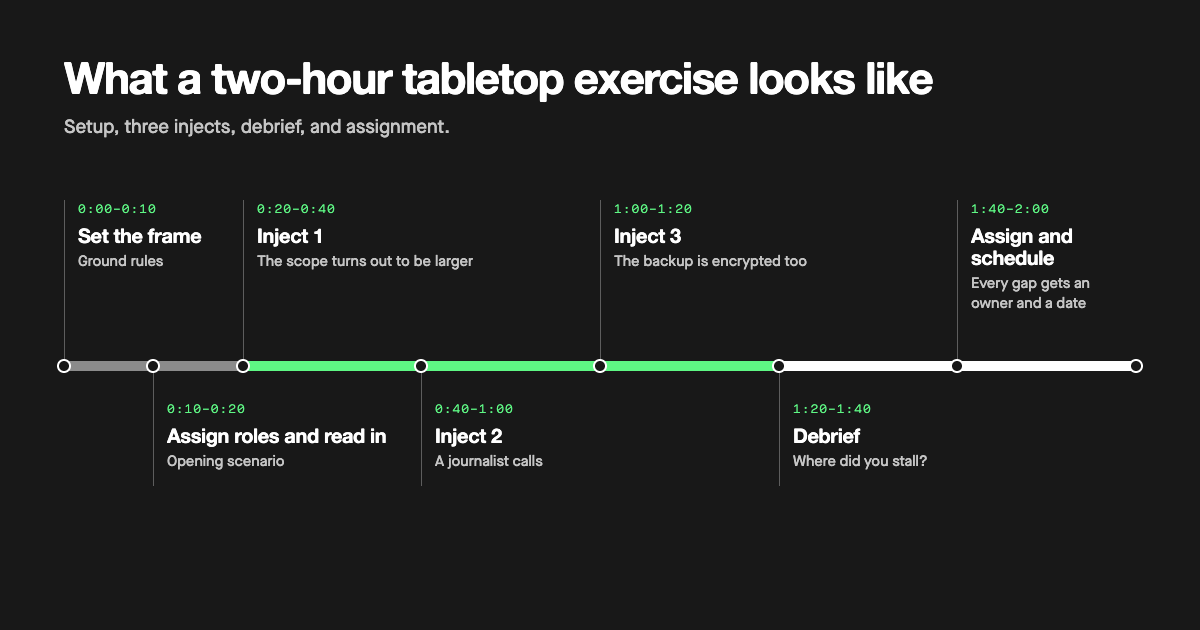
0:00–0:10—Set the frame
The incident master states the ground rules: this is a discussion, “I’d check the logs” isn’t an answer, and the current incident response plan is on the table for gaps to be marked against.
0:10–0:20—Assign roles and read in
Each player takes a role. The incident master delivers the opening scenario—one alert, one phone call, one piece of incomplete information.
0:20–1:20—Play, in three injects
The incident master releases new information roughly every 20 minutes. Each inject should change the shape of the problem: the scope turns out to be larger, a journalist calls, the backup you were counting on is encrypted too. Players respond in character and the incident master keeps asking the follow-up question—which logs, who has access, how long does that take.
1:20–1:40—Debrief
Go around the table. What did you need and not have? Where did you stall? What did you assume that turned out to be wrong? The note-taker logs each one.
1:40–2:00—Assign and schedule
Every gap gets a named owner and a date. Book the follow-up review before anyone leaves. This block is the difference between an exercise and an afternoon.
Common tabletop exercise scenarios
Pick a scenario that maps to systems your team actually owns. A generic one produces a generic conversation.
- Ransomware: Encryption starts on a file server outside business hours. Tests containment authority, backup assumptions, and whether anyone will disconnect a production system without waiting for approval.
- Business email compromise: A finance leader’s account sends a payment redirect that clears internal review. Tests identity response, session revocation speed, and how quickly fraud gets reported up.
- Insider data exfiltration: A departing employee moves a large volume of data to personal storage. Tests your legal and HR coupling, your monitoring coverage on sanctioned tools, and who decides whether to confront someone.
- Cloud credential abuse: A developer access key is used from an unfamiliar region. Tests cloud logging coverage, key rotation, and whether anyone can quickly answer what that key could reach.
- Third-party breach: A vendor tells you they were compromised and your data may be involved. Tests contractual notification handling, your vendor inventory, and who owns the relationship under pressure.
Expel’s take
Expel Managed Detection and Response (MDR) covers the detection and response layer 24×7, and a tabletop exercise tests the part that stays with your team no matter who watches your alerts.
We run these ourselves, and what we see in customer environments matches what teams find in their own rooms: the detection is rarely the bottleneck. Our median time to detect is 2.41 minutes, and our mean time to respond is 13 minutes. Those numbers only translate into a contained incident if the decisions on your side keep pace—if someone can authorize isolation, if legal is already in the thread, and if the person who needs to know is reachable.
That’s the handoff a tabletop exercise makes visible. It’s also why we built a free one. Our Oh Noes! incident response tabletop exercise gives you the scenarios, the role sheets, and a guide for running it yourself—no facilitator, no budget, two hours.
Frequently asked questions
What is an incident response tabletop exercise?
An incident response tabletop exercise is a discussion-based drill where a team talks through a simulated attack scenario in real time. No systems are touched. It tests whether the incident response plan, the escalation paths, and the people all work together under pressure.
What scenarios should you use in a tabletop exercise?
Start with the incidents most likely to hit your organization: ransomware, business email compromise, stolen cloud credentials, insider data exfiltration, and a third-party or vendor breach. Pick a scenario that maps to systems your team actually owns, not a generic one.
What is the difference between a tabletop exercise and a simulation?
A tabletop exercise is a discussion: people describe what they would do. A technical simulation or threat emulation exercise actually executes attacker behavior in a lab or production environment so you can see whether detections fire. Most teams need both.
How do you prepare for a tabletop exercise?
Pick one scenario, write three or four escalating injects, confirm attendees and their roles, book two uninterrupted hours, and decide in advance who is facilitating. Have the current incident response plan in the room so gaps get marked against the real document.
What should come out of a tabletop exercise?
A written gap log with named owners and dates. The exercise itself has little value if the findings aren’t converted into changes to the incident response plan, the on-call rota, or the escalation matrix within a few weeks.