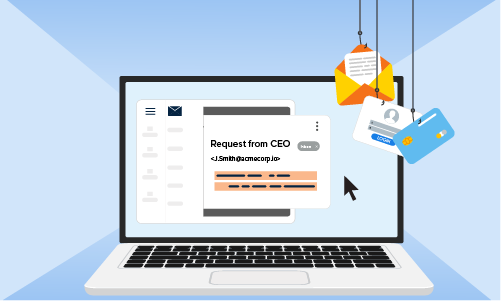

Phishing is a social engineering attack in which adversaries impersonate legitimate entities via email, text, or other channels to trick users into revealing credentials, clicking malicious links, or downloading malware. It remains one of the most common initial access vectors in cybersecurity incidents.
Phishing scams often exploit human psychology rather than technical vulnerabilities, making them particularly dangerous and effective. Cybercriminals carefully craft these messages to appear authentic, often replicating the exact look and feel of legitimate communications from trusted organizations like banks, social media platforms, or government agencies.
Why does phishing matter?
Phishing attacks remain one of the most prevalent and successful forms of cyberattack, with devastating consequences for both individuals and organizations:
- Financial losses reaching billions annually worldwide, with the FBI’s Internet Crime Complaint Center reporting over $4.1 billion in losses from business email compromise attacks alone in recent years. These attacks often start with sophisticated phishing campaigns targeting key employees.
- Compromised personal and corporate data leads to cascading security breaches. Once attackers gain access to one system, they often use that foothold to move laterally within networks, compromising additional systems and gathering more sensitive data. This can include intellectual property, customer databases, financial records, and employee personal information.
- Damaged business reputation and lost customer trust can persist long after the initial attack. Organizations that fall victim to phishing attacks often face significant challenges in maintaining customer confidence, particularly if sensitive customer data is exposed. The recovery process can take years and require substantial investment in rebuilding trust through enhanced security measures and transparency.
- Regulatory fines for data breaches have become increasingly severe, with legislation like GDPR imposing penalties of up to 4% of global annual revenue. Organizations must demonstrate they took reasonable precautions to prevent phishing attacks or face heightened scrutiny from regulators.
- Gateway to more severe cyberattacks like ransomware, as phishing often serves as the initial entry point for more sophisticated attacks. Criminals may use compromised credentials to deploy ransomware, conduct espionage, or establish longterm persistent access to networks.
Expel’s 2026 Annual Threat Report
Our SOC sees millions of alerts yearly. Here’s what attackers are actually doing—and how to play defense when you’re short on time and people.
What are the types of phishing attacks?
Email phishing is the most common form—attackers send fraudulent emails masquerading as legitimate organizations, often creating urgency or fear to compel quick action. Common lures include password reset notifications, invoice or payment alerts, shipping updates, and IT support messages.
Spear phishing is a highly targeted variant directed at specific individuals or organizations. Attackers gather personal information from social media, professional networks, company websites, and data breaches to craft personalized messages that reference real events, colleagues, or projects—making them extremely difficult to identify as fraudulent.
Whaling is a subset of spear phishing that targets high-profile executives or senior employees with access to sensitive data or financial resources. These attacks often exploit authority and urgency to bypass normal security procedures and may target executive assistants and support staff as an indirect path to the intended victim.
Vishing (voice phishing) uses phone calls to extract sensitive information, with attackers posing as technical support, bank fraud departments, government agencies, or healthcare providers. VoIP technology enables caller ID spoofing to make calls appear to come from legitimate sources.
Smishing (SMS phishing) uses text messages with similar tactics to email phishing. Common lures include package delivery notifications, banking alerts, and two-factor authentication codes. The limited screen space and immediate nature of text messages make it harder for victims to verify legitimacy.
Clone phishing involves copying a legitimate email previously sent by a trusted source and replacing the original attachments or links with malicious ones. Because the content mirrors a real message the recipient may have already seen, these attacks can be particularly convincing.
What techniques do phishing attackers use?
Regardless of the attack type, phishing relies on a consistent set of manipulation techniques:
Spoofed sender addresses: attackers use domain spoofing, display name spoofing, lookalike domains, and email header manipulation to make messages appear to come from legitimate sources.
Urgency creation: fake account suspension notices, payment overdue warnings, legal action threats, and limited-time offers are designed to prevent careful consideration before clicking.
Brand impersonation: exact replication of logos, color schemes, email layouts, and disclaimer text makes fraudulent messages visually indistinguishable from the real thing.
Social engineering: attackers exploit authority figures, fear of missing out, professional obligation, and personal relationships to manufacture pressure that overrides skepticism.
How do you prevent phishing attacks?
Effective phishing defense requires both technical controls and human awareness working together.
Technical controls include advanced email filtering, real-time URL scanning, attachment analysis, domain authentication, and network segmentation. These create multiple layers of protection that reduce the volume of malicious messages that reach employees in the first place.
Employee education is equally critical. Continuous training programs should cover threat recognition, safe email practices, and proper incident reporting procedures—and must evolve alongside new attack techniques.
Incident response procedures should be clearly defined so that when phishing succeeds, the response is swift: disconnect affected systems, reset compromised credentials, notify relevant stakeholders, and preserve evidence for investigation.
How is phishing evolving?
The phishing landscape is changing rapidly. AI now enables highly tailored attacks through natural language processing, automated reconnaissance, and voice cloning for vishing. Deepfake technology produces increasingly convincing impersonations. Mobile devices have become a primary target, with growing emphasis on messaging apps, mobile banking platforms, and QR code manipulation.
Defenses are adapting through machine learning detection, behavioral analysis, and zero-trust architectures—but the threat will continue to evolve. Organizations that stay ahead will need adaptive defenses, continuous user education, and cross-organization threat intelligence sharing.
Advanced phishing methods include:
AI-powered attacks
- Natural language processing for more convincing messages
- Automated social engineering reconnaissance
- Dynamic content generation based on target profiles
- Voice cloning for vishing attacks
- Behavioral analysis to improve attack timing
- Automated vulnerability identification
Mobile-focused threats
- Advanced SMS and messaging app attacks
- Mobile banking trojans
- App-based phishing schemes
- QR code manipulation
- Mobile device management bypasses
- Cross-platform attack coordination
Enhanced social engineering
- Deep-fake technology integration
- Realtime attack customization
- Emotional manipulation algorithms
- Context-aware attack timing
- Multichannel attack coordination
- Automated relationship mapping
The future of phishing defense will require:
- Advanced AI-powered detection systems
- Behavioral analysis and anomaly detection
- Zero trust security architectures
- Continuous authentication methods
- Enhanced user education and awareness
- Crossorganization threat sharing
- Adaptive security responses
- Regular security posture assessments
Phishing attacks remain a significant cybersecurity threat, growing in both sophistication and impact. Effective defense demands a multi-layered approach that integrates advanced technical controls, ongoing employee training, and proactive threat detection. As attackers refine their techniques, organizations must stay alert and agile to address new and emerging risks.
Frequently asked questions
Why does phishing matter?
Phishing matters because it’s one of the most reliable and cost-effective attack methods available to cybercriminals. It bypasses technical controls by targeting people directly, and its consequences extend well beyond the initial compromise. A single successful phishing email can lead to credential theft, ransomware deployment, regulatory penalties, and reputational damage that takes years to repair. For security teams, phishing is also a high-volume problem—which is why efficient detection and response capabilities are essential.
What are the types of phishing attacks?
Phishing takes many forms depending on the target and channel. Email phishing casts a wide net using fraudulent messages that impersonate trusted organizations. Spear phishing and whaling are targeted variants that use personal research to attack specific individuals or executives. Vishing and smishing extend the same tactics to phone calls and text messages, respectively. Clone phishing reproduces legitimate emails with malicious payloads substituted in. Each variant exploits trust and urgency—the delivery mechanism changes, but the underlying technique doesn’t.
What techniques do phishing attackers use?
Phishing attackers combine technical deception with psychological manipulation. On the technical side, they spoof sender addresses, clone brand assets, and manipulate email headers to make messages appear legitimate. On the psychological side, they manufacture urgency, invoke authority, and exploit trust to push recipients into acting before they think. These techniques work together—a visually convincing email delivered with the right emotional pressure is far more effective than either element alone.
How do you prevent phishing attacks?
Phishing prevention works best as a layered strategy. Technical controls—email filtering, URL scanning, domain authentication—reduce what reaches employees. Security awareness training improves employees’ ability to recognize and report what gets through. And a defined incident response process ensures that when a phishing attempt succeeds, the damage is contained quickly. No single control is sufficient on its own; the combination is what makes the defense effective.
How is phishing evolving?
Phishing is becoming more targeted, more convincing, and harder to detect at scale. AI enables attackers to automate reconnaissance, generate personalized lures, and even clone voices for vishing attacks. Deepfakes are making impersonation more believable across both audio and video channels. Mobile-focused attacks are increasing as users conduct more sensitive activity on devices with less security visibility. Organizations need defenses that can adapt as quickly as the threat does—static controls and annual security training are no longer sufficient.
How Expel can help
Expel Phishing provides comprehensive detection and response against email threats. When employees report suspicious emails, Expel’s analysts investigate, determine if they’re malicious, and notify both your team and the employee. The service examines user interactions with suspicious emails, checks if anyone else received the same threat, and provides detailed remediation recommendations. Supporting major email providers like Microsoft 365 and Google Workspace, Expel Phishing employs a structured quality control process to ensure consistent, high-quality analysis of every reported email. By handling the time-consuming process of investigating suspicious emails, Expel allows your security team to focus on strategic priorities while maintaining robust protection against evolving phishing threats. Learn more about the service here.