

Managed security services (MSS) are outsourced cybersecurity functions—monitoring, threat detection, and incident response—delivered by a third-party provider. They let organizations extend their security capabilities without the cost and complexity of building everything in-house.
Key takeaways
- Managed security services (MSS) cover a broad range of outsourced functions: firewall management, vulnerability scanning, SIEM monitoring, endpoint security, identity management, threat intelligence, incident response, email security, and more.
- MDR is a specialized subset of MSS—it adds proactive threat hunting, human expert analysis, and actual response actions on top of the monitoring that traditional MSSPs provide.
- Organizations adopt MSS to close gaps caused by talent shortages and alert fatigue, get 24×7 coverage without building it in-house, and meet compliance requirements for continuous monitoring and documented incident response.
Managed security services (MSS) are outsourced services provided by third-party companies (sometimes called managed security service providers or MSSPs) to manage and protect an organization’s cybersecurity operations.
These services typically include monitoring, managing, and responding to security threats, vulnerabilities, and incidents in real time. MSS providers offer a range of security functions such as intrusion detection, firewall management, vulnerability scanning, threat intelligence, and security event management. By adopting managed security services, organizations can improve their security posture, ensure compliance with regulations, and reduce the burden on in-house IT and security teams.
What do managed security services include?
Managed security services encompass many security functions that organizations can outsource to strengthen their cybersecurity posture. Common types of managed security services include:
- Intrusion detection and prevention systems (IDPS): Continuous security monitoring of network traffic for suspicious activity, with the capability to block or mitigate threats in real time
- Managed firewall: Configuration, monitoring, and management of firewall systems to protect networks from unauthorized access and cyberattacks
- Vulnerability management: Regular scanning, identification, and remediation of security vulnerabilities in an organization’s systems and networks
- Security information and event management (SIEM): Aggregation and analysis of security events and logs to detect and respond to threats, often with 24×7 monitoring
- Endpoint security management: Protection and management of endpoints (like laptops, servers, and mobile devices) through antivirus, anti-malware, and other security tools
- Threat intelligence: Collection and analysis of data on potential threats, providing actionable insights to prevent or mitigate cyberattacks
- Incident response and remediation: Proactive and reactive services to handle security breaches or incidents, including investigation, containment, and recovery efforts
- Identity and access management (IAM): Management of user identities, permissions, and access to ensure that only authorized individuals have access to critical systems and data
- Managed detection and response (MDR): Advanced threat detection and response services, combining human expertise with technology to identify and respond to sophisticated threats
- Compliance management: Assistance with meeting regulatory and compliance requirements by managing security controls, audits, and reporting
- DDoS protection: Protection against distributed denial of service (DDoS) attacks, ensuring that an organization’s online services remain available during an attack
- Email security management: Filtering and protecting email communications from threats like phishing, malware, and spam
These services can be tailored to an organization’s specific needs, providing comprehensive security coverage and allowing internal teams to focus on core business functions.
See how MDR works in real-time with our on-demand demo
See how our 24×7 SOC actually protects you—no sales meeting required.
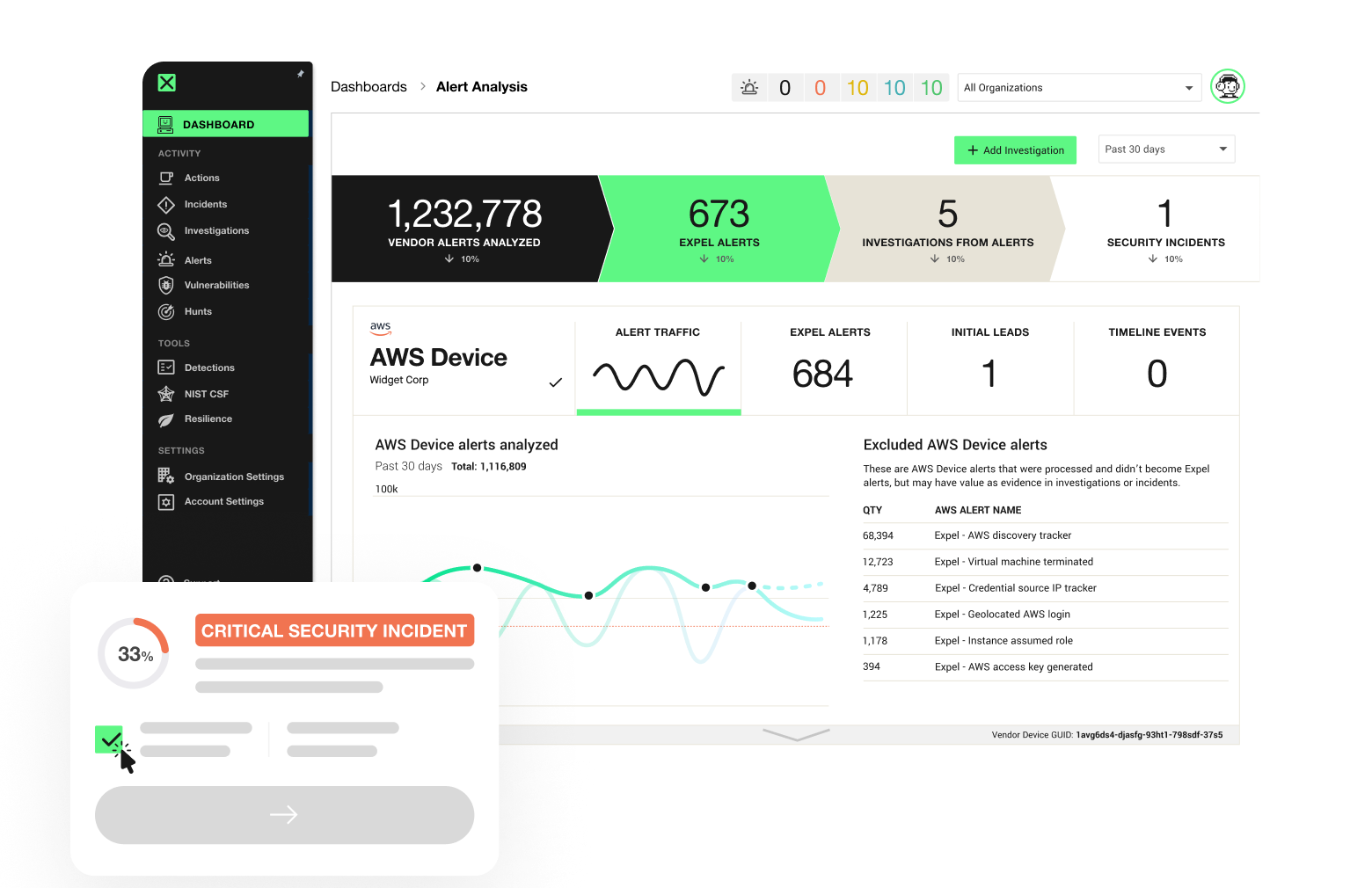
What is managed detection and response in managed security services?
Managed detection and response (MDR) is a specialized service within the broader category of managed security services. It focuses on the proactive detection, investigation, and response to threats in an organization’s environment. Unlike traditional security services that may rely heavily on automated tools, MDR combines advanced technology with human expertise to identify and respond to sophisticated threats that might evade standard defenses. Partnering with an MSSP that offers MDR provides organizations with enhanced threat detection capabilities.
The three terms get used interchangeably in vendor marketing, but they describe different things—a category, a provider type, and a service model.
| MSS | MSSP | MDR | |
|---|---|---|---|
|
What the term refers to |
The umbrella category of outsourced security functions | The provider that delivers them, usually across a broad tool set | A specialized service inside MSS, focused on detection and reponse |
|
Primary job |
Extend security capacity you don’t have in-house | Keep security tools configured, running, and monitored | Find, investigate, and contain threats |
|
Typical scope |
Anything from firewall management to IAM to compliance reporting | Firewalls, IDPS, VPN, SIEM, endpoint tools, log retention | Endpoint, cloud, identity, network, and SaaS telemetry mapped to detections |
|
Detection approach |
Varies by service purchased | Mostly vendor-supplied rules and signatures on the tools under management | Custom detection engineering, behavioral analytics, and hypothesis-based threat hunting |
|
What happens on a real alert |
Contract-dependent | You get a ticket or escalation and your team investigates | Provider’s analysts investigate, confirm, and take or recommend containment actions |
|
Who owns response |
You, unless the contract says otherwise | You | Shared, with defined actions the provider executes directly |
|
Coverage |
Service-dependent | Often 24×7 uptime monitoring, with business-hours analysis | 24×7 analyst coverage |
|
Best fit |
Orgs filling a specific, defined gap | Orgs that need tools managed and compliance evidence produced | Orgs that need threats caught and stopped, not just alerts routed |
|
What you still own |
Whatever isn’t in scope | Investigation, triage decisions, and remediation | Environment ownership, business context, and sign-off on out-of-scope actions |
MDR services usually include:
- Threat detection: Managed detection and response services use a combination of advanced analytics, machine learning, and threat intelligence to continuously monitor and detect potential threats in real time.
- Threat hunting: This proactive hunting for hidden or emerging threats that might not trigger automated alerts requires deep analysis of network, endpoint, and cloud activities to uncover malicious behaviors.
- Incident investigation: When a threat is detected, MDR providers investigate the incident to understand the scope, impact, and nature of the threat. This includes analyzing logs, system behaviors, and other data sources.
- Response and remediation: Once a threat is confirmed, MDR services provide or recommend specific actions to contain and neutralize the threat. This might include isolating affected systems, removing malicious software, or blocking malicious IP addresses.
- Continuous monitoring: MDR services typically offer 24×7 monitoring of an organization’s IT environment, ensuring that any suspicious activity is quickly identified and addressed.
- Reporting and analysis: Regular reports and insights are provided to the organization, detailing the threats detected, actions taken, and recommendations for improving security posture.
MDR enhances an organization’s ability to detect, investigate, and respond to security threats more effectively and efficiently, providing a higher level of security coverage than many traditional managed security services.
Why do organizations choose managed security services?
All IT services need skilled people from either inside or outside the business. However, the complexity of cybersecurity is escalating—and it’s becoming increasingly dangerous and damaging when hackers and online criminals succeed in breaching networks. The rapidly evolving targets and tactics of security threats require skilled and dedicated cybersecurity teams with ongoing training and continually updated security technology.
Many organizations lack the budget and people for comprehensive security services. The talent gap in security—along with “alert fatigue”—severely strains in-house security teams. Outsourced managed security services provider solutions can alleviate these pressures.
Benefits of managed security services
Today’s organizations face increasingly sophisticated threats while managing resource constraints. Outsourcing security services offers critical advantages by providing round-the-clock security expertise without the overhead of fully staffing a 24×7 internal team. This approach offers immediate access to specialized threat analysts who continuously monitor environments when internal teams are unavailable.
By implementing proven detection methodologies and automated response workflows, outsourcing security services can significantly shorten threat identification timeframes and containment periods. Advanced hunting capabilities uncover stealthy adversaries that might evade traditional security controls. Organizations also strengthen their compliance programs through systematic monitoring and comprehensive security documentation.
The flexible nature of managed security services allows coverage to expand alongside business growth without proportional resource investments. By effectively triaging alerts and eliminating noise, outsourcing can help security teams focus on genuine threats instead of false positives. When incidents occur, swift expert response minimizes operational impact and protects organizational reputation against damaging data breaches.
Expel’s take
Managed security services (MSS) is a broad category, and the most important distinction within it is between providers who manage your tools and providers who actually investigate and contain threats. Traditional MSSPs handle device configuration, firewall rule management, and alert forwarding—valuable, but fundamentally reactive and passive. MDR sits at the active end of the spectrum: Expel analysts investigate confirmed incidents, correlate activity across your entire stack, and execute containment actions directly rather than sending you a ticket and waiting. The practical question when evaluating any MSS provider is where on that spectrum they operate and what they’re actually authorized to do when something real happens. Coverage breadth matters too: Expel MDR covers detection and response, threat hunting, phishing investigation, and vulnerability prioritization as a unified service—not as separate add-ons that require separate contracts and separate coordination. The clearer the delineation between what the provider does autonomously and what requires your sign-off, the fewer gaps appear when speed matters most.
How Expel approaches managed security services
Expel delivers API-driven managed detection and response (MDR) that reduces risk and strengthens your security posture. We enhance your existing security program with precise detections and automation that deliver industry-leading results across all cloud environments—with complete transparency.
Expel MDR covers detection and response, threat hunting, managed phishing protection, and vulnerability prioritization. We combine expert practitioners, specialized knowledge, and innovative technology to handle security operations while you focus on building trust with customers, partners, and employees.
Our security operations platform powers all our services, using advanced AI to eliminate false positives, correlate high-priority alerts, and provide crucial context—delivering actionable answers faster—with a 13-minute MTTR—providing clear remediation guidance and unmatched visibility to enhance your security program.
Frequently asked questions (FAQs)
What are managed security services?
Managed security services are cybersecurity functions you outsource to a third-party provider instead of staffing them internally. That covers a wide range—firewall and endpoint management, vulnerability scanning, SIEM monitoring, identity and access management, email security, threat intelligence, compliance reporting, and incident response. Providers deliver them individually or bundled, usually on a subscription. The category is broad enough that two providers can both call themselves managed security services and do almost nothing alike, which is why scope matters more than the label.
What are the benefits of managed security services?
The main one is round-the-clock coverage without hiring for it—staffing a 24×7 internal rotation takes eight to ten analysts before you account for turnover. You also get access to detection content and threat intelligence that a provider maintains across its whole customer base, which is more current than most in-house teams can keep up. Alert triage handled externally means your team spends its time on genuine threats instead of false positives. And systematic monitoring plus documented response produces the audit evidence most compliance frameworks require.
How much do managed security services cost?
Pricing usually keys off one of three things: number of endpoints or users, volume of data ingested, or a flat tier tied to a defined scope of services. Cost scales with breadth of coverage and depth of response—monitoring-only contracts are the cheapest, and services where the provider actively investigates and contains threats cost more. The variables that move the number most are how many log sources you onboard, how many surfaces you want covered, and whether response actions are included or billed as incident work. Ask what’s excluded rather than what’s included; the gaps are where unplanned spend shows up.
What’s the difference between MSS and MDR?
MSS is the category and MDR is a service inside it. Most traditional managed security services focus on keeping your tools running and forwarding alerts to your team. MDR focuses on the detection and response work itself—building custom detections, investigating what fires, and taking containment action. The practical test is what the provider does when something real happens: route it to you, or handle it.
How do you choose a managed security services provider?
Start by naming the gap you’re actually filling—24×7 coverage, cloud visibility, compliance evidence, or response capacity—because providers optimize for different ones. Then get specific about response authority: what actions the provider can take without asking, and what waits for your approval. Ask how detections get built and maintained, since vendor-default rules age badly. Finally, check whether you can see the provider’s work in progress or only its monthly report—transparency is what tells you whether the service is doing anything.