

ITDR vs. SIEM is a common comparison among security teams evaluating their identity detection coverage. SIEM (security information and event management) aggregates and correlates log data across the entire environment. ITDR (identity threat detection and response) applies behavioral analytics specifically to identity telemetry to detect credential abuse, MFA bypass, and lateral movement that SIEM wasn’t designed to surface.
Key takeaways
- SIEM correlates log data broadly across the environment; ITDR focuses behavioral analytics on identity telemetry specifically
- SIEM sees authentication events as log entries; ITDR establishes behavioral baselines per identity to detect what those logs hide
- ITDR doesn’t replace SIEM—it enriches the identity signal SIEM receives, reducing alert volume and improving fidelity
- Organizations that rely on SIEM alone for identity threat detection have a structural blind spot: SIEM has no per-identity behavioral baseline
- The right question isn’t “ITDR or SIEM?”—it’s “does our SIEM have enough identity context to detect credential abuse?”
The question “do I need ITDR if I already have a SIEM?” comes up in almost every identity security evaluation. It’s a reasonable question—SIEM ingests identity logs, fires authentication alerts, and sits at the center of most SOC workflows. The answer, though, is that SIEM and identity threat detection and response (ITDR) solve different problems. SIEM was built for breadth: correlating events across network, endpoint, application, and identity data at scale. ITDR was built for depth: establishing behavioral baselines per identity and detecting the anomalies that log correlation alone can’t surface. This page breaks down what each tool does, where SIEM has structural limits on identity detection, and how to decide whether you need both.
What does SIEM do, and what are its limits on identity?
SIEM aggregates log data from across the environment—network devices, endpoints, applications, cloud services, and identity systems—and applies correlation rules to surface potential threats. In a mature SIEM deployment, authentication events from Active Directory, Okta, Azure Entra ID, and cloud IAM systems flow into the SIEM alongside network and endpoint telemetry.
SIEM is powerful at breadth correlation: detecting when an account that authenticated from an unusual IP also triggered an endpoint alert and accessed a sensitive share within a short window. That cross-domain correlation is genuinely valuable.
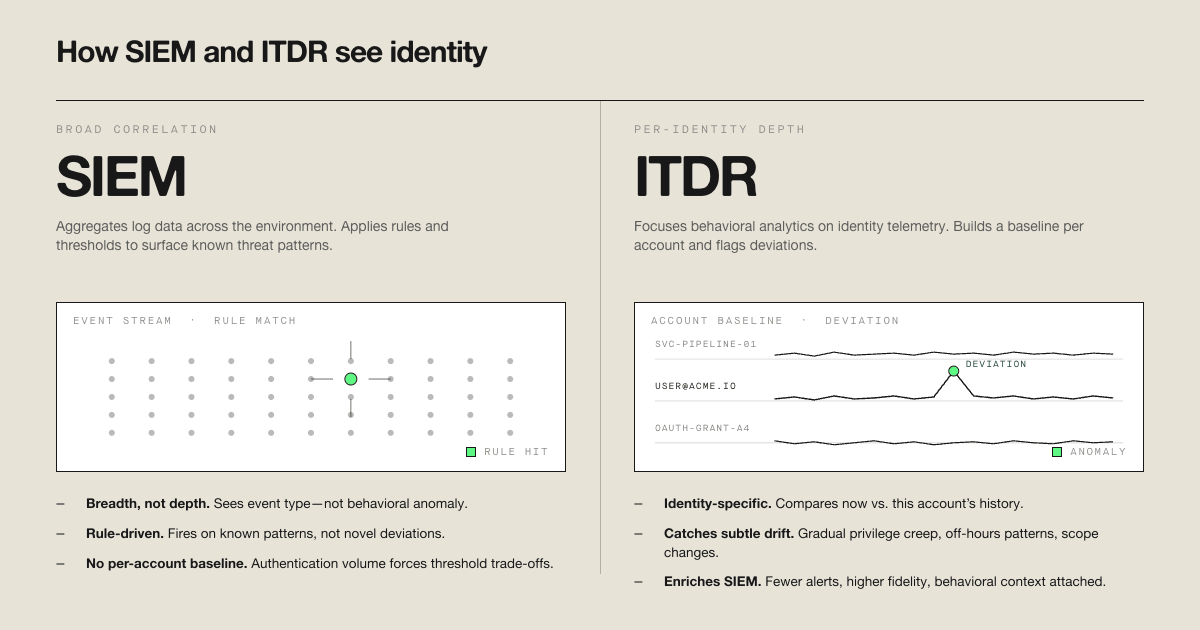
But SIEM has a structural limitation on identity detection: it has no per-identity behavioral baseline.
When a SIEM receives an authentication event, it evaluates it against rules—known bad IPs, impossible travel thresholds, authentication failure counts. It can’t ask: “Is this what this specific account normally does?” Authentication volume in large environments is enormous, and SIEM wasn’t designed to maintain behavioral models for tens of thousands of individual identities. The result is one of two outcomes: too many alerts (every unusual authentication fires) or too few (thresholds are raised to reduce noise, and real attacks slip through).
| SIEM capability | Strength | Identity detection limit |
|---|---|---|
|
Log aggregation |
Ingests identity events at scale | Sees event type, not behavioral anomaly |
|
Correlation rules |
Cross-domain threat detection | Rules fire on known patterns, not novel deviations |
|
Alert generation |
Broad threat surface coverage | High authentication volumes result in noise or threshold-raising |
|
Per-identity baseline |
Not designed for this | No behavioral model per account |
What does ITDR do that SIEM can’t?
ITDR addresses the exact gap SIEM leaves open. Rather than correlating events across the environment, ITDR focuses specifically on identity telemetry—ingesting authentication events, privilege changes, session activity, and API calls from cloud IAM, SaaS, and on-premises directories—and builds per-identity behavioral models.
The detection signals ITDR surfaces that SIEM typically misses:
- Impossible travel with valid MFA: SIEM can fire on impossible travel, but often suppresses the alert when MFA succeeds. ITDR understands that MFA success doesn’t eliminate the anomaly; AiTM phishing produces exactly this pattern.
- First-time access to sensitive resources: SIEM rules don’t know whether this account has ever accessed this resource before. ITDR does.
- Gradual privilege escalation: Slow, incremental privilege additions over days or weeks stay below SIEM alert thresholds. ITDR’s behavioral baseline catches cumulative drift.
- Service account deviation: API calls from service accounts at unusual times, volumes, or to unexpected endpoints look like normal traffic in SIEM correlation. ITDR flags the deviation from baseline.
- MFA configuration changes: New authenticator enrollment, MFA method changes, and backup code generation are high-signal identity events that rarely make it into SIEM detection rules at the right fidelity.
For more on specific detection use cases, see how to detect MFA bypass attacks.
Signs your SIEM is missing identity attacks
Most SIEMs are missing identity attacks—the question is whether you can tell. These are the operational signals that your SIEM’s identity detection coverage has gaps:
You’re tuning down authentication alerts because there are too many. When teams raise authentication alert thresholds to manage volume, they’re trading detection coverage for quiet. Every threshold raised is a window an attacker can operate within undetected.
Your SIEM fires on authentication failures but not authentication successes. Identity attacks like AiTM phishing, push bombing, and session hijacking produce successful authentication events. If your detection logic is built around failure counts, it’s blind to the attacks that have already succeeded.
You have no baseline for what “normal” looks like per account. Can your SIEM tell you the last time this specific service account called the KMS API? Whether this user has ever authenticated from this ASN before? If not, you can’t detect deviations—only rule matches.
Identity alerts arrive with no behavioral context. When an identity alert lands in your SIEM queue, does it tell you whether this behavior is normal for this account? Or just that a threshold was crossed? Pre-investigated, behaviorally enriched alerts are the difference between a 30-second triage and a 30-minute one.
You’ve had identity incidents that your SIEM didn’t surface. The clearest signal: if a credential abuse incident, unauthorized access event, or MFA bypass has ever been discovered through means other than a SIEM alert—a user report, a routine access review, an unrelated investigation—your SIEM has a detection gap at the identity layer.
Do I need ITDR if I already have a SIEM?
For most organizations with meaningful cloud or SaaS footprints: yes. SIEM alone has structural limits on identity detection that aren’t resolved by tuning, adding more rules, or increasing log coverage. The limitation is architectural—SIEM wasn’t designed to maintain per-identity behavioral models.
The question to ask is: Can your SIEM tell you whether this authentication is normal for this specific account? Not whether it matches a known-bad IP or fires a threshold rule—but whether the behavioral pattern is consistent with this account’s history. If the answer is no, that’s the gap ITDR fills.
Organizations in high-risk identity environments—regulated industries, remote workforces, heavy SaaS adoption, or any environment where credential-based attacks are a primary threat vector—have the most to gain from adding ITDR alongside their SIEM.
How do ITDR and SIEM work together?
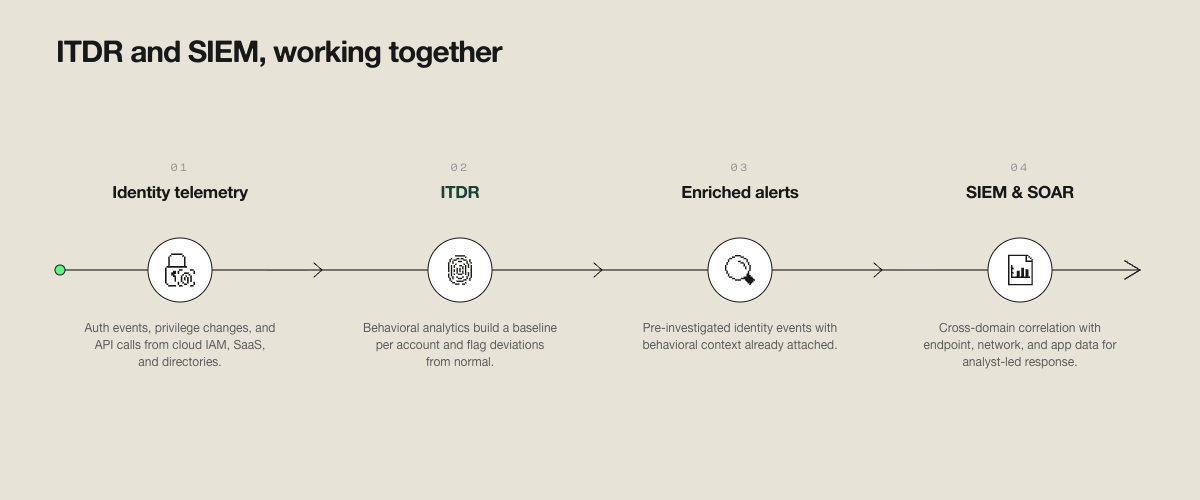
In a mature deployment, ITDR and SIEM form a layered identity security stack, not competing alternatives. ITDR ingests identity telemetry, builds per-account behavioral baselines, and generates enriched, pre-investigated alerts. Those alerts flow into the SIEM or SOAR with behavioral context already attached—fewer events, higher fidelity, faster triage. The SIEM then correlates ITDR identity alerts with endpoint, network, and application data for full-kill-chain visibility.
The integration decision matrix
Not every environment needs ITDR immediately. Use this matrix to assess where you are and what the right next step is.
| Your situation | What it means | Recommended action |
|---|---|---|
|
SIEM deployed, no identity-specific tuning |
Authentication events flowing in but no behavioral baselines | Start with ITDR—your SIEM identity coverage is rule-only |
|
SIEM with heavy identity alert tuning |
Thresholds raise to manage volume; detection coverage traded for quiet | ITDR reduces volume through behavioral precision, not threshold-raising |
|
Recent credential abuse or MFA bypass incident |
SIEM didn’t surface it, or surfaced it late | ITDR closes the specific detection gap that allowed the incident |
|
Heavy SaaS or cloud footprint |
Most identity telemetry lives outside central SIEM coverage | ITDR’s native cloud IAM and SaaS integrations cover what SIEM misses |
|
Compliance requirements (SOX, PCI-DSS, HIPAA) |
Privileged access monitoring and audit trails required | ITDR provides the behavioral detection layer compliance reporting depends on |
|
Small SOC, high alert volume |
Analysts drowning in low-fidelity alerts | ITDR’s pre-investigated alerts reduce triage time per identity event |
Expel’s take
The question we hear most often in identity security evaluations is “do I need ITDR if I already have a SIEM?” Our answer is almost always yes—not because SIEM is inadequate, but because it has a structural limitation on identity: it can’t maintain per-identity behavioral baselines at enterprise authentication volumes. Organizations that rely on SIEM alone for identity detection end up doing one of two things: raising alert thresholds until the signal is quiet (and real attacks slip through), or drowning analysts in low-fidelity authentication noise. ITDR doesn’t replace SIEM—it enriches the identity signal SIEM receives, so the alerts that reach analysts are already behaviorally contextualized.
Frequently asked questions
What is the difference between ITDR and SIEM?
SIEM aggregates and correlates log data broadly across the environment using rules and thresholds. ITDR focuses specifically on identity telemetry, establishing per-account behavioral baselines to detect credential abuse, MFA bypass, and lateral movement that log correlation alone can’t surface. SIEM has breadth; ITDR has identity-specific depth.
Do I need ITDR if I already have a SIEM?
For most organizations with cloud or SaaS environments: yes. SIEM has a structural limitation on identity detection—it can’t maintain per-identity behavioral baselines at scale. ITDR fills that gap. The two tools are complementary: ITDR enriches the identity signal SIEM receives, reducing noise and improving fidelity on identity-layer threats.
How do ITDR and SIEM work together?
Identity telemetry flows into ITDR, which builds behavioral baselines and generates enriched, pre-investigated alerts. Those alerts flow into the SIEM or SOAR with behavioral context already attached. The SIEM correlates identity alerts with endpoint, network, and application data for full-kill-chain visibility. The result is fewer alerts, higher fidelity, and faster analyst response.
What does SIEM miss on identity attacks?
SIEM misses attacks that require per-identity behavioral context: impossible travel where MFA succeeded (a signal of AiTM phishing), first-time access to sensitive resources, gradual privilege escalation over time, service account behavioral deviation, and MFA configuration changes. These patterns require a behavioral baseline per account that SIEM wasn’t designed to maintain.
When should I prioritize ITDR investment?
ITDR is most urgent for organizations with heavy SaaS or cloud footprints, remote or hybrid workforces, recent identity incidents, compliance requirements around privileged access monitoring, or SOC teams struggling with high-volume, low-fidelity identity alerts in their SIEM.