

AI-automated threat detection and response is the use of machine learning and automation to handle data-intensive, time-critical work at each stage of the threat lifecycle—triage, investigation, and containment—without requiring manual analyst effort at every step. The result is faster detection-to-response times and analyst capacity freed for complex, judgment-intensive decisions.
Key takeaways
- AI automates threat detection and response across three distinct stages—triage, investigation, and response—each building on the last rather than operating independently
- At the triage stage, AI ingests telemetry, correlates events, and assigns risk scores, so analysts review a prioritized queue of genuine findings rather than raw alert volume
- At the investigation stage, AI pre-assembles context from identity systems, endpoint telemetry, threat intelligence, and historical events before an analyst touches the case—transforming their task from gathering information to evaluating it
- At the response stage, low-risk containment actions can execute autonomously; high-impact decisions require human approval before execution
- The human approval gate on consequential actions isn’t a bottleneck—it’s the governance mechanism that makes autonomous response safe to run at scale
Alert triage automation: how AI handles incoming threats
Alert triage is where AI automation delivers the most immediate and measurable security operations impact. Security tools generate enormous volumes of alerts—in large environments, thousands to hundreds of thousands daily. AI triage handles this volume in three steps:
Scoring and classification: ML models assess each incoming alert against learned patterns and risk indicators, producing a threat confidence score and risk rating. Alerts are classified as high-confidence threat (immediate analyst attention), suspicious (investigation warranted), likely benign (expedited review), or clear false positive (suppress or batch review).
Correlation: AI systems correlate related alerts, or events from different tools and data sources that together tell a more complete story than any individual alert. An authentication anomaly, an unusual process execution on the same endpoint, and an unexpected outbound network connection may each appear marginal individually; correlated together, they indicate compromise.
Prioritization: AI queues analyst attention by threat severity and time-sensitivity, ensuring that the most critical findings are reviewed first regardless of when they arrived in the alert stream.
The measurable outcome: organizations with effective AI triage report analyst alert review volumes reduced by 90% or more, with confirmed threats found faster and at higher rates than manual triage produces.
Automated investigation enrichment
When a triaged alert reaches an analyst, AI has already assembled the contextual information needed to investigate it:
- Identity context: What is this user’s normal behavior pattern? Have they authenticated from this location before? What systems do they typically access?
- Endpoint context: What has been happening on this endpoint recently? What processes are running? Have there been recent file system changes or network connections that are unusual?
- Threat intelligence: Have we seen this indicator before, across this customer or across our broader customer base? What do threat intelligence feeds say about this IP address, domain, or file hash? How does this activity map to known attacker TTPs?
- Historical correlation: Have there been related events in the past 24 hours, 7 days, or 30 days that connect to this alert? Is this the latest event in a sequence that suggests a developing compromise?
This enrichment, assembled automatically in seconds, transforms the analyst’s task from data gathering to decision-making. The investigation starts at the evaluation stage rather than the collection stage.
Response automation and the human approval gate
When a threat is confirmed, AI-powered response automation reduces time-to-containment from hours to seconds for well-defined scenarios. Common automated response actions include:
Account containment: Disabling compromised accounts, revoking active sessions, resetting credentials, and restricting access is triggered automatically when account compromise meets defined confidence thresholds.
Endpoint isolation: Quarantining endpoints showing active compromise indicators by removing them from network access while preserving forensic evidence.
Network controls: Blocking specific malicious IP addresses, domains, or traffic patterns at the network layer in response to confirmed threat indicators.
Case documentation: Automatically generating incident cases, populating timeline data, and producing initial investigation documentation by reducing the administrative burden that follows confirmed incidents.
What AI cannot automate at each stage
Triage: AI cannot reliably classify genuinely ambiguous alerts in cases where the evidence is mixed, where the activity pattern is novel, or where business context determines the correct classification. Generative AI can also hallucinate, confidently producing incorrect investigative summaries, while ML models can generate false positives by interpreting benign behavior. Both scenarios require human judgment to catch.
Investigation: AI cannot always determine whether anomalous activity is malicious or legitimate in a specific business context– for example, whether a large data access is an attacker exfiltrating data or a legitimate quarter-end business process. AI cannot follow evidence into territory outside its training distribution; human investigators can.
Response: AI cannot make response decisions that require weighing security consequences against business operational impact. Isolating a critical production system mid-business-day has different implications than isolating a developer workstation at 2am. This tradeoff requires human judgment.
How AI automates each stage of SOC operations
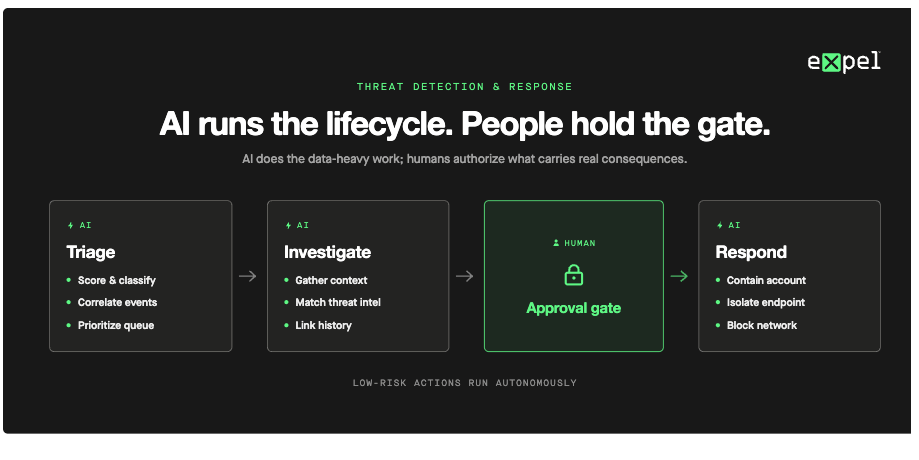
AI doesn’t automate security operations as a single action—it works across three distinct stages, each building on the last.
- Triage: AI ingests telemetry from across the environment, correlates events across tools and data sources, and assigns risk scores to incoming alerts. High-confidence threats are routed immediately to analysts; clear false positives are suppressed. The result is that analysts review a small, prioritized queue of genuine findings rather than an undifferentiated flood of raw alerts.
- Investigate: Before a triaged alert reaches an analyst, AI automatically enriches it with context from identity systems, endpoint telemetry, threat intelligence feeds, and historical event correlation. The analyst receives a pre-assembled investigation package—user behavior history, related events, threat intelligence matches—rather than starting data collection from scratch. This transforms the analyst’s task from gathering information to evaluating it.
- Respond: For confirmed threats meeting defined confidence thresholds, AI executes low-risk containment actions autonomously: account suspension, endpoint isolation, network blocks. High-impact or difficult-to-reverse actions—decisions with real operational consequences—are staged for human approval before execution. The human approval gate isn’t a bottleneck; it’s the governance mechanism that makes autonomous response safe to run at scale.
The human approval gate concept in detail
The human approval gate is the governance mechanism that determines which automated actions execute autonomously and which require human authorization before proceeding.
Effective approval gate design considers three factors:
- Action reversibility: Reversible actions (account suspension that can be immediately lifted, temporary network blocks) carry lower risk of autonomous execution than irreversible actions (data deletion, permanent access revocation).
- AI confidence level: High-confidence determinations with strong evidence support warrant more autonomous action authority than low-confidence or ambiguous classifications.
- Impact scope: Actions affecting a single low-criticality system carry lower risk of autonomous execution than actions affecting critical systems, broad user populations, or customer-facing infrastructure.
The combination of these factors determines the governance model: low-impact, reversible, high-confidence actions execute autonomously; high-impact, irreversible, or ambiguous situations require human authorization.
Governance requirements for automated security
Automated threat detection and response requires explicit governance design, not just capability deployment.
Action boundaries: Document precisely which actions AI can take autonomously and under what conditions. This isn’t a limitation, it’s what makes autonomous action safe and auditable.
Complete auditability: Every automated action should be logged with the reasoning that triggered it—what data, what classification, what confidence level. This enables review, improvement, and accountability.
Override and rollback mechanisms: Humans must be able to quickly review and reverse automated actions. The ability to roll back a containment action that turns out to be a false positive is essential operational capability.
Performance monitoring: AI automation requires ongoing monitoring of whether it’s performing correctly—false positive rates, response accuracy, missed detections. AI that performs well initially but degrades over time without detection creates compounding security risk.
Expel’s take
Automation is only as good as what it’s built on. At Expel, we’ve spent years tuning our detection logic and response playbooks so that when AI acts, it acts on signal—not noise. Our analysts aren’t managing a queue of raw alerts; they’re reviewing findings that AI has already triaged, enriched, and scored.
But we’re deliberate about where automation stops. Low-risk containment actions—isolating an endpoint, suspending a compromised account—run without waiting for analyst confirmation. High-impact decisions don’t. That boundary isn’t a limitation; it’s the design. Autonomous response without human judgment baked into the architecture is how teams end up making fast mistakes at scale.
Frequently asked questions
How does AI automate alert triage in a SOC?
AI automates alert triage by ingesting telemetry from all security tools, correlating related events into unified incidents, applying ML models to assign confidence and risk scores, suppressing known-benign alerts, and routing high-confidence threats to analysts—transforming thousands of raw alerts into a manageable investigation queue.
What is automated threat investigation enrichment?
Automated threat investigation enrichment is the process of AI systems automatically gathering context about a detected threat—pulling user identity information, endpoint health status, recent authentication activity, cloud configuration context, and threat intelligence matches—to give analysts a complete picture without manual data gathering.
What response actions can AI automate in a SOC?
AI can automate low-risk response actions including isolating compromised endpoints, blocking suspicious network connections, disabling compromised accounts, quarantining malicious files, and generating incident documentation. High-impact actions require human authorization to ensure business context is considered.
What is a human approval gate in security automation?
A human approval gate is a defined point in an automated response workflow where an analyst must review and approve an action before it executes. Approval gates ensure AI automation doesn’t take high-impact actions without human validation—balancing speed with accountability.
What can AI not automate in SOC operations?
AI cannot fully automate decisions requiring business context (which assets are critical, which risks are acceptable), communication with stakeholders, investigation of truly novel attack techniques not present in training data, legal and compliance determinations, and strategic security planning.