

Security observability is the ability to reconstruct and explain what happened in an environment—not just whether events were logged. It covers whether activity, intent, and decision paths can be understood after the fact.
Key takeaways
- Security observability is the ability to reconstruct and explain what happened, not just record that it happened.
- Logging records events, monitoring alerts on them, and observability lets an analyst explain the sequence and the reason behind it.
- Security observability and DevOps observability share telemetry but answer different questions: adversary activity versus system health.
- AI weakens observability because prompts, context, and decision paths often aren’t logged or reproducible.
- Improving observability starts with finding where activity can’t be reconstructed, not with adding more log volume.
Most security teams have more logs than they can read. That doesn’t mean they can explain what happened during an incident. Security observability is the gap between those two things: whether your team can rebuild a sequence of activity, attribute it to an actor, and say why it happened. It matters more now because AI systems take actions that traditional logs weren’t built to capture. In Expel’s AI security risk framework, observability is one of six control planes, and the one every other control depends on. This page covers what security observability is, how it differs from logging, monitoring, and DevOps observability, and how to check your own coverage.
How is security observability different from logging or monitoring?
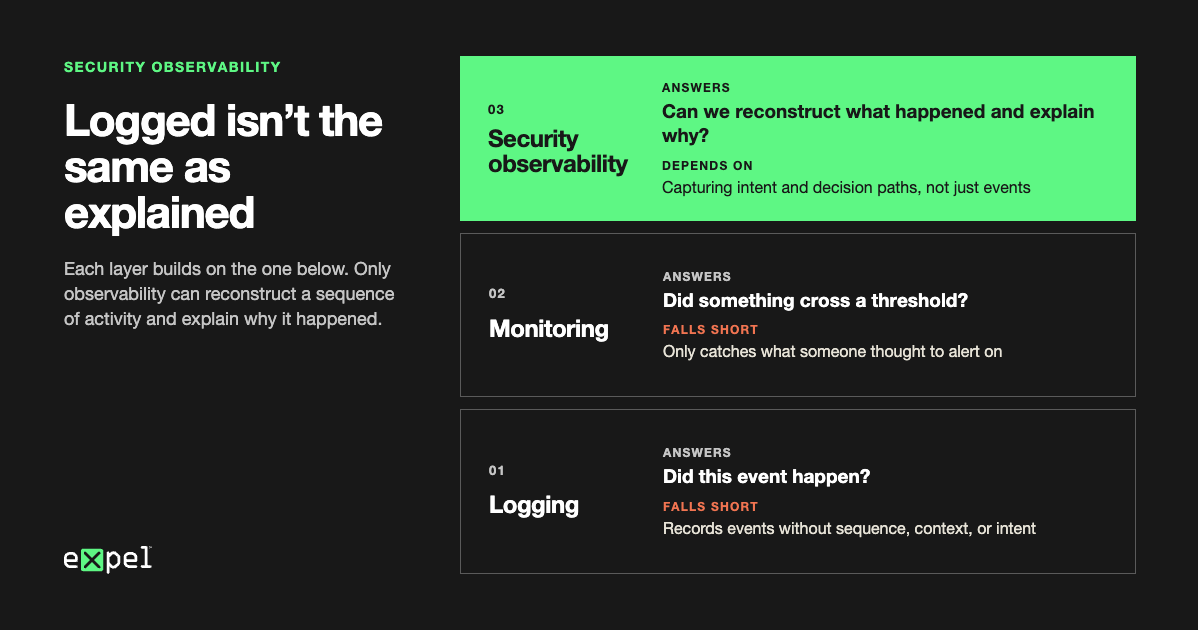
Logging, monitoring, and observability get used interchangeably, but they answer different questions. Logging records that an event occurred. Monitoring watches those records and alerts when something crosses a threshold. Observability asks whether an analyst can take the records and reconstruct what actually happened—who did what, in what order, and why.
A team can have complete logs and still lack observability. If a cybercriminal uses a stolen session token, the logs show a legitimate user doing legitimate-looking things. Without context on intent and decision paths, an analyst can’t tell the difference between the employee and the bad actor holding that employee’s session.
| Capability | Question it answers | Where if falls short |
|---|---|---|
|
Logging |
Did this event happen? | Records events without sequence, content, or intent |
|
Monitoring |
Did something cross a threshold? | Only catches what someones thought to alert on |
|
Security observability |
Can we reconstruct what happened and explain why? | Depends on capturing intent and decision paths, not just events |
Is security observability the same as DevOps observability?
No. They borrow the same word and often the same data, but they’re built for different jobs.
DevOps observability measures system health and performance. Site reliability engineers use metrics, logs, and traces to answer questions like “why is this service slow?” or “which deployment broke checkout?” The tooling is tuned for uptime, and retention reflects that. Data is often sampled and kept for days or weeks to control cost.
Security observability measures whether adversary and AI-driven activity can be reconstructed, attributed, and explained. The questions change: Which identity made this API call? What did it access next? Was that action intended? Answering them takes data DevOps pipelines often drop, like full authentication context, process lineage, and retention long enough to cover a breach that went unnoticed for months.
The overlap is real, and sharing pipelines can save money. But a dashboard that’s green for availability tells you nothing about whether you could explain an intrusion.
Why does AI weaken security observability?
AI-driven actions aren’t deterministic, so the same prompt can produce a different output on a second run, so you can’t replay an event to understand it.
On top of that, the inputs that shaped an AI decision—the prompt, the retrieved context, the tools an agent called—often aren’t logged at all. Traditional logs capture what happened (a file was read, an email was sent) but not the reasoning that led there. When an AI agent with broad permissions takes an unexpected action, the record shows the action and the agent’s identity. It doesn’t show whether the agent was following instructions, misreading them, or being manipulated through prompt injection.
That makes attribution ambiguous even when logging is technically complete. It’s also why observability is a precondition for AI detection and response (AIDR). AIDR is a detection category, and you can’t detect what you can’t reconstruct.
How do you assess and improve your security observability?
- Find where activity can’t be reconstructed. Take a recent incident or tabletop scenario and try to rebuild it end to end. Every gap you hit is a blind spot.
- Capture AI inputs, not just outputs. Log prompts, retrieved context, and tool calls for AI workflows that touch sensitive data or take action.
- Correlate across sources. Tie identity, cloud, SaaS, and endpoint telemetry together so one actor’s activity reads as one story.
- Match retention to how long breaches go unnoticed. If detection can take months, 30 days of logs won’t cover the investigation.
- Treat observability as a control, not a report. Give it an owner and measure it the way you’d measure any other control.
Expel’s take
In our SOC, observability isn’t a dashboard. It’s what lets an analyst answer the question every customer asks after an incident: what happened, and are we sure it’s over? Our analysts work in Expel Workbench™, which records every investigative action with timestamps, so the investigation itself can be reconstructed, not just the attack.
When AI-related activity shows up in an alert, we don’t investigate it in isolation. We correlate it with identity, cloud, SaaS, and endpoint signals across 160+ coverage areas. Ruxie, our AI SOC manager, speeds up that enrichment and correlation, but analysts make the call. That’s the model we think AI security needs more broadly—AI in the human loop, with people accountable for decisions and a record that shows how they got there. It’s the same approach behind our AI attack surface coverage.
Frequently asked questions
What is security observability?
Security observability is the ability to reconstruct and explain what happened in an environment, not just whether events were logged. It covers whether activity, intent, and decision paths can be understood after the fact. Expel treats observability as the control function that makes every other security control verifiable.
How is security observability different from logging or monitoring?
Logging records that an event occurred. Monitoring alerts when an event crosses a threshold. Security observability answers whether an analyst can reconstruct a sequence of activity and explain why it happened. A team can have complete logs and still lack observability if intent and decision paths were never captured.
Is security observability the same as observability in DevOps?
No. DevOps observability measures system health and performance using metrics, logs, and traces. Security observability measures whether adversary and AI-driven activity can be reconstructed, attributed, and explained. The two use overlapping telemetry but answer different questions, and DevOps tooling rarely retains the data a security investigation needs.
Why does AI weaken security observability?
AI-driven actions aren’t deterministic, so the same input can produce different outcomes. Prompts, retrieved context, and decisions are often not logged, reproducible, or auditable. Traditional logs capture what happened but not intent or reasoning, which makes attribution across systems ambiguous even when logging is complete.
How do you improve security observability?
Start by finding where activity can’t currently be reconstructed, then instrument those points instead of adding more log volume. Capture prompt, context, and action data for AI workflows, and correlate across identity, cloud, and endpoint sources. Expel’s SOC uses Expel Workbench to document every analyst action with timestamps.