

AI SOC analyst—a security operations professional whose role has shifted from manually reviewing every alert to governing AI systems, validating autonomous findings, and applying human judgment to the complex investigations AI can’t fully resolve.
Key takeaways
- The AI SOC analyst role hasn’t been eliminated—it’s shifted from first responder on every alert to the judgment layer overseeing AI systems.
- Traditional Tier 1 work (manual alert review, enrichment, playbook execution) is now largely automated.
- Analysts now spend more time governing agent behavior, validating autonomous findings, and tuning detection logic.
- The role requires new skills on top of core security expertise: AI failure-mode recognition, confidence score interpretation, and agent governance.
- This is a role evolution, not workforce displacement—novel threats and stakeholder communication still require human expertise AI can’t replicate.
For the architecture and governance context behind this shift, see what is an agentic SOC. And if you’re wondering whether this is really about your job disappearing rather than changing, that’s not what this page is for. This page is about what the role looks like day to day once AI takes over the repetitive work, not whether the role survives.
What did the SOC analyst role look like before agentic AI?
Traditional Tier 1 SOC analysts spent the bulk of a shift on manual, repetitive work: reviewing every alert that fired regardless of how routine it looked, pulling enrichment data from multiple tools by hand, and running predefined playbook steps one at a time. A busy shift could mean triaging hundreds of alerts, the large majority of which turned out to be false positives or low-priority noise—work that was necessary but rarely used the analyst’s actual security judgment.
This is the version of the role most people still picture when they hear SOC analyst, and it’s also the version most associated with burnout—think high volume, low variety, and constant context-switching between tools.
What has changed with agentic AI in the SOC?
The manual triage layer has largely moved to AI agents. Where an analyst used to pull enrichment data by hand, an agent now does it automatically and surfaces a reasoned conclusion. Where an analyst used to decide whether an alert warranted escalation, an agent now makes that first pass and only escalates what clears a confidence threshold or falls outside its guardrails.
The work changes shape rather than shrinking. The volume of alerts an analyst personally reviews drops, but the ones that reach them tend to be genuinely harder, because they’re ambiguous, novel, or high-stakes enough that the agent correctly determines a human should weigh in.
What do AI SOC analysts now do more of?
- Governing agent behavior: Defining and adjusting the boundaries of what an agent can act on autonomously versus what requires approval.
- Validating autonomous findings: Spot-checking agent conclusions, especially on decisions with real consequence, rather than re-doing the investigation from scratch.
- Tuning detection logic: Refining what triggers agent attention in the first place, based on what’s proving to be signal versus noise.
- Handling complex escalations: The incidents that didn’t fit a pattern the agent recognized, which is where security judgment matters most.
The throughline is that analysts now spend less time gathering data and more time exercising judgment about data someone—or something—else already gathered.
What skills does an AI SOC analyst need?
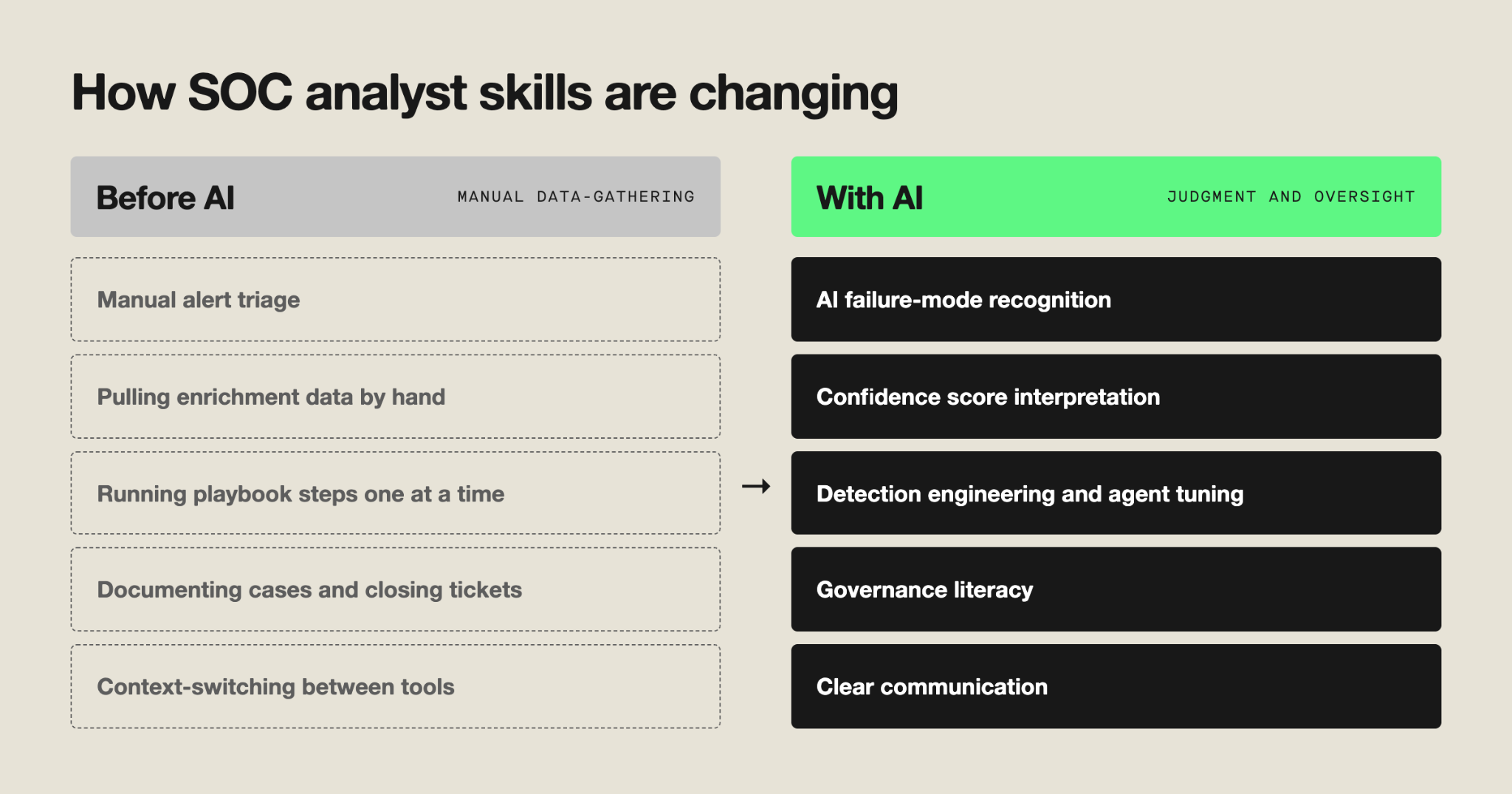
Beyond core security fundamentals, the role now calls for:
- AI failure-mode recognition—knowing when an agent’s confident-sounding conclusion is actually wrong, and why.
- Confidence score interpretation—understanding what a model’s certainty score does and doesn’t tell you about a specific finding.
- Detection engineering and agent tuning—the ability to adjust what an agent watches for and acts on, not just consume its output.
- Governance literacy—defining clear boundaries for agent action, and understanding the accountability chain when something goes wrong.
- Clear communication—explaining an AI-driven decision to a non-technical stakeholder in a way that holds up for legal and compliance review.
It’s a different skill set from the traditional role, weighted more toward oversight and less toward manual data-gathering.
| Time | Before AI | After AI |
|---|---|---|
|
Hour 1-2 |
Manually triage overnight alert queue | Review AI-prioritized findings, spot-check top escalations |
|
Hour 3-4 |
Pull enrichment data across multiple tools | Validate agent-surfaced context, investigate flagged anomalies |
|
Hour 5-6 |
Run playbook steps for confirmed incidents | Handle the incidents the agent escalated as genuinely novel |
|
Hour 7-8 |
Document cases, close routine tickets | Tune detection logic, review agent decision logs for accuracy |
Best practices: How to develop for this role
- Build fluency in how the AI tools your SOC uses actually reason, not just what output they produce—you can’t validate a conclusion you don’t understand the basis for.
- Practice spotting failure modes deliberately. Review a sample of agent decisions specifically looking for where confidence and correctness diverge.
- Get comfortable owning detection tuning as an ongoing responsibility, not a one-time setup task.
- Develop the communication side deliberately—being able to explain an AI-driven containment decision clearly to legal, compliance, or an executive is now part of the job, not an occasional ask.
Expel’s take
Our own SOC has lived through this shift directly. As Ruxie, our AI SOC manager, has taken over more of the manual triage and enrichment work, our analysts have moved further up the judgment chain. They govern what Ruxie is allowed to act on, validate her more consequential findings, and take on the genuinely hard escalations that used to get buried under alert volume. The team structure reflects that split deliberately, with Ruxie and human analysts each owning the part of the work they’re better suited to.
Frequently asked questions
What is an AI SOC analyst?
An AI SOC analyst is a security operations professional who works in an AI-powered environment—reviewing AI-prioritized alerts, investigating AI-surfaced threats with AI-generated context, approving response actions, and governing AI agent behavior. The role requires both traditional security expertise and the ability to direct, validate, and tune AI systems. The work has shifted from manual data gathering to judgment and oversight.
How has the AI SOC analyst role changed from a traditional SOC analyst?
Traditional Tier 1 SOC analysts spent most of their time manually reviewing alerts, gathering enrichment data, and running predefined playbook steps. In an AI SOC, those tasks are largely automated. AI SOC analysts now spend time reviewing AI investigation output, handling complex edge cases AI escalates, tuning detection logic, and governing agent behavior—higher-value, less repetitive work that requires stronger judgment rather than less expertise.
What skills does an AI SOC analyst need that a traditional analyst didn’t?
Beyond core security skills, AI SOC analysts need: the ability to interpret AI reasoning and identify when AI recommendations are wrong (AI failure mode recognition), understanding of confidence score interpretation and model drift, experience with detection engineering and agent tuning, governance skills for defining agent action boundaries, and the ability to explain AI-driven decisions clearly to non-technical stakeholders for legal and compliance accountability.
Is the AI SOC analyst role being replaced by AI?
No. AI handles high-volume, repeatable Tier 1 work—freeing analysts from alert fatigue. The analyst role is evolving: from first responder on every alert to the judgment layer overseeing AI systems. Novel threats, business context decisions, stakeholder communication, and complex incident response all require human expertise AI cannot fully replicate. For the full workforce analysis, see our page on whether AI will replace cybersecurity professionals.
What does an AI SOC analyst do day-to-day at Expel?
Day to day, an Expel SOC analyst reviews Ruxie’s AI-prioritized findings, spot-checks and validates the more consequential ones, investigates the incidents Ruxie escalates as genuinely novel, and continuously tunes detection logic based on what’s proving to be signal versus noise. The work is weighted toward judgment and oversight rather than manual alert triage.