

Key takeaways
- Agentic MDR uses AI agents to detect, investigate, and respond to threats without waiting on a human prompt at each step.
- The provider still runs the service, but agents handle the first-pass work, and humans own the judgment calls and anything with real consequences.
- The difference from traditional MDR isn’t whether AI is involved, it’s how much of the investigation and response an agent completes without a person driving it.
- Two limitations buyers often miss: you can’t easily change how the provider’s AI classifies alerts, and most services run on the provider’s own detection library rather than your custom rules.
- “AI MDR” and “agentic MDR” aren’t automatically the same claim, so ask a provider which specific steps its AI completes without a person.
Managed detection and response (MDR) means outsourcing threat detection and response to a provider’s security operations center. Managed detection and response covers that model broadly. Agentic MDR narrows it down to a specific delivery approach: instead of an analyst reviewing every alert before acting, AI agents run the first pass on detection and investigation, at the same depth on alert one thousand as alert one, and a person steps in for the calls that need judgment.
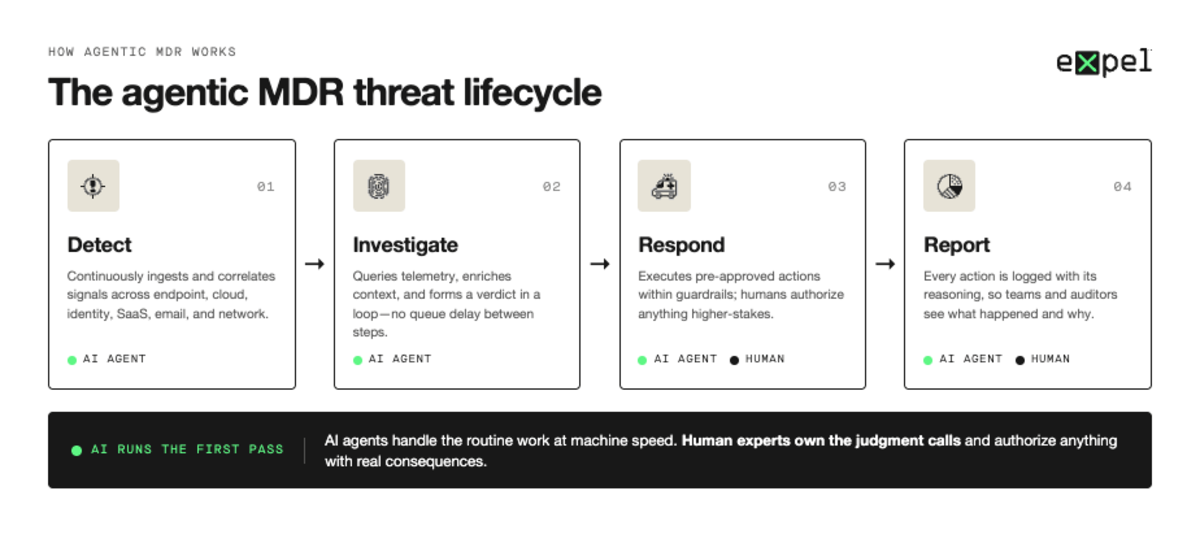
Agentic MDR covers four stages. Detection means continuously ingesting signals across endpoint, cloud, identity, SaaS, email, and network, then correlating across those surfaces at once, catching cross-surface patterns a human working alert-by-alert would likely miss. Investigation runs as a loop: the agent ingests a signal, queries telemetry, enriches context, and forms a verdict, with no queue delay between steps. Response means executing pre-approved actions like blocking an IP, isolating an endpoint, or revoking a session within set guardrails, while anything with higher stakes still requires human authorization. Reporting closes the loop, and every action an agent takes gets logged with the reasoning behind it, so a security team (and an auditor) can see not just what happened, but why.
Agentic MDR vs. traditional MDR
The difference isn’t whether AI is involved, as most providers use machine learning somewhere in detection already. It’s how much of the investigation and response an agent completes without a person driving it that differentiates the two.
| Traditional MDR | Agentic MDR | |
|---|---|---|
|
Detection |
Rules and machine learning flag anomalies for an analyst | AI agents flag and begin investigating in the same step |
|
Investigation |
Analyst manually gathers context across tools | Agent pulls context automatically and presents a case |
|
Response |
Analyst recommends or executes actions | Agent executes pre-approve actions directly |
|
Human role |
Runs every step | Reviews, tunes, and owns judgment calls |
What are the key benefits of agentic MDR?
The clearest benefit is speed. When an agent can investigate and act without waiting behind a person in a queue, the gap between “something happened” and “something was done” shrinks. That speed holds up at scale, too. An agent applies the same depth of investigation to its thousandth case as its first, which is hard for a human team to sustain 24×7. It also produces a more complete audit trail by default, since every agent action gets logged with its reasoning as a normal part of the workflow, not an extra step someone has to remember to do.
What limitations do buyers miss?
Two things trip up buyers who evaluate agentic MDR only on the speed pitch. The first is provider dependency. You generally can’t change how the AI classifies a given alert type without filing a request with the provider, since you’re not the one operating the agents. Second, most agentic MDR services run on the provider’s own detection library rather than incorporating a customer’s custom rules, so if your environment has unusual detection needs, ask specifically how that gets handled before you sign.
Is agentic MDR the same as AI MDR?
Not quite. “AI MDR” gets used as a catch-all for any provider that mentions AI in its marketing, which by now is most of them. Agentic MDR is the narrower claim: the AI isn’t just assisting an analyst, it’s completing steps of the investigation and response on its own inside a workflow a human still owns. If a provider calls itself AI MDR but can’t say which specific steps its AI completes without a person, that’s usually where marketing and reality part ways.
What does agentic MDR actually mean for a security team?
The alert queue stops being the job. Agents run first-pass triage continuously, so what reaches an analyst is a case with the context already assembled—telemetry pulled, signals correlated across endpoint, cloud, identity, SaaS, email, and network, and a proposed verdict with the reasoning attached. The work shifts from building the picture to deciding what to do about it.
That changes what you hire for more than how many people you hire. Tier-one triage has long been the entry point into security operations, and agentic MDR takes most of it off your plate. What matters more is reading an agent’s reasoning and catching when it’s wrong, tuning guardrails, and handling the cases that don’t fit a pattern. Response stays bounded by what you’ve pre-approved—blocking an IP, isolating an endpoint, revoking a session—and anything above that line waits for a person. Accountability doesn’t move either. When someone asks why an endpoint got isolated at 3am, that’s your answer to give.
Expel’s take
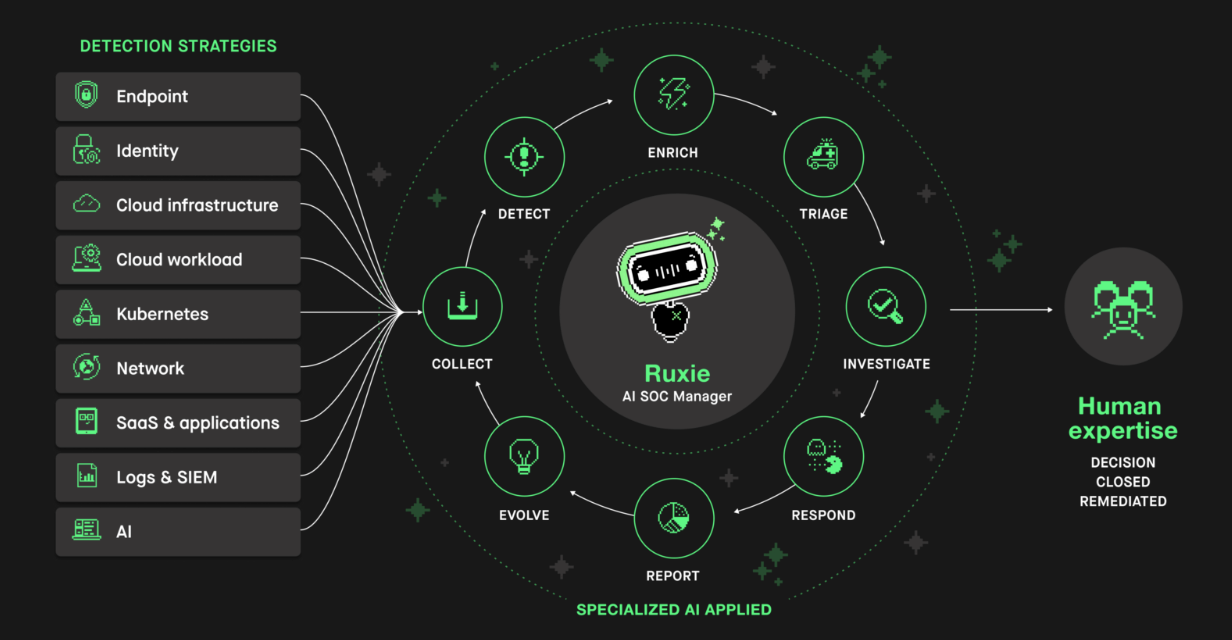
Ruxie, Expel’s AI SOC manager, is AI-powered and human-led: she handles the repetitive, high-volume parts of triage and investigation at machine speed, and Expel’s SOC analysts authorize the actions that carry real consequences. That division of labor is part of how Expel holds a 14-minute MTTR on high- and critical-severity incidents.
Frequently asked questions
What is agentic MDR?
Agentic MDR is a managed detection and response service where AI agents triage, investigate, and respond to security threats automatically, without waiting for a human analyst to prompt each step. The provider operates the service, and humans handle complex cases and high-stakes response decisions.
How is agentic MDR different from traditional MDR?
Traditional MDR relies on an analyst reviewing every alert before investigating. Agentic MDR uses AI agents to handle routine triage and investigation at machine speed, compressing response time on qualifying alerts while humans focus on complex threats and final response authorization.
What threat types does agentic MDR detect and respond to?
Agentic MDR can detect and respond across multiple attack surfaces, including endpoint, cloud, identity, SaaS, email, and network. Agents correlate signals across these surfaces at once, catching cross-surface attack patterns that point-in-time human triage often misses.
What are the main limitations of agentic MDR?
The two biggest limitations are provider dependency, since you can’t change how the AI handles an alert class without a service request, and gaps in custom detection coverage, since most agentic MDR services run the provider’s own detection library rather than a customer’s rules.
Does agentic MDR replace human security analysts?
No. It shifts analysts from first-pass triage to oversight, complex investigation, and high-stakes decisions. Human judgment stays essential for ambiguous threats, novel attack patterns, and any response action with real operational consequence.