

Table of Contents
Now that you understand how alert fatigue impacts your SOC team, it’s time to reduce false positives, automate triage, and create sustainable operations. This guide provides step-by-step implementation frameworks, timelines, and success metrics for deploying alert fatigue solutions that transform overwhelming alert volumes into manageable, meaningful security operations.
Implementing detection quality improvements
Reducing false positives through better detection engineering delivers the highest ROI for combating alert fatigue. Here’s how to implement detection quality improvements in your SOC.
Phase 1: Detection baseline assessment
Start by understanding your current detection landscape. Track not only frequency of tool use, but how detection rules are making teams faster over time. Document which detections generate the most alerts, which have the highest false positive rates, and which consume disproportionate analyst time.
Create a detection inventory spreadsheet with these columns:
- Detection name and ID
- Alert volume (last 30 days)
- True positive rate
- Average investigation time
- Last tuning date
- Priority score (volume × false positive rate)
Identify your top 10 noisiest detections—these become your tuning priorities. According to our detection engineering experts, when detection quality is bad, burnout goes up because analysts see the same noisy detection repeatedly and develop bias against it.
Phase 2: Create strategic detection tuning framework
Implement systematic tuning for your highest-priority noisy detections. Rather than treating every possible signal as equally important, focus on creating high-quality, high-fidelity detections that provide genuine leads worth investigating.
Context-aware rule development significantly improves signal-to-noise ratios. For example, rather than generating alerts on every unusual PowerShell execution, effective detections focus on specific behavioral patterns tied to active threat campaigns. An alert on a CPU spike becomes more meaningful when enriched with instance details, historical trends, recent changes, network traffic patterns, and relevant IAM activities.
Establish continuous feedback loops between SOC analysts and detection engineers. Organizations should regularly evaluate rule performance, identify detections generating excessive false positives, and tune thresholds based on environmental context.
Environmental baseline understanding allows detection rules to distinguish between abnormal activity and legitimate business operations. What appears suspicious in one organization might be completely normal in another. High-quality detections account for these differences, reducing false positives while maintaining sensitivity to genuine threats.
Phase 3: Detection lifecycle management
Implement detection-as-code practices for sustainable quality. This means:
- Managing detection rules using GitHub or similar version control
- Implementing unit tests for every detection
- Using continuous integration to build detection packages
- Creating clear error codes when rules fail validation
- Establishing peer review processes for new detections
Success metrics for detection quality:
- Reduce false positive rate from baseline by 40-60% within 12 weeks
- Increase true positive rate to above 10% for tuned detections
- Decrease average investigation time by 30% for optimized alerts
- Achieve 90% analyst confidence rating in tuned detection quality
Deploying automation and alert prioritization systems
Automation transforms how your SOC handles thousands of daily alerts without burning out analysts. Implementation requires careful planning and phased deployment.
Phase 1: Automated enrichment deployment
Automated alert enrichment addresses one of the most time-consuming aspects of triage. We’ve has developed bots, for example, responsible for enriching alerts with additional context like IP information, domain reputations, and environment-specific details.
Implementation steps:
- Week 1: Identify top five alert types requiring manual enrichment
- Week 2: Build enrichment playbooks for each alert type (IP lookups, user context, asset information, historical behavior)
- Week 3: Deploy automated enrichment for highest-volume alert category
- Week 4: Measure time savings and expand to remaining alert types
When alerts arrive pre-enriched with relevant context, analysts can make faster decisions about whether activity represents a genuine threat. Advanced enrichment includes correlating alerts across your entire security stack based on key evidence fields, providing analysts with a comprehensive picture of what activity took place.
Phase 2: Machine learning prioritization
Machine learning-based prioritization helps surface the most critical alerts for immediate attention. We use decision tree classification models trained on past analyst triage decisions to predict the likelihood that specific alert types are malicious.
Implementation framework:
- Weeks 5-6: Collect historical triage decisions (minimum 1,000 alerts per category)
- Weeks 7-8: Train initial models on high-volume alert categories
- Weeks 9-10: Deploy models in shadow mode (predictions logged but not acted upon)
- Weeks 11-12: Enable active routing based on ML predictions
For example, rather than treating all PowerShell alerts identically, machine learning examines process arguments and execution context to predict malicious likelihood. High-probability malicious alerts enter the priority queue for immediate investigation, while lower-risk alerts can be processed during less critical periods.
Phase 3: Severity-based queuing systems
Implement severity-based queuing where alerts are routed based on confidence level. As Expel’s SOC operates, high-confidence alerts are triaged first, followed by medium alerts, then low-priority alerts.
Create three distinct queues:
- Priority queue: ML confidence >70% or critical asset involvement
- Standard queue: ML confidence 30-70% or medium business impact
- Research queue: ML confidence <30% or informational alerts
Success metrics for automation and prioritization:
- Reduce manual enrichment time by 60-80%
- Process 3x more alerts with same analyst headcount
- Achieve <15 minute mean time to triage for priority queue alerts
- Maintain 95%+ accuracy in ML-based prioritization
Establishing alert management processes
Effective alert management requires more than just better technology—it demands thoughtful processes that help analysts work efficiently while maintaining high-quality security outcomes.
Implementing time series analysis
Time series analysis for capacity planning helps security leaders understand alert trends before they become crises. By analyzing historical alert volumes, organizations can identify patterns, predict future alert loads, and adjust resources proactively.
Set up weekly analysis routines:
- Generate alert volume trend charts (daily/weekly/monthly)
- Calculate rolling 30-day average and identify deviations
- Investigate root causes of spikes (new signatures, product updates, environmental changes)
- Adjust detection thresholds or analyst capacity proactively
Effective managers ask specific data-driven questions: “The daily alert trend is climbing—what are you seeing?” rather than general inquiries like “how’s it going?” This approach transforms vague concerns into actionable insights about which detections need tuning or which new security tools are generating excessive noise.
Establishing feedback mechanisms
Continuous feedback loops ensure detection quality improves over time. Triage processes should include regular assessment of how alerts are interpreted and prioritized.
Implementation checklist:
- Week 1: Create feedback forms for analysts to flag noisy detections
- Week 2: Establish bi-weekly tuning meetings between analysts and detection engineers
- Week 3: Implement automated reporting on detections with >80% false positive rates
- Week 4: Deploy feedback dashboard tracking tuning requests and resolution time
When analysts repeatedly close specific alert types as false positives, this signals detection thresholds need adjustment. Create a simple escalation path: analyst identifies noisy detection → ticket created → detection engineer reviews within 48 hours → tuning deployed within one week.
Tracking investigation efficiency metrics
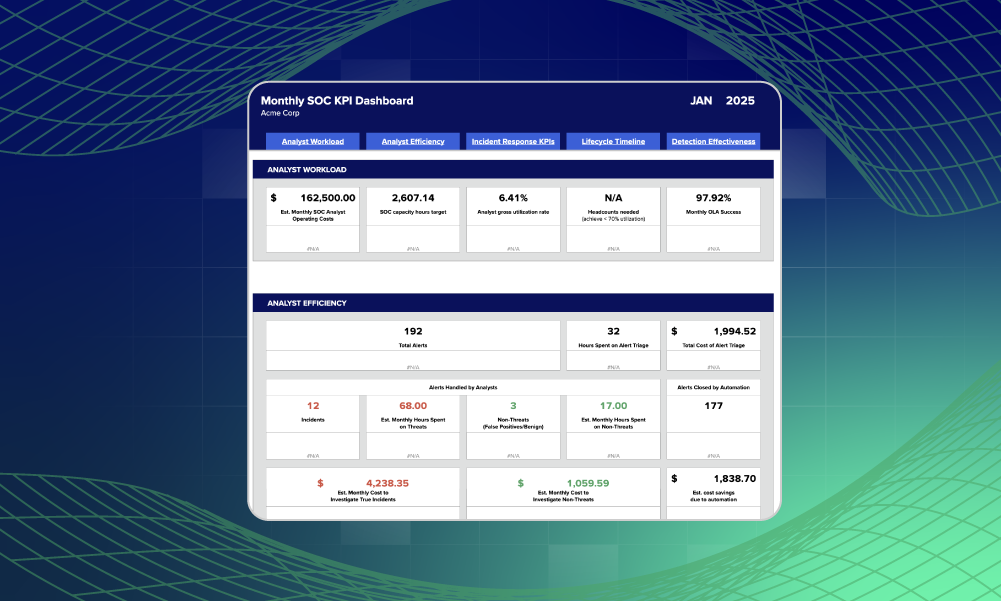
Investigation efficiency metrics provide visibility into time spent across different phases of the alert lifecycle. Organizations should track not just total time on alerts, but break down work time by alert type, severity level, and environment.
Essential metrics to implement:
- Mean time to triage (MTTT) by alert category
- Mean time to investigate (MTTI) by severity level
- Pathway metrics (% of alerts moving from triage to investigation)
- Alert closure reasons (true positive, false positive, benign, insufficient data)
- Analyst capacity utilization (% of time on high-value vs low-value work)
Tracking pathway metrics reveals how alerts flow through the SOC. If 50% of suspicious login alerts require additional investigation, this suggests the triage phase needs more automated enrichment or different detection logic.
Success metrics for process improvements:
- Reduce mean time to triage by 50% within 8 weeks
- Increase percentage of alerts closed at triage (without investigation) from 60% to 85%
- Decrease investigation time variability (standard deviation) by 40%
- Achieve 95% on-time response for high-severity alerts
Implementing strategic alert fatigue solutions
Beyond tactical improvements, organizations also need strategic solutions addressing alert fatigue at a systemic level.
Managed detection and response evaluation
Managed detection and response (MDR) services provide immediate relief from alert overload. MDR transforms the economics of alert fatigue by filtering alerts before they reach internal teams.
Implementation timeline:
- Weeks 1-2: Document current alert volumes, false positive rates, and analyst capacity
- Weeks 3-4: Evaluate MDR providers based on detection quality, response times, and integration capabilities
- Weeks 5-6: Pilot MDR service with subset of security tools (typically EDR and cloud monitoring)
- Weeks 7-8: Measure results and decide on full deployment
One organization reported that implementing MDR afforded rapid monitoring, investigation, and response, saving at least 40 work hours per week previously spent sifting through alerts—without adding new tools or headcount. Expel’s MDR approach applies expert-written detection logic to filter out false positives, prioritize and correlate alerts, and enrich them with deep context before analysts see them.
Organizations report reducing false positive rates from 99%+ with previous providers to below 10% with properly implemented MDR. The MDR provider’s team triages thousands of alerts, surfaces only critical threats, and decides on remediation paths.
Risk-based prioritization framework
Implementing risk-based prioritization helps teams focus on threats that matter most. Rather than treating all alerts equally, effective SOC operations categorize detections based on MITRE ATT&CK framework positioning, focusing on post-exploitation activity with the highest likelihood of representing active attacks.
Framework implementation:
- Weeks 1-2: Map all detections to MITRE ATT&CK tactics
- Weeks 3-4: Assign risk scores based on tactic positioning (initial access = lower, exfiltration = higher)
- Weeks 5-6: Incorporate asset criticality into risk scoring
- Deploy risk-adjusted alert routing
This strategic focus allows security teams to efficiently allocate resources to the most critical threats.
Threat intelligence integration
Threat intelligence integration improves detection precision and reduces false positives. By actively updating detections to tune out noise and focus on actual threats based on patterns observed across multiple environments, organizations achieve better alert quality.
Phased implementation:
- Weeks 1-4: Subscribe to relevant threat intelligence feeds
- Weeks 5-8: Build automated pipelines feeding threat intel into detection engineering workflows
- Weeks 9-12: Create detections for specific behavioral patterns tied to active campaigns rather than generic suspicious activity
When threat intelligence feeds directly into detection engineering workflows, teams create rules for specific behavioral patterns tied to active campaigns rather than generic suspicious activity.
Success metrics for strategic solutions:
- If implementing MDR: Reduce internal analyst alert load by 70-90%
- Decrease time from detection to response for critical threats by 60%
- Increase focus on post-exploitation detection from 30% to 60% of high-priority alerts
- Improve threat detection coverage across MITRE ATT&CK framework by 40%
Building sustainable SOC alert triage operations
The ultimate goal isn’t eliminating all alerts—it’s building sustainable operations where the right alerts reach the right analysts at the right time with sufficient context for rapid decision-making.
Creating meaningful work opportunities
Creating opportunities for meaningful work helps prevent burnout even when alert volumes remain high. No one wants to just look at alerts all day—it isn’t interesting, challenging, or meaningful work. Organizations should ensure analysts have opportunities to pursue quality leads, work on complex problems, develop new detection rules, and engage in threat hunting activities that provide intellectual stimulation beyond routine triage.
Implementation practices:
- Dedicate 20% of analyst time to detection engineering and threat hunting
- Rotate analysts through different specializations quarterly
- Create career advancement paths tied to detection quality improvements
- Celebrate analyst contributions to detection tuning and automation
Quality control implementation
Quality control processes maintain high standards even as operations scale. Implement sampling-based quality reviews that randomly select alerts and investigations for assessment.
Quality control framework:
- Week 1: Define quality criteria for alert investigations
- Week 2: Build random sampling methodology (5-10% of closed alerts)
- Week 3: Train team leads on quality assessment scoring
- Week 4: Launch weekly quality review meetings
This catches problems early—whether poor detection quality, inadequate analyst training, or process gaps—before they multiply across the entire operation.
Regular detection reviews
Regular detection reviews ensure rules remain effective as environments evolve. Cloud provider updates, infrastructure changes, and application deployments all affect alert behavior. Maintain open dialogues about detection performance, sharing knowledge about which rules require adjustment and continuously beta testing new detections before full deployment.
Establish monthly detection review cadence:
- Review detections with >5% increase in volume month-over-month
- Assess detections with declining true positive rates
- Test new detection rules in staging before production deployment
- Retire outdated detections no longer providing value
Success metrics for sustainable operations:
- Achieve <10% analyst turnover annually (vs industry average of 20%+)
- Maintain analyst job satisfaction scores above 4/5
- Increase percentage of analyst time on meaningful work from 30% to 60%
- Sustain quality scores above 90% for 95% of investigated alerts
Overall implementation timeline and ROI
A comprehensive alert fatigue solution implementation typically spans 16-24 weeks with measurable results appearing within the first month:
- Month 1: Detection baseline and initial tuning (20-30% alert reduction)
- Month 2-3: Automation deployment (50-60% faster triage)
- Month 4-6: Full implementation with strategic solutions (70-80% false positive reduction)
Expected ROI after six month implementation:
- 70-80% reduction in false positive alerts
- 60% decrease in mean time to triage
- 40 hours per week analyst time savings per team member
- 50% reduction in burnout and turnover risk
- 3-4x improvement in detection quality scores
The path forward requires organizations to recognize that alert fatigue isn’t simply an operational challenge—it’s a sustainability issue affecting security outcomes, team wellbeing, and organizational risk. By systematically implementing improved detection quality, intelligent automation, strategic prioritization, and potentially managed services, SOC teams can transform overwhelming alert volumes into manageable, meaningful security operations.