

Mitigation reduces the likelihood or impact of a security risk without removing its cause. Remediation removes the cause entirely. In incident response (IR), teams usually mitigate first to stop active damage, then remediate to close the gap permanently.
Key takeaways
- Mitigation buys time. Remediation ends the problem.
- Mitigation is usually fast and reversible—isolate a host, disable an account, add a firewall rule. Remediation is usually slower and permanent—patch, rebuild, reconfigure.
- During an incident, mitigation almost always comes first, because you can apply it before you fully understand the root cause.
- A mitigated risk is still an open risk. Compensating controls can hold indefinitely, but the underlying issue stays on the books as residual risk.
- Conflating the two is how incidents get closed prematurely. Track remediation work separately from containment.
The distinction matters because these two words get treated as synonyms in vendor copy, and the confusion has real consequences. A team that reports an issue “mitigated” to leadership may be describing a firewall rule around an unpatched server, which is a different security posture entirely. Security frameworks, cyber insurance questionnaires, and auditors all draw the line clearly, so your incident response documentation should too. The practical version? Ask whether the thing that caused the problem still exists. If it does, you’ve mitigated.
What is mitigation in cybersecurity?
Mitigation reduces risk without eliminating its source. It’s the security equivalent of a tourniquet—effective, immediate, and not a cure.
Common mitigations during an incident:
- Isolating a compromised endpoint from the network
- Disabling a credential or revoking active sessions
- Blocking a malicious domain or IP at the perimeter
- Applying a web application firewall (WAF) rule in front of a vulnerable app
- Network segmentation to limit lateral movement
- Turning off a non-essential service that’s being exploited
Outside of active incidents, mitigation also describes long-term compensating controls. If a legacy system can’t be patched without breaking a business process, segmenting it away from everything else is a mitigation you may live with for years. That’s a legitimate risk decision, as long as it’s a documented one.
What is remediation in cybersecurity?
Remediation removes the root cause. After remediation, the specific weakness an attacker used no longer exists.
Common remediation include:
- Applying a vendor patch to a vulnerable system
- Rebuilding a compromised host from a known-good image
- Rotating and removing exposed credentials, keys, or tokens
- Fixing the misconfiguration that exposed a storage bucket or management port
- Removing an attacker’s persistence mechanisms—scheduled tasks, malicious accounts, modified startup items
- Correcting the process gap that allowed the issue, such as an onboarding flow that over-provisioned access
Remediation is slower because it usually requires change control, testing, and a maintenance window. It’s also the only step that prevents a repeat of the same incident.
How do mitigation and remediation compare side by side?
| Mitigation | Remediation | |
|---|---|---|
|
What it does |
Reduces likelihood or impact | Removes the cause |
|
Root cause |
Still present | Eliminated |
|
Speed |
Minutes to hours | Days to weeks |
|
Durability |
Temporary or compensating | Permanent |
|
Typical example |
Isolate the host, block the IP | Patch the vulnerability, rebuild the host |
|
Residual risk |
Yes—stays tracked | Close |
|
IR phase |
Containment | Eradication and recovery |
When should you mitigate versus remediate during an incident?
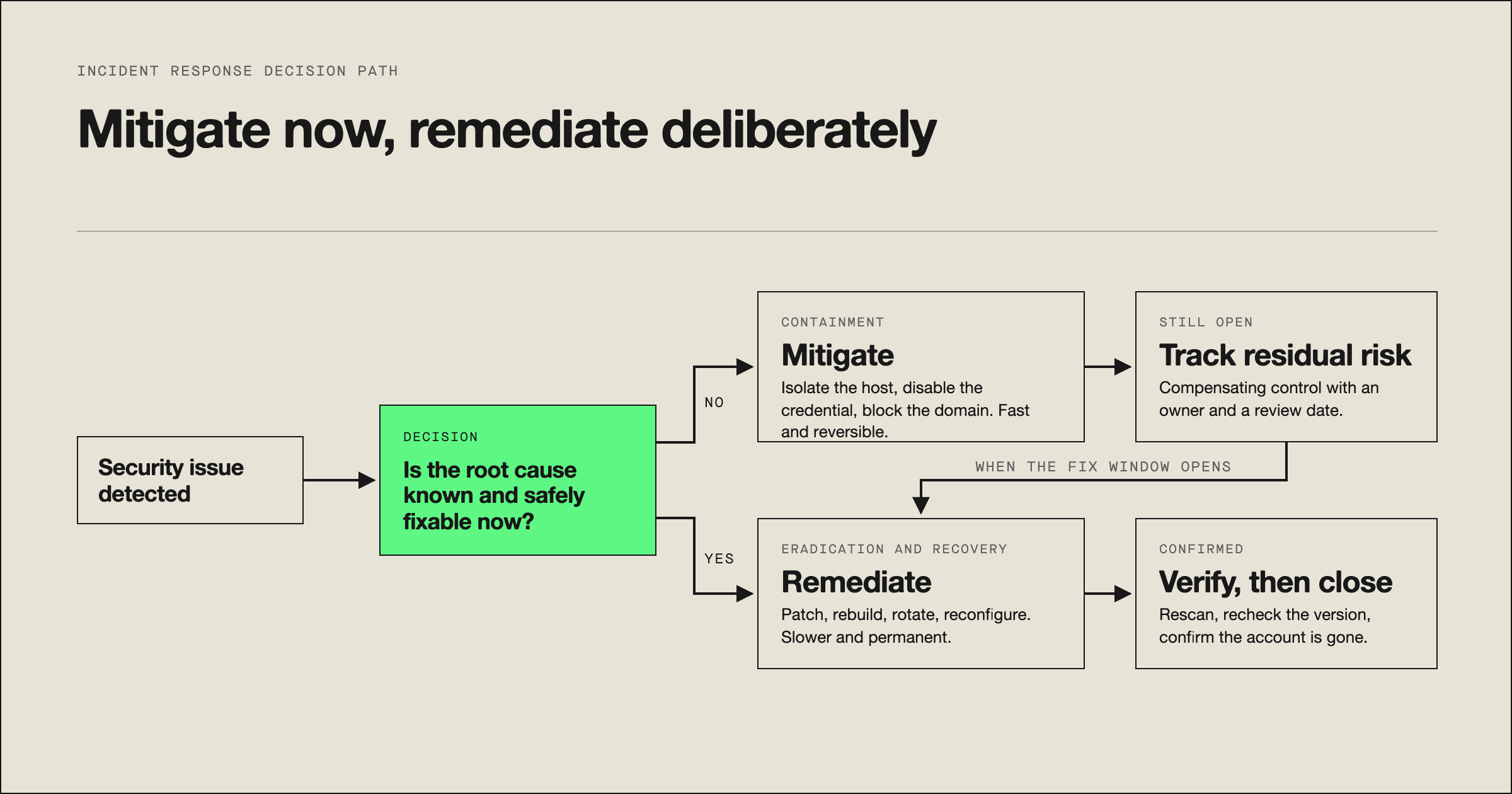
Mitigate immediately, remediate deliberately. That sequence holds in almost every incident, for two reasons.
First, mitigation doesn’t require full understanding. You can isolate a host that’s beaconing to an unfamiliar domain before you know what malware family it is, what it touched, or how it got there. Waiting for certainty while an attacker moves laterally is the more expensive mistake.
Second, remediation done too early destroys evidence and often misses the real entry point. Reimaging a workstation in the first 10 minutes feels decisive, but it wipes the artifacts you need to answer the question that actually matters: how did they get in, and are they still in? Threat hunting across the rest of the environment during containment frequently turns up a second compromised system that a fast reimage would have hidden.
The exception is ransomware, where encryption spreads fast enough that containment speed dominates every other consideration.
What does this look like on a vulnerable internet-facing server?
An external scan flags a critical, actively exploited vulnerability on a public-facing application server. The vendor patch requires a four-hour maintenance window that can’t happen until the weekend.
Mitigation, within the hour: Add a WAF rule blocking the exploit pattern, restrict management access to a virtual private network (VPN) range, and increase logging on the host so any exploitation attempt is visible. The vulnerability is still there, but the realistic path to exploiting it is narrower.
Remediation, that weekend: Apply the patch, verify the version, remove the temporary WAF rule, and confirm the host is off the exposed-services inventory.
What gets tracked in between: The open remediation ticket, the compensating controls in place, and the accepted residual risk with an owner and a date. If the patch slips, the risk register shows it. That’s the part teams skip.
Best practices for tracking mitigation and remediation
- Use both words deliberately in tickets, incident reports, and status updates. Never as synonyms.
- Never close an incident on containment alone. Open a linked remediation item with an owner and a due date, tracked in your incident response plan’s post-incident process.
- Give every compensating control an expiration or review date, so temporary mitigations don’t quietly become permanent architecture.
- Record accepted residual risk explicitly, including who accepted it.
- Verify remediation instead of assuming it. Rescan, recheck the version, confirm the account is actually gone.
- In post-incident reviews, separate “what we contained” from “what we fixed.” The gap between those two lists is your real exposure.
- Report both to leadership. Executives who only hear “contained” will assume “fixed.”
Expel’s take
The reason we’re precise about these two words is that our alert-to-resolution workflow treats them as different jobs with different owners.
When a detection fires in Expel Workbench™, containment actions—isolating a host, disabling a credential—are pre-authorized and often automated, because their value depends entirely on speed. That’s mitigation, and it’s what gets us to a 14-minute mean time to remediate on fully automated high- and critical-severity incidents. Remediation recommendations come separately, written for the customer’s environment, because removing a root cause means touching production systems that Expel doesn’t own and shouldn’t unilaterally change.
Keeping those tracks distinct is also how our post-incident findings feed back into detections. If a phishing-compromised account was the entry point, the remediation isn’t just resetting that password—it’s the detection logic and the conditional access change that catch the next one. Contained and fixed are different milestones, and reporting them as one is how organizations end up handling the same incident twice.
Frequently asked questions
What is the difference between remediation and mitigation?
Remediation eliminates the root cause of a security issue, like patching a vulnerability or removing malware. Mitigation reduces the risk or impact without fixing the underlying cause, like adding a firewall rule around an unpatched system. Teams often mitigate immediately, then remediate once a permanent fix is ready.
Is mitigation a permanent fix?
No. Mitigation is typically a temporary or compensating measure—isolating a host, disabling an account, blocking traffic—used to reduce risk quickly while a permanent remediation like a patch or rebuild is planned and applied.
Which comes first in incident response, mitigation or remediation?
Mitigation usually comes first, because it can be applied immediately to stop active harm and doesn’t require full root cause analysis. Remediation follows once the cause is understood and a fix can be applied safely without disrupting operations further.
Can a vulnerability be mitigated without being remediated?
Yes, and it happens often. A compensating control like network segmentation or a WAF rule can mitigate risk indefinitely when remediation isn’t immediately possible. But an unremediated vulnerability remains residual risk and should stay tracked until a permanent fix is applied.
Why does the remediation versus mitigation distinction matter for incident response plans?
Plans that conflate the two can leave teams believing an issue is closed when it’s only contained. Separating them clearly means post-incident tracking captures outstanding remediation work instead of closing tickets prematurely.