

Table of Contents
When organizations invest in managed detection and response (MDR), they often focus on immediate benefits—24×7 monitoring, faster threat detection, and expert incident response. These are critical capabilities, but they’re just the beginning of what quality MDR delivers.
The real value of MDR emerges over time through continuous improvement of your security program. Unlike point solutions that remain static, effective MDR partnerships create a virtuous cycle: every incident teaches lessons that strengthen your defenses, every detection gap identified gets closed, and every threat pattern observed informs better protection strategies.
Think of MDR not as a security product you purchase, but as a partnership that makes your organization more resilient with each passing month. At Expel, we’re committed to strengthening your SecOps program to improve your security maturity. Let’s explore exactly how MDR drives continuous security posture improvement over time.
How does MDR build cyber resilience?
Cyber resilience means more than just bouncing back from attacks—it means getting stronger after every incident and proactively preventing future threats. MDR builds resilience through multiple interconnected mechanisms that compound over time.
Resilience recommendations
We can’t control when attackers will show up. If they don’t, that’s a good thing. But we feel it’s still our responsibility to provide value. Resilience recommendations are how we do that. You’ll get recommendations based on your environment and past trends that can help you fix the root cause of recurring events or even prevent them from happening in the first place.
These recommendations do two things: disrupt attackers or enable defenders. Recommendations disrupting attackers prevent threats from successfully performing their intended goal, while recommendations enabling defenders allow your team—including the MDR provider—to respond more effectively when threats do occur.
For example, after responding to multiple phishing incidents, an MDR provider might recommend implementing DMARC email authentication to prevent sender spoofing, or deploying URL filtering to block malicious links before users click them. If we spot trends in vulnerabilities or incidents across your environment, we’ll tailor resilience recommendations for how your org can fix the root cause of those issues and prevent them from needing automated security remediation time after time.
Root cause analysis
Every incident provides learning opportunities. You get guidance on how to reduce risk, save money, and improve efficiency, along with root cause analysis for every incident and resilience recommendations for future improvements.
Root cause analysis goes beyond understanding what happened to identify why it happened and how to prevent recurrence. Did the incident occur because of missing patches? Weak authentication controls? Insufficient network segmentation? Understanding these root causes enables strategic improvements rather than just tactical fixes.
Gap analysis
MDR providers continuously assess your defensive posture and identify coverage expansion opportunities. We help you identify and close security gaps—ensuring a secure, resilient cloud environment. These gap analyses cover multiple dimensions:
- Technology gaps: Unmonitored systems or unintegrated security tools
- Detection gaps: Attack techniques your current rules don’t catch
- Process gaps: Missing playbooks or unclear responsibilities
- Visibility gaps: Blind spots in logging or monitoring
Each identified gap becomes an opportunity for improvement, with the MDR provider offering specific recommendations to address it.
Hardening guidance
Beyond addressing specific gaps, MDR provides strategic hardening guidance to make your environment inherently more secure. Your cloud alerts are a valuable source of information about the cloud security of your cloud resources. The insights you gather can help you architect a more secure environment, reduce alert volume, and adopt a more proactive approach to improve security posture over time.
This guidance might include:
- Defining cloud landing zones to limit recurring issues and better protect high-risk resources
- Modifying IAM roles in response to changing alert patterns
- Tweaking golden images to reduce configurations that lead to vulnerabilities
- Implementing network segmentation to contain potential breaches
MDR continuous improvement
The continuous improvement process built into quality MDR services ensures your security program never stagnates. This improvement happens through systematic detection tuning, playbook optimization, and ongoing knowledge transfer.
Detection tuning
Your environment is unique, and generic detection rules often generate false positives or miss threats specific to your business. We augment your alerts with Expel-written detections aligned to the MITRE ATT&CK framework to round out your MITRE coverage, improve accuracy, and free your team from the burden of false positives and low fidelity alerts.
Over time, MDR providers tune detections specifically for your environment by:
- Refining query filters to improve specificity of detection logic
- Modifying risk scores to assign lower scores to authorized activities that were triggering false positives
- Creating custom detections for threats relevant to your specific technology stack and business operations
- Adjusting thresholds based on observed baselines of normal activity
As your cloud usage evolves, many rules will likely need adjustment to adapt to new baselines. Quality MDR providers maintain open dialogues to constantly update detection rules for the benefit of their customers.
Playbook optimization
Response playbooks evolve based on lessons learned from real incidents. When MDR analysts respond to threats in your environment, they document what worked well and what could be improved. These lessons inform playbook updates that make future incident response faster and more effective.
According to MDR experts, established and documented investigation and response processes with playbooks, lessons learned, and continuous improvement of SOC processes and tools characterize mature security operations.
For example, if multiple ransomware incidents revealed certain file types or network shares were particularly vulnerable, the response playbook gets updated to include proactive monitoring and faster containment procedures for those specific risk areas.
Coverage expansion
Expel-written detections continuously learn and adapt based on activity in the environment, putting customers ahead of threats and equipping them with the answers and best-practices to track Kubernetes security posture over time.
As your organization adopts new technologies—moving workloads to the cloud, implementing new SaaS applications, or deploying container platforms—MDR coverage expands to protect these new attack surfaces. The monitoring breadth grows organically with your technology footprint.
Feedback loop
According to cybersecurity research, the proactive nature of MDR helps organizations improve their security operations over time. By analyzing past incidents and by using advanced threat intelligence, MDR services help prevent the same types of attacks from recurring by addressing their root cause.
This continuous improvement cycle enhances immediate threat response capabilities and strengthens long-term security strategies. Insights from active threat incidents inform future security improvements, creating a continuous feedback loop to strengthen your security posture over time. Additionally, standard reporting metrics should be included in the feedback loop, so stakeholders can see the progress and improvements being made over time.
Does MDR help strengthen security posture?
Absolutely—and this happens through multiple mechanisms compounding over time. Your security posture encompasses your overall defensive capability, and MDR strengthens it systematically across people, processes, and technology.
Technology optimization
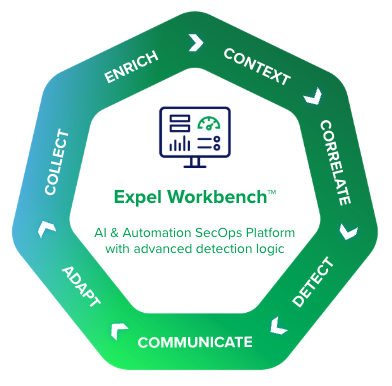
MDR helps you get more value from your existing security investments. Expel, for example, continuously learns from data ingested into our security operations platform, Expel Workbench™, to improve how we augment your tech. This means the security tools you already own become more effective as the MDR provider tunes them for your environment. As another example, we also use AI to empower our SOC analysts to deliver faster response actions, enhancing your security program metrics, including mean time to detect, and improving your overall security posture.
Process maturity
MDR partnerships accelerate your security program’s maturity by providing access to proven processes and best practices developed across hundreds of customer environments. Your team learns from the MDR provider’s methodology for incident response, investigation techniques, and threat analysis approaches.
Our managed SOC team continually offers strategic guidance and support to make you stronger. This knowledge transfer means your internal team becomes more capable over time, even as they’re freed from the tactical burden of alert triage.
Strategic security planning
Beyond tactical improvements, MDR informs strategic security decisions. “This isn’t just about containing the immediate threat—it’s about helping customers improve their overall security posture. Sometimes this means reinforcing recommendations that security teams have already made internally but couldn’t get organizational buy-in for”.
Having a trusted third party validate security recommendations can help security teams get the resources and budget they need to implement improvements. We actively recommend ways to harden your defenses—fewer fires for you, less work for us.
Measurable progress
According to external research, continuous analysis of security data and past incidents helps organizations learn from previous attacks and strengthen their defenses. This ongoing improvement enhances the ability to prevent and respond to future threats, optimizing security configurations and eliminating rogue systems.
Quality MDR services provide metrics demonstrating this improvement:
- Reduced alert volumes as false positives decrease
- Faster response times as processes mature
- Fewer recurring incidents as root causes get addressed
- Improved detection coverage as gaps are identified and closed
You continuously receive resilience recommendations on how you can shift your program from reactive to proactive, and benefit from the automation and intelligence of our platform.
Learning from MDR incidents
Every security incident generates valuable intelligence informing future defenses. The key is systematically capturing lessons learned and translating them into actionable improvements.
Incident patterns
When MDR providers monitor hundreds of customer environments, they identify patterns single organizations would never see. For example, if the MDR provider observes a new phishing technique successfully compromising multiple organizations, they can proactively implement detections and protective measures for all customers—including those not yet targeted.
Regular reviews, resilience recommendations, and strategic guidance to reduce risk over time ensure intelligence from the broader customer base informs protections for your specific environment.
Trending analysis
Trending analysis might reveal:
- Certain systems are repeatedly involved in incidents
- Particular user groups frequently fall victim to phishing
- Specific misconfigurations keep appearing across deployments
- Seasonal variations in attack types targeting your industry
These trends inform targeted improvements. Rather than generic security advice, you receive specific guidance based on actual patterns observed in your environment.
Post-incident reviews
After significant incidents, quality MDR providers conduct thorough post-incident reviews. You’ll also get a detailed findings report, written in plain English, so anyone can understand what happened and what was done to fix it.
Post-incident analyses assess the effectiveness of the response and identify areas for improvement. These reviews examine not just the incident itself but the response process, identifying opportunities to improve detection rules, response procedures, and preventive controls.
Shared intelligence
One of the most powerful aspects of MDR is the shared intelligence across the customer base. When the MDR provider learns about a new threat from investigating an incident at one customer, that intelligence immediately benefits all customers through updated detections, threat bulletins, and proactive hunting.
Transparent analysis based on real-world incidents, not theoretical scenarios, and actionable recommendations security teams can implement immediately enable the entire customer community to benefit from collective experience.
MDR maturity improvement
Organizations using MDR experience predictable maturity improvements following a progression that accelerates security capabilities over time. Understanding this timeline helps set realistic expectations about when you’ll see different types of value.
Foundation and baseline
The first month focuses on integration, baselining, and initial value delivery:
- MDR integrates with your security tools (typically within hours or days)
- Analysts learn your environment and establish what’s normal
- Initial detection rules are deployed
- First incidents are detected and remediated
- Immediate noise reduction as the MDR filters false positives
Optimization
By the third month, optimization begins delivering compounding improvements:
- Detection rules are tuned specifically for your environment
- False positive rates drop significantly
- Response times improve as playbooks align with your operations
- First resilience recommendations are delivered based on observed patterns
- Your team begins learning from MDR expertise
Maturation
At six months, the partnership reaches maturity with substantial improvements:
- Custom detections address threats specific to your technology stack
- Coverage gaps identified during earlier months are closed
- Security posture scoring shows measurable improvement
- Recurring incidents are eliminated through root cause fixes
- Your internal team operates more strategically, freed from tactical firefighting
Full value realization
After a year, organizations typically see transformational results:
- Security incidents decrease as preventive measures mature
- Detection coverage spans your entire attack surface comprehensively
- Response is highly automated for common threats
- Your security program demonstrates clear ROI to leadership
- The partnership enables strategic security initiatives not previously possible
MDR services must remain dynamic to adapt to evolving threats and vulnerabilities. Service providers update their detection rules, response strategies, and threat intelligence sources to stay ahead of cyber threats.
How long before MDR shows value?
Many organizations wonder: how long before MDR shows value? The answer depends on what type of value you’re measuring.
Immediate value: Noise reduction, expert analysis of critical alerts, and 24×7 coverage begin immediately upon go-live.
Early improvements: Faster incident response, reduced false positives, and initial resilience recommendations start appearing within the first quarter.
Substantial improvements: Custom detection tuning, coverage expansion, and measurable security posture improvements become evident.
Transformational impact: Strategic security maturity, significantly reduced incident volumes, and comprehensive defensive coverage reach full maturity.
What improvements should I expect?
Organizations should expect several categories of measurable improvement:
Operational metrics: Mean time to detect (MTTD) decreases as detections are optimized, mean time to respond (MTTR) drops as response automation matures, and false positive rates decline as rules are tuned to your environment.
Security outcomes: Total incident volume decreases as preventive measures improve, recurring incidents are eliminated through root cause analysis, and dwell time for undetected threats approaches zero.
Team productivity: Internal analysts spend less time on alert triage, security staff focus on strategic initiatives rather than firefighting, and team satisfaction improves as burnout decreases.
Key takeaways
MDR drives continuous security improvement through resilience recommendations that address root causes, detection tuning that reduces false positives while catching previously missed threats, playbook optimization based on lessons learned from real incidents, and coverage expansion as your technology footprint grows.
Over time, MDR helps by systematically strengthening your defensive capabilities across all dimensions—better technology utilization, more mature processes, stronger strategic alignment, and measurable security posture improvement. The improvement cycle is ongoing: detect threats, analyze patterns, learn from incidents, implement recommendations, and detect even better.
The maturity timeline follows a predictable progression. Month one delivers immediate value through noise reduction and expert coverage. Month three brings optimization with tuned detections and reduced false positives. Month six shows maturation with custom coverage and eliminated recurring issues. Month 12 demonstrates full value realization with transformational security improvements.
Organizations benefit from continuous feedback loops where incident intelligence informs detection improvements, response effectiveness shapes playbook updates, and trending analysis drives strategic recommendations. This systematic approach to improvement ensures your security program strengthens continuously rather than remaining static.
When evaluating MDR providers, look for those committed to continuous improvement—not just detecting today’s threats but making you more resilient against tomorrow’s attacks. Ask about their resilience building recommendation process, how they tune detections over time, what knowledge transfer looks like, and how they measure and report on security posture improvement.